Best Forged Kitchen Knives: 15 Spec-Based Picks
As an Amazon Associate we earn from qualifying purchases. Links on this page are affiliate links.
A forged kitchen knife gives you durable construction, solid balance, and dependable strength for everyday cutting tasks. The Imarku 14-Piece Japanese Steel Knife Set leads the lineup with its high-carbon stainless steel blades, acute 10–15° edges, and a storage block with a built-in sharpener.
This guide compares 15 products based strictly on the specifications published on the listings, focusing on steel type, dimensions, and blade geometry. It helps you decide which forged blade style and handle setup fit your specific meal prep needs.
Quick picks
The best fit for you
- You want an all-in-one forged cutlery block set Imarku 14-Piece Japanese Steel Knife Set It provides a 14-piece high-carbon stainless steel lineup with full-tang construction and a built-in block sharpener.
- You need a compact blade for detailed peeling tasks Mercer Culinary Renaissance 2.5-Inch Peeling Knife The 2.5-inch forged blade weighs just under 0.15 pounds for precise in-hand produce trimming.
- You want a forged Damascus steel slicing knife KYOKU Shogun 8.5-Inch Forged Damascus Kiritsuke Knife It features an 8.5-inch forged Damascus steel blade with a VG-10 core and full-tang construction.
Our 15 picks
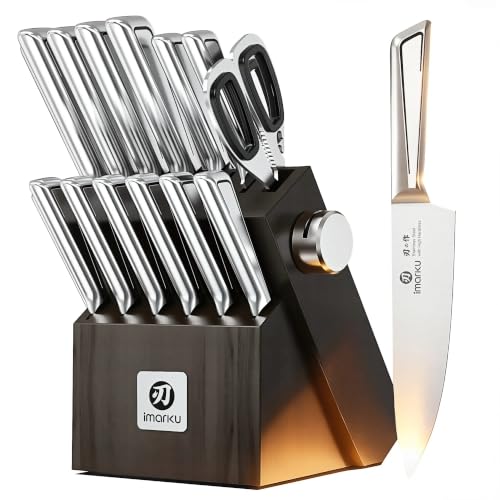
Imarku 14-Piece Japanese Steel Knife Set
Best for: complete forged kitchen cutlery setups
- Construction
- Forged
- Blade Material
- High-carbon stainless steel
- Edge Angle
- 10–15°
- Storage Type
- Knife Block
- Features
- Dishwasher Safe, Built-in Sharpener
- Style
- Japanese
View on Amazon: Imarku 14-Piece Japanese Steel Knife Set (paid link)
This 14-piece collection provides forged high-carbon stainless steel blades honed to an acute 10–15° angle. Unlike standalone knives on the list, it supplies an 8-inch chef knife, bread knife, slicing knife, 7-inch santoku, utility knife, paring knife, kitchen shears, and six serrated steak knives. The hardwood countertop block houses a built-in sharpener for edge touch-ups. It suits you if you need a fully equipped kitchen block set with full-tang Japanese-style blades.
Pros
- Full-tang precision-forged high-carbon stainless steel construction
- Blades sharpened to an acute 10–15° cutting angle
- Hardwood block includes an integrated pull-through sharpener
- 14-piece set includes kitchen shears and six serrated steak knives
Cons
- Block footprint requires 10.06 by 7.09 inches of counter space
- Needs 14.57 inches of vertical height clearance for storage
- Steak knives use serrated edges rather than straight blades
Good fit if
- You want an all-in-one forged set that includes prep knives and steak knives.
- You prefer acute Japanese-style 10–15° cutting edges over broader angles.
- You want an integrated block sharpener on hand for routine maintenance.
Skip if
- You only need a single forged prep knife rather than a multi-piece block.
- You have low upper cabinets that cannot clear a 14.57-inch block.
Verdict: imarku 14-Piece Forged Japanese Knife Block Set delivers a complete full-tang kitchen cutlery lineup with acute 10–15° edges and integrated block sharpening. It serves as an all-in-one forged setup if you want to equip a counter in one step.

Imarku 7-Inch Forged Santoku Knife
Best for: long edge retention during heavy prep
- Construction
- Forged
- Blade Length
- 7 Inch
- Knife Type
- Santoku Knife
- Blade Material
- Powder steel
- Blade Hardness
- 62±1 HRC
- Handle Material
- Pakka wood
View on Amazon: Imarku 7-Inch Forged Santoku Knife (paid link)
This 7-inch Japanese-style santoku knife features multi-layer forged construction centered on a powder steel core hardened to 62±1 HRC. Its 12.57-inch total length integrates a seamless mirror-finished bolster and a diamond-profile Pakkawood handle. Weighing 0.99 pounds, it provides solid mass for cutting produce and meats. You get high edge retention rated at 800 on the TCC scale, making it practical for demanding prep tasks.
Pros
- Multi-layer forged blade with 62±1 HRC powder steel core
- Edge retention rated to 800 on the TCC scale
- Ergonomic Pakkawood handle with diamond-profile contour
- Seamless forged bolster balances blade and handle
Cons
- Relatively heavy at 0.99 pounds for a santoku
- Weak magnetic attraction limits magnetic rack storage
Good fit if
- You want a high-hardness 62 HRC powder steel blade for extended edge life.
- You prefer a heavier, 0.99-pound knife with a contoured Pakkawood handle.
Skip if
- You store your kitchen knives on magnetic strips or bars.
- You prefer lightweight prep knives under half a pound.
Verdict: Imarku 7-Inch Forged Powder Steel Santoku Knife delivers hard 62 HRC powder steel and high edge retention in a substantial forged build. Choose it if you prefer heavier prep tools and do not rely on magnetic knife racks.

HENCKELS Forged Accent 2-Piece Paring Knife Set
Best for: detail peeling and trimming with white handles
- Construction
- Forged
- Blade Length
- 3 in, 4 in
- Knife Type
- Paring
- Color
- White
- Style
- German
- Dimensions
- 13 × 10.5 × 0.83 inches
View on Amazon: HENCKELS Forged Accent 2-Piece Paring Knife Set (paid link)
This two-piece set provides a 3-inch paring knife and a 4-inch paring knife featuring forged bolster construction and white handles. Satin-finished blades handle small meal prep tasks like trimming produce and meat. If you need dedicated small forged blades with clean white styling, this pair equips your workstation without adding large, bulky cutlery.
Pros
- Forged bolster design creates a seamless blade-to-handle transition
- Includes both 3-inch and 4-inch paring knife sizes
- Satin-finished blades built for detail cutting
Cons
- Covers only small paring tasks, lacking a full-size chef knife
- No storage block or blade sheaths included in specs
Good fit if
- You need forged 3-inch and 4-inch blades for detail prep.
- You prefer white handles over standard black cutlery.
Skip if
- You need large slicing blades like santoku or chef knives.
- You want an all-in-one cutlery set with a countertop storage block.
Verdict: HENCKELS Forged Accent 2-Piece Paring Knife Set gives you forged bolster durability and two small blade lengths tailored specifically for detail work.

Mercer Culinary Renaissance 2.5-Inch Peeling Knife
Best for: detailed produce peeling and precision trimming
- Construction
- Forged
- Blade Length
- 2.5 in
- Knife Type
- Peeling
- Blade Material
- High-carbon German cutlery steel
- Dimensions
- 8 × 4 × 1 inches
- Weight
- 2.39 ounces
View on Amazon: Mercer Culinary Renaissance 2.5-Inch Peeling Knife (paid link)
The Mercer Culinary Renaissance 2.5-Inch Peeling Knife is a compact tool precision-forged from high-carbon German cutlery steel. It features an eight-inch overall length, a rounded spine, and a triple-riveted ergonomic handle that keeps total weight down to roughly 0.15 pounds. This small profile suits you if you need fine control for peeling fruits, trimming garnishes, deseeding peppers, or deveining shrimp without the bulk of a larger blade.
Pros
- Precision-forged from high-carbon German cutlery steel
- Triple-riveted handle with a rounded spine for grip comfort
- Lightweight build weighing under 0.15 pounds
- Compact 2.5-inch blade shaped for detailed peeling work
Cons
- Hand-wash only; not dishwasher-safe
- Short 2.5-inch blade is too small for slicing larger produce or meat
Good fit if
- You need a small, forged blade specifically for peeling produce, coring, or deveining shrimp.
- You want a lightweight knife weighing less than 0.15 pounds with an ergonomic handle.
Skip if
- You need a general-purpose chef knife or a paring blade longer than three inches.
- You want low-maintenance kitchen cutlery that is safe to run through a dishwasher.
Verdict: Mercer Culinary Renaissance 2.5-Inch Peeling Knife delivers a precision-forged German steel blade tailored for detailed in-hand trimming and peeling. Its compact 2.5-inch profile and low weight give you exact control for delicate prep work.
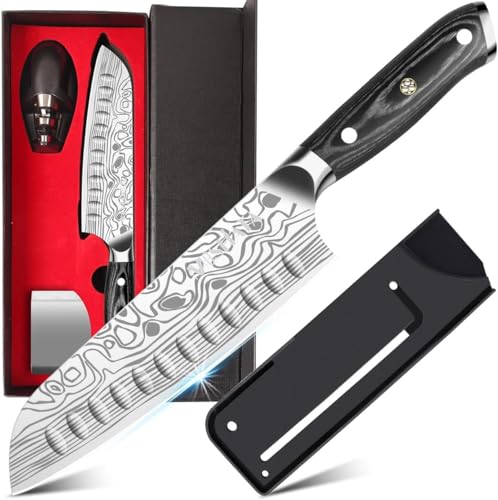
MOSFiATA 7-Inch Forged Santoku Knife
Best for: all-in-one forged santoku cutting and prep kits
- Construction
- Full Tang, Forged
- Blade Length
- 7"
- Knife Type
- Santoku
- Edge Angle
- 14-16 degrees per side
- Blade Hardness
- 56 ±1 HRC
- Handle Material
- Micarta
View on Amazon: MOSFiATA 7-Inch Forged Santoku Knife (paid link)
This MOSFiATA 7-inch santoku knife features forged EN.4116 German stainless steel with a 56 ±1 HRC rating and a 2.5 mm blade thickness. It combines a full-tang build with a triple-riveted Micarta handle for structural stability. Sharpened to a 14-to-16-degree angle per side, this blade suits you if you want a complete forged vegetable prep tool packaged with its own sheath, manual sharpener, and finger guard.
Pros
- Forged EN.4116 German stainless steel blade hardened to 56 ±1 HRC
- Full-tang construction with triple-riveted Micarta handle
- Hand-polished 14- to 16-degree edge angle per side
- Includes sheath, manual sharpener, and finger protector
Cons
- At 56 ±1 HRC, steel is softer than specialized high-hardness alloys
- Total weight of 0.7 pounds is heavier than standard thin santokus
Good fit if
- You want a forged santoku knife complete with edge-maintenance accessories and a sheath.
- You prefer a full-tang build with a durable, triple-riveted Micarta handle.
Skip if
- You prefer ultra-hard steel exceeding 60 HRC for maximum edge retention.
- You want a lightweight prep knife under half a pound.
Verdict: MOSFiATA 7-Inch Forged Santoku Knife delivers durable German steel construction and balanced full-tang handling alongside practical maintenance accessories. It gives you a dependable, moderately hard utility blade tailored for routine chopping and slicing.

FAMCÜTE 7-Inch Forged Santoku Knife
Best for: high-hardness Japanese-style slicing and chopping
- Construction
- Forged
- Blade Length
- 7"
- Knife Type
- Santoku Knife
- Blade Material
- 9CR18MOV steel
- Blade Hardness
- HRC 62
- Handle Material
- Rosewood
View on Amazon: FAMCÜTE 7-Inch Forged Santoku Knife (paid link)
The FAMCÜTE 7-Inch Forged Santoku Knife features a 7-inch blade constructed from five layers of 9CR18MOV clad steel. It reaches a hardness rating of up to 62 HRC, paired with an octagonal rosewood handle for balance. Weighing 0.69 pounds, this forged knife suits you if you need a mid-weight Japanese-style chopping knife designed for edge retention during daily kitchen prep tasks.
Pros
- Forged 5-layer 9CR18MOV clad steel construction
- Blade hardness rated up to 62 HRC
- Octagonal rosewood handle design
- Treated with vacuum nitriding and anti-rust technology
Cons
- No blade sheath or storage cover included in specifications
- Natural rosewood handle lacks the dishwasher compatibility of synthetic materials
Good fit if
- You want a 7-inch forged santoku blade with 62 HRC hardness.
- You prefer a non-slip octagonal rosewood handle.
- You want a multi-layer steel knife weighing under 0.7 pounds.
Skip if
- You prefer synthetic or seamless stainless steel handles.
- You need a knife that includes a sheath or dedicated storage block.
Verdict: FAMCÜTE 7-Inch Forged Santoku Knife combines 5-layer 9CR18MOV steel and 62 HRC hardness with an octagonal rosewood handle. It provides a balanced 0.69-pound build for controlled chopping and slicing.
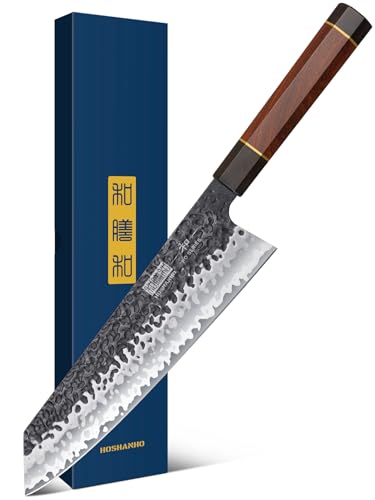
HOSHANHO 9-Inch Forged Kiritsuke Knife
Best for: long-blade slicing of boneless proteins and produce
- Construction
- Forged
- Blade Length
- 9 in
- Knife Type
- Kiritsuke Chef
- Blade Material
- 10Cr15CoMoV, composite steel
- Edge Angle
- 12°–15° per side
- Handle Material
- Rosewood
View on Amazon: HOSHANHO 9-Inch Forged Kiritsuke Knife (paid link)
This Japanese-style 9-inch forged kiritsuke knife features an 8-layer composite steel blade with a 10Cr15CoMoV steel core. The blade measures 2.5 mm thick with a 12-to-15-degree edge bevel on each side and a hand-hammered texture. It weighs about 0.52 pounds and pairs with an octagonal natural rosewood handle. If you need a long, lightweight slicing and chopping blade for boneless meats, sushi, and produce, this knife fits your prep routine.
Pros
- Core of 10Cr15CoMoV steel clad in 8 composite steel layers
- Hand-sanded cutting angle of 12 to 15 degrees per side
- Octagonal natural rosewood handle with ambidextrous grip
- Blade thickness of 2.5 mm with hammered non-stick texture
Cons
- Cannot be used on bones or frozen foods
- Requires hand washing without abrasive sponges
- At 9 inches, the blade is longer than standard 8-inch chef knives
Good fit if
- You prepare sushi, vegetables, or boneless meats requiring a 9-inch blade.
- You prefer an octagonal rosewood handle suited for both left and right hands.
- You want an acute 12-to-15-degree edge angle with a 10Cr15CoMoV steel core.
Skip if
- You need a heavy knife rated for cutting through bone or frozen items.
- You prefer dishwasher-safe cutlery that does not require immediate hand drying.
Verdict: HOSHANHO 9-Inch Forged Kiritsuke Knife provides a thin 2.5 mm blade with an acute 12-to-15-degree edge for precise slicing tasks. Its octagonal rosewood handle and lightweight forged steel build suit prep work on boneless foods.

SANMEIHO 8-Inch Forged Gyuto Knife
Best for: lightweight Japanese-style precision slicing
- Construction
- Forged
- Blade Length
- 8 in
- Knife Type
- Chef, Gyuto
- Blade Material
- 10Cr15MoV core
- Edge Angle
- 12°
- Blade Hardness
- 62 HRC
View on Amazon: SANMEIHO 8-Inch Forged Gyuto Knife (paid link)
The SANMEIHO 8-Inch Forged Gyuto Knife is a Japanese-style kitchen knife built for daily slicing and prep. It features an 8-inch blade with a 10Cr15MoV core clad in nine layers of stainless steel, hardened to 62 HRC. The blade is ground to an acute 12-degree cutting edge and weighs 0.25 pounds. You get a hybrid G10 and rosewood handle secured by a brass pin, suited for cooks who want an ultra-light, acute edge.
Pros
- 10Cr15MoV steel core rated at 62 HRC
- 9-layer clad stainless steel construction
- Acute 12-degree factory edge angle
- Hybrid G10 and natural rosewood handle with brass pin
- Lightweight build at 0.25 pounds
Cons
- Acute 12-degree edge requires careful maintenance to avoid chipping
- Rosewood handle section precludes dishwasher cleaning
- No blade sheath or edge guard listed in specifications
Good fit if
- You want an acute 12-degree Japanese cutting angle for precision slicing.
- You prefer an exceptionally light 0.25-pound chef knife to minimize fatigue.
- You want a hard 62 HRC core protected by layered stainless cladding.
Skip if
- You prefer a heavier Western-style knife for dense cutting tasks.
- You want an entirely synthetic or dishwasher-safe handle.
Verdict: SANMEIHO 8-Inch Forged Gyuto Knife pairs an acute 12-degree edge with a 62 HRC core in an exceptionally light package. It delivers Japanese-style precision slicing for everyday kitchen prep.

Bloomhouse 3.5-Inch Olive Wood Paring Knife
Best for: Small-scale peeling, trimming, and garnishing tasks
- Construction
- Full Tang, Forged
- Blade Length
- 3.5 in
- Knife Type
- Paring
- Blade Material
- High-carbon German steel
- Handle Material
- Italian olive wood
- Recommended Use
- Peeling
View on Amazon: Bloomhouse 3.5-Inch Olive Wood Paring Knife (paid link)
This is a 3.5-inch paring knife designed for detailed peeling, trimming, and garnishing tasks. You get a forged high-carbon German stainless steel blade paired with a full tang build for balance. The handle uses Italian olive wood. At approximately 0.51 pounds, it suits you if you want a compact, natural-wood prep tool built with forged German steel construction.
Pros
- Forged high-carbon German stainless steel blade
- Full tang construction for structural balance
- Italian olive wood handle
Cons
- Weight of 0.51 pounds is heavy for a small paring knife
- No protective sheath or blade guard included in the box
Good fit if
- You need a compact 3.5-inch forged blade for small peeling and garnishing tasks.
- You prefer a full tang knife with an Italian olive wood handle.
Skip if
- You need a larger chef or santoku knife for broad cutting board work.
- You prefer synthetic dishwasher-safe handle materials over wood.
Verdict: Bloomhouse 3.5-Inch Forged Olive Wood Paring Knife pairs full tang German steel with an Italian olive wood handle for controlled prep work. It provides solid construction for detail cutting tasks.

KYOKU Shogun 8.5-Inch Forged Damascus Kiritsuke Knife
Best for: precise slicing with Damascus steel
- Construction
- Forged
- Blade Length
- 8.5"
- Knife Type
- Kiritsuke Knife
- Blade Material
- VG-10 steel
- Edge Angle
- 8 to 12 degree
- Blade Hardness
- 58-60 HRC
View on Amazon: KYOKU Shogun 8.5-Inch Forged Damascus Kiritsuke Knife (paid link)
The KYOKU Shogun Kiritsuke knife features an 8.5-inch forged blade with a 67-layer Damascus pattern over a Japanese VG-10 steel core. Hardened to 58-60 HRC and ground to an acute 8-to-12-degree edge, it offers fine slicing ability for meats, fish, and vegetables. If you want a full-tang, Japanese-style multi-purpose knife with a moisture-resistant G10 fiberglass handle and an included sheath, this design suits detailed prep tasks.
Pros
- Forged 67-layer Damascus blade with Japanese VG-10 core
- Acute 8 to 12 degree edge angle with 58-60 HRC hardness
- Moisture- and heat-resistant G10 fiberglass handle with full tang
- Includes protective sheath and storage case
Cons
- At 13.8 inches overall length, it requires ample cutting board clearance
- Acute 8-to-12-degree edge profile is unsuitable for cutting through bone
Good fit if
- You want a forged VG-10 Damascus blade sharpened to an acute Japanese edge profile.
- You need an 8.5-inch Kiritsuke shape bundled with a dedicated sheath and case.
- You prefer a full-tang build with a durable G10 fiberglass handle.
Skip if
- You prefer a compact chef knife shorter than eight inches.
- You need a standard Western edge angle for rough, heavy-duty hacking.
Verdict: KYOKU Shogun 8.5-Inch Forged Damascus Kiritsuke Knife delivers high-hardness VG-10 steel with acute edge geometry for precision slicing. Its full-tang fiberglass handle and included protective sheath provide a complete, durable cutting setup.
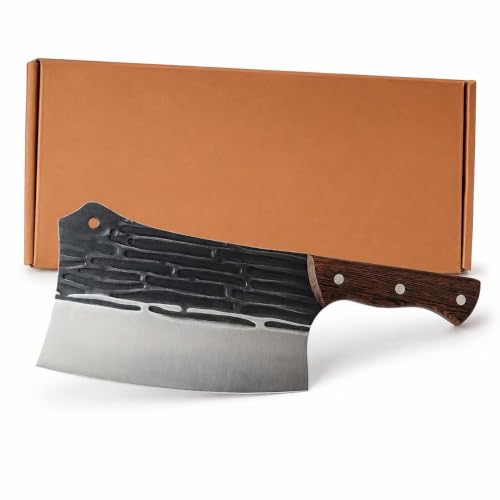
SHI BA ZI ZUO 7.3-Inch Forged Cleaver Knife
Best for: heavy meat and vegetable prep tasks
- Construction
- Forged
- Blade Length
- 7.3"
- Knife Type
- Cleaver, Butcher Knife
- Blade Material
- High carbon stainless steel
- Handle Material
- Solid wood
- Recommended Use
- Vegetables, Meat
View on Amazon: SHI BA ZI ZUO 7.3-Inch Forged Cleaver Knife (paid link)
This SHI BA ZI ZUO cleaver gives you a 7.3-inch forged high-carbon stainless steel blade designed for slicing meat and chopping vegetables. At 2.14 pounds, it brings substantial heft to prep work, backed by a solid wood handle for grip stability. The blade surface features hammered texturing and an oxidation blackening finish. If you need a heavy, wide-profile forged blade for standard butchery and produce cutting, this fits your kitchen.
Pros
- Forged high-carbon stainless steel blade provides rigid strength
- Substantial 2.14-pound weight aids downward cutting force
- Hammered and oxidation-blackened finish provides an anti-stick surface
- Solid wood handle delivers a sturdy, non-slip grip
Cons
- Heavy 2.14-pound build can cause hand fatigue during extended prep
- Requires hand washing instead of machine washing
Good fit if
- You want a heavy 2.14-pound cleaver that uses momentum to cut meat and vegetables.
- You prefer a forged blade with an anti-stick hammered finish and wooden handle.
- You need a broad 7.3-inch blade for cutting meat off bones and chopping produce.
Skip if
- You prefer lightweight cutlery designed to minimize wrist strain.
- You require dishwasher-safe kitchen tools.
Verdict: SHI BA ZI ZUO 7.3-Inch Forged Cleaver Knife delivers substantial 2.14-pound cutting momentum and a forged high-carbon build for processing meat and vegetables. It serves you well if you prioritize downward heft and traditional wood handle construction.

HOSHANHO 6.9-Inch Forged Santoku Knife
Best for: precise slicing with a high-hardness Japanese blade
- Construction
- Forged
- Blade Length
- 7 in
- Knife Type
- Santoku
- Blade Material
- 10Cr15CoMoV steel
- Edge Angle
- 12°
- Blade Hardness
- 62 HRC
View on Amazon: HOSHANHO 6.9-Inch Forged Santoku Knife (paid link)
This Japanese-style forged santoku knife features a 10Cr15CoMoV steel core heat-treated to 62 HRC for high edge retention. The 6.9-inch blade is sharpened to an acute 12-degree angle per side to reduce slicing drag. Weighing under 0.47 pounds, it includes an octagonal rosewood handle with a widened finger guard. It suits you if you want a hard, acute forged blade for detailed vegetable, meat, and fish slicing.
Pros
- Forged 10Cr15CoMoV steel core tempered to 62 HRC
- Hand-sharpened 12-degree V-angle edge on both sides
- Octagonal rosewood handle with widened finger guard
- Lightweight build at approximately 0.46 pounds
Cons
- Rosewood handle requires wood maintenance unlike synthetic scales
- No blade sheath or protective cover included in specifications
Good fit if
- You prefer an acute 12-degree edge angle for clean, thin cuts.
- You want high-carbon core steel rated at 62 HRC for edge longevity.
- You like a traditional octagonal wooden handle profile.
Skip if
- You want low-maintenance synthetic handle materials.
- You need an included travel sheath or storage guard.
Verdict: HOSHANHO 6.9-Inch Forged Santoku Knife provides high hardness with its 62 HRC 10Cr15CoMoV core and acute 12-degree edge. Its lightweight build and octagonal rosewood handle deliver precision control for everyday prep tasks.
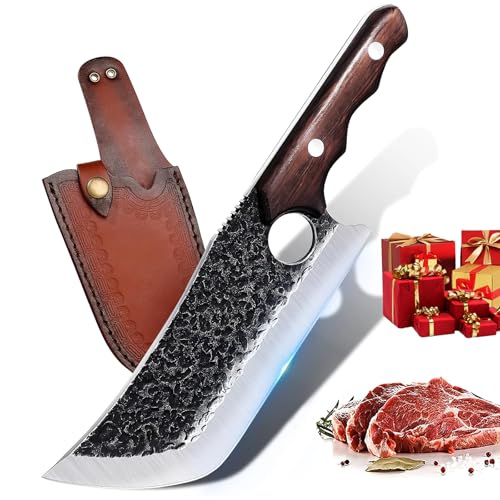
DRGSKL Forged Meat Cleaver with Sheath
Best for: heavy-duty butchering and outdoor cooking
- Construction
- Forged
- Knife Type
- Meat Cleaver Knife
- Blade Material
- High carbon steel
- Handle Material
- Wenge Wood
- Storage Type
- Sheath
- Color
- Black
View on Amazon: DRGSKL Forged Meat Cleaver with Sheath (paid link)
The DRGSKL Forged Meat Cleaver with Sheath gives you a heavy-duty tool built from high carbon steel. Measuring 10.5 inches overall and weighing roughly 1.45 pounds, it pairs an arched blade profile with an integrated finger hole for close control. The full-tang wenge wood handle handles butchering and outdoor chores. If you prepare whole cuts of meat or need a rugged camp knife, this blade delivers solid chopping mass.
Pros
- Forged high carbon steel blade holds an edge under heavy kitchen use
- Full-tang wenge wood handle features an integrated finger hole for grip control
- Substantial 1.45-pound weight provides cutting leverage through bone and cartilage
- Includes a fitted leather belt sheath for storage and field transport
Cons
- High carbon steel is not dishwasher safe and requires hand drying to prevent rust
- Heavy 1.45-pound weight can cause hand fatigue during repetitive thin slicing
Good fit if
- You need a heavy forged cleaver for separating ribs and deboning meat.
- You want an integrated blade finger hole for close, controlled grip leverage.
- You take your prep knives outdoors for camping or barbecue tasks.
Skip if
- You prefer low-maintenance, dishwasher-safe stainless steel blades.
- You want a lightweight, nimble knife for delicate vegetable cutting.
Verdict: DRGSKL Forged Meat Cleaver with Sheath provides a weighty, full-tang carbon steel build suited for tough butchering and outdoor cooking. Its integrated finger hole and substantial heft make it a capable tool when standard kitchen knives feel too light.
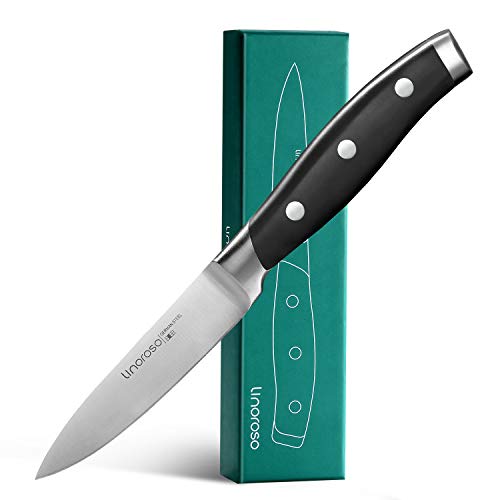
Linoroso 3.5-Inch Forged Paring Knife
Best for: detailed peeling and precision fruit prep
- Construction
- Full Tang, Forged
- Blade Length
- 3.5 in
- Knife Type
- Paring knife
- Blade Material
- German high-carbon stainless steel
- Edge Angle
- 11-12°
- Blade Hardness
- 56+ HRC
View on Amazon: Linoroso 3.5-Inch Forged Paring Knife (paid link)
The Linoroso 3.5-Inch Paring Knife provides forged German stainless steel in a compact footprint. You get full-tang construction, a 56+ HRC rating, and an acute 11–12° hand-ground edge designed for precise peeling and trimming. At 0.37 pounds with a total length under 9.5 inches, this tool suits you if you need controlled detail work rather than heavy chopping across the kitchen cutting board.
Pros
- Forged German ThyssenKrupp stainless steel blade
- Full-tang build with ergonomic handle
- Acute 11–12° hand-ground cutting edge
- Heat-treated to 56+ HRC hardness rating
Cons
- Short 3.5-inch blade limits use to small prep tasks
- Steel rated at 56+ HRC holds edges shorter than harder alloys
- No protective sheath or blade guard included
Good fit if
- You need a dedicated forged knife for peeling, coring, and small fruit prep.
- You prefer an acute 11–12° edge angle paired with German stainless steel.
- You want full-tang balance in a compact 0.37-pound tool.
Skip if
- You need a larger primary knife for slicing meat or chopping dense vegetables.
- You prefer high-hardness steel above 60 HRC for maximum edge retention.
Verdict: Linoroso 3.5-Inch Forged Paring Knife delivers full-tang German steel with an acute 11–12° edge for precise small-scale kitchen prep.
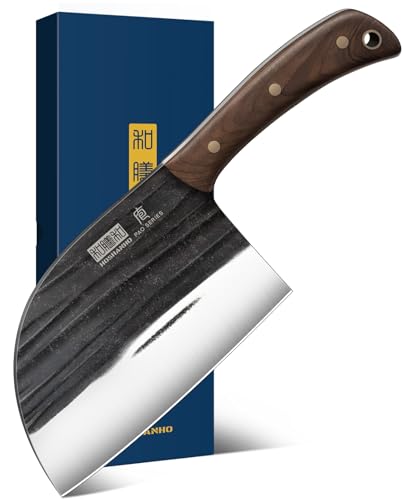
HOSHANHO 6.5-Inch Forged Serbian Chef Knife
Best for: Heavy meat prep and rugged chopping tasks
- Construction
- Forged
- Blade Length
- 6.5"
- Knife Type
- Serbian Chef Knife
- Blade Material
- High carbon steel
- Edge Angle
- 15–20°
- Blade Hardness
- 58-60HRC
View on Amazon: HOSHANHO 6.5-Inch Forged Serbian Chef Knife (paid link)
The HOSHANHO 6.5-Inch Forged Serbian Chef Knife gives you a heavy-duty cutting profile built from high carbon steel rated at 58 to 60 HRC. Its thick 4 mm spine and 1-pound weight deliver stability when chopping through dense meats and bones. The full tang walnut handle is anchored by three steel rivets for control. If you need a forged cleaver hybrid with a 15-to-20-degree edge for butchering tasks, this tool fits your prep routine.
Pros
- Thick 4 mm spine provides rigidity for heavy chopping
- 58-60 HRC high carbon steel blade
- Full tang walnut handle secured with 3 rivets
- 15-20 degree cutting angle balances sharpness and edge durability
Cons
- 1-pound weight can cause fatigue during prolonged fine slicing
- Broad cleaver blade profile lacks agility for intricate peeling tasks
Good fit if
- You need a sturdy 4 mm thick blade for butchering meats and processing joints.
- You prefer a substantial 1-pound tool with a riveted full tang walnut grip.
- You want an edge hardened to 58-60 HRC for resilient outdoor or kitchen chopping.
Skip if
- You want a lightweight chef knife for nimble, continuous vegetable prep.
- You prefer a slim, flexible blade profile rather than a wide cleaver style.
Verdict: HOSHANHO 6.5-Inch Forged Serbian Chef Knife delivers robust chopping power with its 4 mm spine and 58-60 HRC high carbon build. It is a solid, hefty option when your prep work demands forceful cuts through tough meats.
Specifications side by side
| Spec | Imarku 14-Piece Japanese Steel Knife Set | Imarku 7-Inch Forged Santoku Knife | HENCKELS Forged Accent 2-Piece Paring Knife Set | Mercer Culinary Renaissance 2.5-Inch Peeling Knife | MOSFiATA 7-Inch Forged Santoku Knife | FAMCÜTE 7-Inch Forged Santoku Knife | HOSHANHO 9-Inch Forged Kiritsuke Knife | SANMEIHO 8-Inch Forged Gyuto Knife | Bloomhouse 3.5-Inch Olive Wood Paring Knife | KYOKU Shogun 8.5-Inch Forged Damascus Kiritsuke Knife | SHI BA ZI ZUO 7.3-Inch Forged Cleaver Knife | HOSHANHO 6.9-Inch Forged Santoku Knife | DRGSKL Forged Meat Cleaver with Sheath | Linoroso 3.5-Inch Forged Paring Knife | HOSHANHO 6.5-Inch Forged Serbian Chef Knife |
|---|---|---|---|---|---|---|---|---|---|---|---|---|---|---|---|
| Blade Length | not specified | 7 Inch | 3 in, 4 in | 2.5 in | 7" | 7" | 9 in | 8 in | 3.5 in | 8.5" | 7.3" | 7 in | not specified | 3.5 in | 6.5" |
| Knife Type | not specified | Santoku Knife | Paring | Peeling | Santoku | Santoku Knife | Kiritsuke Chef | Chef, Gyuto | Paring | Kiritsuke Knife | Cleaver, Butcher Knife | Santoku | Meat Cleaver Knife | Paring knife | Serbian Chef Knife |
| Blade Material | High-carbon stainless steel | Powder steel | not specified | High-carbon German cutlery steel | not specified | 9CR18MOV steel | 10Cr15CoMoV, composite steel | 10Cr15MoV core | High-carbon German steel | VG-10 steel | High carbon stainless steel | 10Cr15CoMoV steel | High carbon steel | German high-carbon stainless steel | High carbon steel |
| Construction | Precision-forged | Multi-Layer Forged | Forged | Forged | Forged | Hand Forged | Hand forged | 9-layer clad, hand-forged | Forged | Forged Damascus | Hand forged | Hand Forged | Hand Forged | Forged | Hand forged |
| Edge Angle | 10–15° | not specified | not specified | not specified | 14-16 degrees per side | not specified | 12°–15° per side | 12° | not specified | 8 to 12 degree | not specified | 12° | not specified | 11-12° | 15–20° |
| Blade Hardness | not specified | 62±1 HRC | not specified | not specified | 56 ±1 HRC | HRC 62 | not specified | 62 HRC | not specified | 58-60 HRC | not specified | 62 HRC | not specified | 56+ HRC | 58-60HRC |
| Handle Material | not specified | Pakka wood | not specified | not specified | Micarta | Rosewood | Rosewood | G10 & Rosewood | Italian olive wood | fiberglass | Solid wood | Rosewood | Wenge Wood | not specified | Walnut |
| Storage Type | Knife Block | not specified | not specified | not specified | Sheath | not specified | not specified | not specified | not specified | Sheath | not specified | not specified | Sheath | not specified | not specified |
| Features | Dishwasher Safe, Built-in Sharpener | not specified | not specified | not specified | not specified | not specified | not specified | not specified | not specified | not specified | not specified | not specified | not specified | not specified | not specified |
| Color | Silver Gray | Classic Brown | White | Forged Peeling Knife | Silver Santoku Knife | Clad | Gray | 8” Chef Knife | Paring Knife (Olive Wood) | Life-time Warranty, Japanese VG10 Steel Core, Full Tang, G10 Handle with Engraved Rivet & Mosaic Pin, Included Guard, Ice Tempered & Heat Treated, Superior Sharpness, Ergonomic handle & well-balanced design | Black/Silver-X08 | Silver | Black | Black | Silver |
| Style | Japanese | Japanese | German | not specified | German | not specified | Japanese | Japanese | German | Japanese | not specified | Japanese | not specified | German | not specified |
| Size | 14 Pcs | 7 Inch | 4" | 2.5" | 7" | 7" | 9" | 8" | 3.5" | 8.5" | 7.3" | 6.9" | 1 | 3.5" | 6.5" |
| Recommended Use | not specified | not specified | not specified | Peeling | Vegetables | not specified | not specified | not specified | Peeling | not specified | Vegetables, Meat | not specified | Meat | Fruit | Meat |
| Dimensions | 10.1 × 7.09 × 14.6 inches | 12.6 × 1.91 × 1.18 inches | 13 × 10.5 × 0.83 inches | 8 × 4 × 1 inches | 14.1 × 4.7 × 2.08 inches | not specified | not specified | not specified | not specified | 13.8 × 1.95 × 1 inches | not specified | not specified | not specified | 9.45 × 2.36 × 1.18 inches | not specified |
| Weight | not specified | 15.8 ounces | 0.64 ounces | 2.39 ounces | 11.2 ounces | 11 ounces | 8.4 ounces | 4 ounces | 8.15 ounces | 9.6 ounces | 2.14 pounds | 7.41 ounces | 1.45 pounds | 5.93 ounces | 1 pounds |
| Length | not specified | not specified | not specified | not specified | not specified | not specified | not specified | not specified | not specified | not specified | not specified | not specified | 10.5 inches | not specified | not specified |
| Model | ZCD-0291 | P9S | 1021240 | M23640 | 178mm 三徳刀 | SHG-0007 | 9 inch Kiritsuke Knife | SMHCS-2025-05-01 | 137707.01 | 8541907472 | X08 | 7 Inch Santoku Knife | SUVELAM | Linoroso | 6.5 Inch Chef Knife |
Is a Forged Knife Worth It?
Forged construction shapes the blade and tang from solid steel, often incorporating integrated bolsters and full-tang handles. In daily kitchen prep, this construction yields rigid blade spines—ranging from 2.5 mm slicers up to 4 mm cleavers—that resist flexing under downward pressure. Knives with forged builds also support substantial builds, reaching up to 1.45 pounds in dedicated butcher tools. If you need structural rigidity and a solid bolster transition between blade and handle, forged construction provides those exact specifications.
Worth it if
- You want a full-tang build with integrated bolster durability for firm handling.
- You need a rigid spine, up to 4 mm thick, that resists bending under force.
Skip it if
- You prefer a flexible blade profile over a rigid forged spine.
- You want to avoid heavier utility profiles that reach up to 1.45 pounds.
Just as you measure blade balance by steel dimensions, you can evaluate each 60 mechanical keyboard by its compact layout measurements and switch specifications.
How We Chose Forged Knives
You find knives here based strictly on published specifications for forged construction. Each selected item lists forged construction in its title or official feature list, confirming the blade is formed from heated steel rather than stamped. To keep comparisons practical, only one size or variant from a given product line is included.
The 15 picks are ordered with products in stock first, then by Amazon sales rank to highlight better-selling options first. Products are not physically handled, and all specifications come directly from manufacturer listings. Live prices and stock availability update at least daily on the page.
How to Choose the Best Forged Knives
-
Select Blade Length by Task
Check the blade length specification to match your workspace and ingredients. Compact 2.5-inch to 3.5-inch blades handle in-hand peeling, garnishing, and seed removal without excess leverage getting in your way. A mid-sized 7-inch profile balances chopping clearance with board control. Long 8.5-inch to 9-inch formats, such as the HOSHANHO 9-Inch Forged Kiritsuke Knife, give you single-stroke slicing power across wide roasts and dense vegetables. Verify your cutting board dimensions before buying to ensure the blade clears your prep zone comfortably.
-
Compare Overall Knife Weight
Examine the weight specification to align the knife with your cutting style. Lightweight forged models, like the SANMEIHO 8-Inch Forged Gyuto Knife at 0.25 pounds, maximize agility and reduce wrist fatigue during high-volume vegetable slicing. In contrast, blades weighing near one pound rely on gravity and mass to drop through dense proteins and thick root produce with minimal downward muscle effort. If you value quick directional changes and fingertip control, target lower weights; pick heavier builds when you want cutting momentum.
-
Evaluate Handle Material Upkeep
Inspect the handle material attribute to determine your daily maintenance routine. Natural materials, such as the Italian olive wood on the Bloomhouse 3.5-Inch Paring Knife, provide warm tactile grip and traditional styling. However, natural wood requires prompt hand drying and periodic oiling to avoid moisture swelling or cracking. If you prefer low-maintenance prep, choose composite materials like G10 fiberglass or synthetic scales. These resist water absorption, detergents, and temperature shifts without warping, fitting busy kitchens where tools undergo frequent washing and heavy moisture exposure.
-
Check Edge Bevel Angles
Review the published edge grind angle to gauge cutting precision versus edge delicacy. Traditional Western grinds sit around 20 degrees per side for general utility and impact resilience. Japanese-style forged blades sharpen down to acute 11-to-15-degree angles, creating razor-thin cutting profiles that pass through soft produce and boneless meats with zero wedging. The Linoroso 3.5-Inch Forged Paring Knife features an acute 11–12° bevel for exact detail work. Choose narrower angles for precision slicing, but avoid twisting the blade against cutting boards to prevent fine edge micro-chipping.
-
Confirm Storage and Blade Protection
Check the package specs for included blade protection before choosing individual knives. Forged edges dull rapidly and can chip if stored loose inside kitchen drawers against other metal utensils. Knives packaged with dedicated sheaths, like the KYOKU Shogun 8.5-Inch Kiritsuke Knife, allow safe storage in drawer organizers or transport bags right out of the box. If you purchase standalone knives without sheaths, you need dedicated drawer slots, separate edge guards, or a compatible wall bar to maintain cutting bevel integrity between food prep sessions.
Frequently asked questions
Are forged kitchen knives dishwasher safe?
Most forged knives require hand washing, though certain models list dishwasher compatibility. The Imarku 14-piece set specifies dishwasher-safe construction, but models with natural wood handles—such as the Bloomhouse olive wood paring knife or the FAMCÜTE rosewood santoku—require gentle hand cleaning. Hand washing protects wood fibers and preserves finely honed edge geometry over time.
How much do forged kitchen knives weigh?
Forged knife weights vary substantially based on blade dimensions and intended prep work. You can find nimble options like the SANMEIHO 8-inch gyuto at 0.25 pounds or the Mercer 2.5-inch peeling knife at roughly 0.15 pounds. In contrast, heavy-duty butchering tools add substantial mass, such as the DRGSKL meat cleaver weighing nearly 1.45 pounds to assist downward cutting force.
What is a forged kiritsuke knife used for?
A forged kiritsuke knife serves primarily as a specialized slicing tool for boneless proteins, vegetables, and prep garnishing. For example, the HOSHANHO 9-inch kiritsuke features a thin 2.5 mm blade profile and acute cutting angles between 12 and 15 degrees. Models like the KYOKU Shogun 8.5-inch kiritsuke use high-hardness Damascus VG-10 steel to deliver clean, continuous push cuts without crushing delicate food textures.
What is the difference between a forged santoku and a gyuto knife?
Blade length and tip shape separate these two Japanese-style profiles. A forged santoku, such as the 7-inch MOSFiATA or 6.9-inch HOSHANHO, features a flatter cutting edge with a rounded sheep's foot tip for up-and-down chopping. A forged gyuto, like the 8-inch SANMEIHO, provides a longer, gently curved blade that accommodates rocking motions as well as horizontal precision slicing.
What handle materials are used on forged kitchen knives?
Manufacturers pair forged blades with composite, resin, or natural wood handles depending on balance and grip preference. The KYOKU Shogun uses a durable G10 fiberglass handle, while the Linoroso paring knife features an ergonomic black handle. If you prefer traditional organic materials, the Bloomhouse paring knife specifies Italian olive wood, and both FAMCÜTE and HOSHANHO utilize octagonal rosewood handles.
Does a forged knife always feature a full tang?
Many forged knives feature full-tang construction, but designs vary across different culinary styles. Full-tang builds extend steel continuously from the tip through the base of the handle, as seen on the MOSFiATA santoku, Bloomhouse paring knife, and Linoroso paring knife. This construction increases overall stability, though traditional Japanese-style forged blades may instead use stick tangs inserted into octagonal wood handles.
What types of steel are used in forged kitchen knives?
Forged knives feature several steel formulations optimized for edge retention or rust resistance. You can select German stainless steel for toughness, found in models like the Linoroso and MOSFiATA. Alternatively, Japanese-style options utilize harder alloys, such as 9Cr18MoV steel on the FAMCÜTE santoku, 10Cr15CoMoV steel on the HOSHANHO santoku, or multi-layered Damascus VG-10 steel on the KYOKU Shogun.