15 Best Brown Kitchen Knives, Compared
As an Amazon Associate we earn from qualifying purchases. Links on this page are affiliate links.
Finding the right brown kitchen knife comes down to matching blade geometry and handle materials to your food prep tasks. We compared 15 models strictly using the specifications published on their listings.
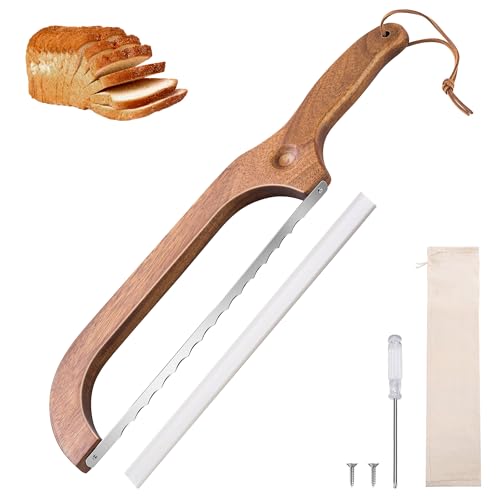
The RAPSAKEMOH 15.7-Inch Wooden Bread Bow Knife takes the top spot because its 15.7-inch wooden frame and 10.6-inch serrated blade provide balanced, ambidextrous control for slicing delicate or crusty loaves. This guide helps you choose the right blade shape, edge type, and dimensions for your kitchen.
Quick picks
The best fit for you
- You slice homemade sourdough loaves and soft artisan breads RAPSAKEMOH 15.7-Inch Wooden Bread Bow Knife Its 15.7-inch bow frame and serrated edge cut delicate bread without crushing crusts.
- You need a narrow knife for deboning poultry and fish Mercer Culinary Millennia 6-Inch Narrow Boning Knife Its narrow 6-inch blade profile and textured handle support precise meat trimming tasks.
- You want a dishwasher safe forged stainless steel chef knife CURTA 8-Inch Commercial Chef's Knife This 8-inch straight-edge blade offers forged stainless steel construction rated as dishwasher safe.
- You debone poultry and fillet fish needing blade flex Dexter 6-Inch Flexible Boning Knife The 6-inch high-carbon steel blade features flexible construction and weighs 0.15 pounds.
Our 15 picks

RAPSAKEMOH 15.7-Inch Wooden Bread Bow Knife
Best for: slicing sourdough and soft homemade bread loaves
- Color
- Brown
- Knife Type
- Bread bow knife
- Edge Type
- Serrated
- Handle Material
- Wood
- Dimensions
- 15.7 × 2.76 × 0.6 inches
- Weight
- 6.38 ounces
The RAPSAKEMOH 15.7-Inch Wooden Bread Bow Knife provides a brown wooden frame fitted with a serrated blade for slicing homemade loaves, sourdough, and baguettes. Measuring 15.7 inches long and weighing about 0.4 pounds, it uses two screws so you can reverse the blade for left- or right-handed use. It includes a protective blade cover and suits you if you need a dedicated slicer that prevents soft loaves from squishing.
Pros
- Reversible serrated blade converts for left- or right-handed use with two screws
- Includes dedicated protective blade cover
- Lightweight 0.4-pound wooden bow frame
- Serrated edge cuts soft bread, sourdough, baguettes, bagels, and fruit
Cons
- Not dishwasher-safe; requires towel drying after every use
- Requires manual screw adjustment to switch cutting orientation
Good fit if
- You slice sourdough, rustic loaves, or soft bread and want to avoid crushing them.
- You need a bread slicer that can adjust for left-handed or right-handed cutting.
Skip if
- You require dishwasher-safe kitchen tools for daily cleaning.
- You prefer a traditional rigid chef knife or standard flat bread blade.
Verdict: RAPSAKEMOH 15.7-Inch Wooden Bread Bow Knife delivers an ambidextrous serrated cutting design built specifically for homemade loaves. It keeps crusty and delicate breads intact while including blade protection for safe storage.
Pranski 14.5-Inch Acacia Wood Bread Knife
Best for: ambidextrous sourdough and artisan bread slicing
- Color
- Brown
- Knife Type
- Bread Knife
- Edge Type
- Serrated
- Handle Material
- Acacia wood
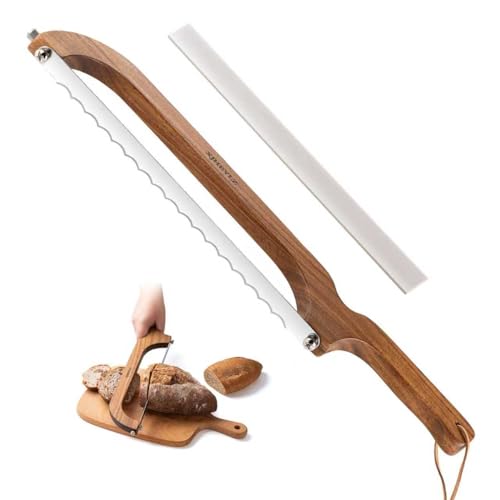
The Pranski 14.5-Inch Acacia Wood Bread Knife gives you a dedicated brown wooden slicing tool for crusty loaves, cakes, and cheese. It features a natural brown acacia wood body and a serrated blade secured with two mounting screws. You can unscrew and reverse the blade for left-handed slicing. It suits you if you bake sourdough and need an ambidextrous slicer that avoids crushing crumb textures.
Pros
- Reversible blade accommodates left- and right-handed cutting
- Constructed with a natural brown acacia wood handle
- Protruding serrated blade cuts bread without crushing crumb structure
- Two mounting screws keep the blade anchored securely
Cons
- Not dishwasher safe; requires immediate hand drying with a cloth
- Requires manual screw loosening and reassembly to switch handedness
- Natural acacia wood grain produces variations in brown coloration
Good fit if
- You need a brown kitchen knife built specifically for slicing sourdough and crusty loaves.
- You want an ambidextrous bread cutter that converts for left-handed use.
Skip if
- You prefer dishwasher-safe cutlery that requires minimal maintenance.
- You need a general-purpose prep knife rather than a dedicated serrated slicer.
Verdict: Pranski 14.5-Inch Acacia Wood Bread Knife provides an ambidextrous serrated cutter mounted in a natural brown acacia wood frame. It offers dedicated slicing control for bread bakers willing to maintain hand-wash wooden cutlery.

Mercer Culinary Millennia 6-Inch Narrow Boning Knife
Best for: Deboning poultry, fish, and trimming cooked meats
- Color
- Brown
- Blade Length
- 6 in
- Knife Type
- Narrow Boning Knife
- Blade Material
- High-carbon Japanese steel
- Dimensions
- 11 × 4 × 1 inches
- Weight
- 5.33 ounces
View on Amazon: Mercer Culinary Millennia 6-Inch Narrow Boning Knife
This Mercer Culinary Millennia knife features a 6-inch narrow blade made from one-piece high-carbon Japanese steel. The ergonomic handle is color-coded brown with textured finger points for a secure grip. It weighs approximately 0.33 pounds and measures 11 inches overall. If you need a dedicated tool for trimming sinew or separating meat from chicken, ham, and fish, this specialized boning knife fits your kitchen prep needs.
Pros
- One-piece high-carbon Japanese steel construction
- Narrow 6-inch blade profile designed for deboning and trimming
- Handle features textured finger points for a non-slip grip
- Lightweight build at approximately 0.33 pounds
Cons
- Hand wash only; not safe for dishwasher use
- Cannot be submerged in water for extended periods
- Narrow blade profile is not suited for general chopping tasks
Good fit if
- You need a narrow 6-inch blade to debone poultry, ham, or fish.
- You want a brown handle with textured points for a slip-resistant grip.
- You prefer a lightweight knife weighing about 0.33 pounds.
Skip if
- You require dishwasher-safe kitchen cutlery.
- You need a wide blade for chopping vegetables or slicing large roasts.
Verdict: Mercer Culinary Millennia 6-Inch Narrow Boning Knife provides a dedicated Japanese steel blade shaped specifically for separating meat from bone and trimming sinew. Its textured brown handle ensures a firm hold during precise butchery tasks.

Emojoy 8-Inch 67-Layer Damascus Chef Knife
Best for: everyday prep needing layered Damascus steel
- Color
- Brown
- Blade Length
- 8 in
- Knife Type
- Chef
- Blade Material
- Damascus steel
- Construction
- Hand-forged, 67-layer Damascus
- Edge Angle
- 15°
This 8-inch chef knife features a 67-layer Damascus steel blade with a 15-degree cutting bevel and a 58 HRC hardness rating. Its brown handle is carved from Calabrian olive wood with a half-bolster profile designed to balance hand clearance and sharpening ease. If you want a full-sized multi-purpose Japanese-steel kitchen knife that pairs patterned metal with real natural hardwood, this configuration fits your prep station.
Pros
- 67-layer Damascus blade with 0.98% carbon and 18% chromium
- Laser-calibrated 15-degree edge angle
- Calabrian olive wood handle with half-bolster design
- Packaged in a dedicated wooden gift box
Cons
- Natural wood handle requires manual washing and drying
- 58 HRC steel is softer than traditional premium Japanese alloys
- Does not include an individual blade sheath
Good fit if
- You want an 8-inch chef knife built with 67-layer Damascus steel.
- You prefer a natural brown olive wood handle with a half bolster.
- You need a sharp 15-degree factory edge out of the box.
Skip if
- You want an ultra-hard blade core rated above 60 HRC.
- You need a low-maintenance, dishwasher-safe synthetic handle.
Verdict: Emojoy 8-Inch Damascus Olive Wood Chef Knife provides standard 58 HRC general kitchen utility with a 15-degree cutting edge. Its layered steel and Calabrian wood construction balance aesthetic appeal with practical chopping performance.
XJHEYLZ 10.6" Sapele Wood Sourdough Bread Knife
Best for: ambidextrous slicing of crusty sourdough loaves
- Color
- Brown
- Knife Type
- Bread knife
- Blade Material
- Stainless steel
- Edge Type
- Serrated
- Handle Material
- Sapele wood
- Weight
- 6.72 ounces
View on Amazon: XJHEYLZ 10.6" Sapele Wood Sourdough Bread Knife
The XJHEYLZ 10.6" Sapele Wood Sourdough Bread Knife is a dedicated slicer built with a serrated stainless steel blade and a brown sapele wood handle. At 0.42 pounds, you get a lightweight tool featuring adjustable tension screws and a reversible design for left- or right-handed use. It includes a protective storage sheath. This knife suits you if you slice crusty loaves, bagels, or cakes at home.
Pros
- Adjustable blade tension via top screw
- Reversible blade assembly supports left-handed use
- Solid sapele wood handle with ergonomic camber design
- Protective storage sheath included
- Lightweight build at 0.42 pounds
Cons
- Not dishwasher-safe; requires towel drying after every use
- Requires manual screw adjustment to switch handedness
Good fit if
- You want an adjustable tension serrated blade with a brown wooden handle.
- You need a reversible bread slicer that accommodates left-handed cutting.
- You want an included protective sheath for drawer storage.
Skip if
- You require dishwasher-safe kitchen cutlery.
- You prefer a conventional rigid chef knife blade without tension screws.
Verdict: XJHEYLZ 10.6" Sapele Wood Sourdough Bread Knife delivers customizable blade tension and ambidextrous functionality inside a brown hardwood frame. Its included sheath and serrated stainless steel edge provide a stable setup for uniform artisan loaf slicing.

Victorinox Wood 4.7-Inch Semi-Stiff Boning Knife
Best for: deboning tasks requiring semi-stiff blade control
- Color
- Brown
- Blade Length
- 5"
- Knife Type
- Boning Knife
- Handle Material
- Wood
- Blade Flexibility
- Semi-Stiff
- Blade Profile
- Curved
View on Amazon: Victorinox Wood 4.7-Inch Semi-Stiff Boning Knife
This Victorinox boning knife features a 4.7-inch curved, semi-stiff blade paired with a brown wooden handle. At 0.19 pounds and 9.92 inches in total length, it gives you a compact profile for carving and deboning tasks. The curved shape helps guide cuts along bone contours. It suits you if you need a lightweight, semi-stiff boning tool with natural wood aesthetics for precise butchery work.
Pros
- Curved semi-stiff blade profile for deboning control
- Lightweight construction at 0.19 pounds
- Compact 4.7-inch blade length for precise maneuverability
- Brown wooden handle design
Cons
- 4.7-inch blade length is shorter than standard 6-inch boning knives
- Semi-stiff flexibility provides less bend than fully flexible fillet blades
Good fit if
- You want a compact 4.7-inch curved blade for controlled deboning.
- You need an ultra-lightweight knife weighing just 0.19 pounds.
- You prefer a semi-stiff blade with a wooden handle.
Skip if
- You require a fully flexible blade for delicate fish filleting.
- You need a longer 6-inch or 8-inch blade for large primal cuts.
Verdict: Victorinox Wood Curved Semi-Stiff Boning Knife provides a compact 4.7-inch curved profile and semi-stiff flex for controlled butchering close to the bone.
Shun Premier 8-Inch Damascus Chef's Knife
Best for: cooks wanting high-grade Japanese Damascus steel
- Color
- Brown
- Blade Length
- 8"
- Knife Type
- Chef's Knife
- Blade Material
- VG-MAX steel
- Construction
- 68 layers of Damascus cladding
- Edge Angle
- 16-degree
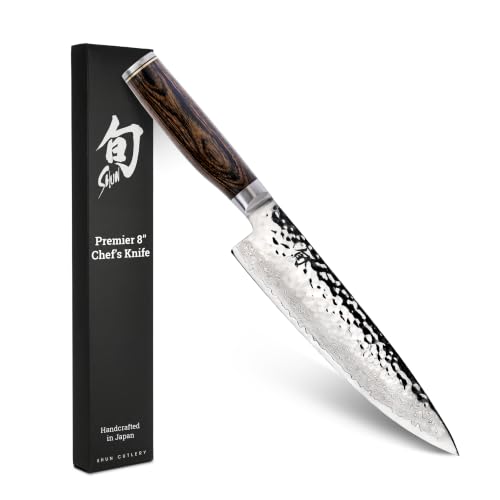
The Shun Premier 8-inch Chef's Knife is a Japanese kitchen knife with a brown contoured Pakkawood handle. It pairs a VG-MAX core with 68 layers of Damascus cladding ground to a 16-degree edge. A hammered tsuchime finish helps reduce surface drag when you slice. Weighing roughly 0.47 pounds with a 13.25-inch total length, it gives you a balanced, ambidextrous tool for daily slicing, dicing, and mincing.
Pros
- VG-MAX core wrapped in 68 layers of Damascus cladding
- Hand-sharpened 16-degree cutting edge
- Hammered tsuchime finish reduces food sticking
- Contoured Pakkawood handle fits left and right hands
- Comes with free manufacturer sharpening and honing support
Cons
- No storage sheath or blade guard included in the package
- Overall length of 13.25 inches requires substantial block or drawer space
Good fit if
- You want an 8-inch Japanese blade with a 16-degree edge and Damascus cladding.
- You prefer an ambidextrous contoured handle made from Pakkawood.
- You want a knife backed by complimentary sharpening and honing.
Skip if
- You need a shorter prep knife under 8 inches for tight cutting spaces.
- You require an included sheath for in-drawer storage.
Verdict: Shun Premier 8-Inch Damascus Chef Knife delivers precise 16-degree slicing performance with a VG-MAX core, hammered finish, and ambidextrous Pakkawood grip. It stands out in 2026 as a specialized Japanese cutting tool with dedicated factory sharpening support.

SYOKAMI 7-Inch Cleaver Knife with Herb Stripper
Best for: vegetable prep and stripping fresh herbs
- Color
- Brown
- Blade Length
- 7"
- Knife Type
- Cleaver Chef Knife
- Blade Material
- German steel
- Edge Angle
- 14-16 degrees per side
- Blade Hardness
- 56+ Rockwell
View on Amazon: SYOKAMI 7-Inch Cleaver Knife with Herb Stripper
The SYOKAMI 7-Inch Cleaver Knife combines cleaver, santoku, and nakiri profiles into a single prep tool. Built from full-tang high-carbon German steel rated at 56+ Rockwell hardness, it features a brown FSC-certified wenge wood handle and an integrated 3-hole herb stripper. Weighing nearly one pound, it suits you if you want a substantial multi-use blade for chopping produce and stripping herbs without changing tools.
Pros
- Integrated 3-hole herb stripper on the blade
- Full-tang German steel rated at 56+ Rockwell hardness
- Hand-polished cutting edge set at 14 to 16 degrees per side
- FSC-certified wenge wood handle with non-slip gear teeth
Cons
- Substantial 0.95-pound weight can cause fatigue during extended slicing
- Cleaver profile is less maneuverable for narrow or flexible boning tasks
Good fit if
- You want an integrated tool to strip herbs directly during vegetable prep.
- You prefer a hefty, cleaver-style blade weighing nearly one pound.
Skip if
- You want a lightweight, flexible knife for precise filleting or boning.
- You prefer a traditional narrow 8-inch chef knife blade.
Verdict: SYOKAMI 7-Inch Cleaver Knife with Herb Stripper offers a durable German steel build and unique built-in herb stripping holes. It serves as a dependable, hefty choice for cooks who want a multi-use Asian cleaver profile.

TUO 8-Inch Chef Knife with Pakkawood Handle
Best for: general prep with a pakkawood grip
- Color
- Brown
- Blade Length
- 8"
- Knife Type
- Chef Knife
- Blade Material
- German high-carbon stainless steel
- Edge Angle
- 14 degrees per side
- Blade Hardness
- HRC56+2
This 8-inch chef knife from TUO pairs a brown pakkawood handle with a German high-carbon stainless steel blade. It features an arc-shaped cutting profile sharpened to a 14-degree angle per side using the Honbazuke method. At 0.46 pounds with an HRC 56±2 hardness rating, it suits you if you need a balanced, general-purpose kitchen knife for chopping, slicing, and everyday prep work.
Pros
- German high-carbon stainless steel blade hardened to HRC 56±2
- Honbazuke edge sharpened to 14 degrees per side
- Ergonomic brown pakkawood handle with a polished bolster
- Weighs 0.46 pounds for balanced handling
Cons
- HRC 56±2 steel hardness offers lower edge retention than harder Japanese steels
- 8-inch blade profile is too large for intricate peeling or trimming tasks
Good fit if
- You want an 8-inch all-purpose blade with an ergonomic brown pakkawood handle.
- You prefer a factory edge sharpened to 14 degrees per side for slicing and dicing.
- You need German high-carbon stainless steel built for rust resistance.
Skip if
- You prefer blade steels hardened beyond HRC 60 for longer edge retention.
- You need a small, specialized knife for peeling or boning.
Verdict: TUO 8-Inch Chef Knife with Pakkawood Handle delivers German high-carbon stainless steel with a factory 14-degree Honbazuke edge. It is a solid choice if you want a balanced everyday chef knife with a brown wood composite grip.

SYOKAMI 10-Inch Serrated Frozen Meat Knife
Best for: slicing crusty bread and boneless frozen meat
- Color
- Brown
- Blade Length
- 10 in
- Knife Type
- Bread knife, frozen meat slicer
- Edge Type
- Serrated
- Handle Material
- Wenge, FSC-Certified Wood
This 10-inch serrated slicer features a brown FSC-certified Wenge wood handle paired with a 2mm full tang blade. Its cutting edge combines large gripping teeth with fine slicing serrations designed for crusty bread and boneless frozen meats. A built-in fork tip lets you move food directly to plates, while blade notches help gauge 1/4-inch and 1/2-inch slices. It suits you if you need a heavy-duty serrated knife for tough slicing tasks.
Pros
- Dual serration pattern with large gripping teeth and fine cutting teeth
- Integrated fork tip on blade end for transferring sliced food
- Solid 2mm full tang blade with FSC-certified brown Wenge wood handle
- Alignment notch guides 1/4-inch and 1/2-inch slice thickness
Cons
- Not intended for bone-in meat cuts
- No blade sheath or edge cover listed in specifications
Good fit if
- You need to slice boneless frozen proteins or crusty artisan loaves.
- You want built-in guide notches for uniform 1/4-inch or 1/2-inch slices.
- You prefer a full tang build with a brown FSC-certified wood handle.
Skip if
- You need to cut through bone-in meats.
- You prefer a plain straight-edge blade for general chopping.
Verdict: SYOKAMI 10-Inch Serrated Frozen Meat Knife provides dual-tooth serrations and a fork tip to tackle crusty bread and boneless frozen meats. Its 2mm full tang construction and brown Wenge handle deliver dependable slicing stability.

Shun Premier 7-Inch Hammered Santoku Knife
Best for: everyday prep with minimal blade drag
- Color
- Brown
- Blade Length
- 7"
- Knife Type
- Santoku Knife
- Blade Material
- VG-MAX steel
- Construction
- 68 layers of Damascus cladding
- Edge Angle
- 16-degree
This Shun Premier 7-inch Santoku knife features a brown Pakkawood handle paired with a VG-MAX steel core clad in 68 Damascus layers. You get a hammered tsuchime finish that reduces food drag, along with a factory 16-degree edge. At 0.47 pounds and 12.25 inches total length, it gives you a compact, balanced cutting profile for preparing vegetables, fruits, and meats.
Pros
- VG-MAX cutting core with 68 layers of Damascus cladding
- Hammered tsuchime finish to reduce food sticking
- Handcrafted 16-degree blade edge
- Contoured brown Pakkawood handle suited for left- or right-hand use
Cons
- Shorter 7-inch blade compared to full-sized 8-inch chef knives
- No blade sheath or storage block listed in specifications
Good fit if
- You want a Japanese santoku with a hammered finish to minimize drag.
- You need an ambidextrous brown Pakkawood handle for balanced control.
- You slice vegetables, fruits, and boneless proteins regularly.
Skip if
- You need a longer 8-inch or 10-inch blade for large kitchen prep.
- You require a specialized serrated bread or narrow boning knife.
Verdict: Shun Premier 7-Inch Santoku Knife delivers a 16-degree VG-MAX Damascus edge and an ambidextrous brown Pakkawood handle for general kitchen prep. It is an ideal pick if you want nimble handling and minimal surface drag while slicing.

CURTA 8-Inch Commercial Chef's Knife
Best for: NSF-certified commercial food preparation
- Color
- Brown
- Blade Length
- 8-inch
- Knife Type
- Chef's Knife
- Blade Material
- 50 Cr MoV15 high carbon stainless
- Construction
- Forged
- Edge Type
- Straight Edge
The CURTA 8-Inch Commercial Chef's Knife gives you an ice-tempered, forged 50 Cr MoV15 stainless steel blade paired with an anti-slip brown handle. Its commercial certifications include NSF listing and HACCP compliance for sanitary standards. If you need a standard straight-edge utility workhorse for chopping, dicing, and slicing in busy kitchens, this dishwasher-safe tool provides balanced cutting control with simple cleaning requirements.
Pros
- Forged 50 Cr MoV15 high-carbon stainless steel construction
- NSF listed and meets HACCP safety standards
- Ice-tempered blade with hand-honed straight edge
- Dishwasher-safe polypropylene and thermoplastic rubber handle
Cons
- Uses a synthetic handle rather than natural wood
- No blade sheath or protective edge guard included
Good fit if
- You want an NSF-listed, commercial-grade knife for sanitary prep work.
- You prefer the easy maintenance of a dishwasher-safe non-slip handle.
- You need a versatile 8-inch forged blade for everyday chopping and slicing.
Skip if
- You prefer traditional pakkawood or natural wood knife handles.
- You need a dedicated narrow or flexible blade specifically for boning tasks.
Verdict: CURTA 8-Inch Commercial Chef's Knife delivers certified sanitary standards and forged stainless steel performance for high-volume prep work.

Dexter 6-Inch Flexible Boning Knife
Best for: deboning poultry and filleting fish
- Color
- Brown
- Blade Length
- 6"
- Knife Type
- Boning
- Blade Material
- DEXSTEEL high-carbon steel
- Handle Material
- Rosewood
- Blade Flexibility
- Flexible
This Dexter 6-inch flexible boning knife pairs a DEXSTEEL high-carbon steel blade with a traditional brown rosewood handle. Weighing 0.15 pounds, it gives you a lightweight, narrow blade engineered to maneuver around joints, meat, fish, and poultry. If you need a dedicated flexible boning tool with wood scales secured by brass rivets, this model provides classic construction and direct control for trimming and filleting tasks.
Pros
- Flexible DEXSTEEL high-carbon steel blade
- Brown rosewood handle secured with brass rivets
- Lightweight build at 0.15 pounds
- Manufactured in the USA
Cons
- Blade choices limited to a single 6-inch size
- No sheath or blade guard included
Good fit if
- You need a flexible, narrow blade for trimming meat and filleting fish.
- You prefer a genuine rosewood handle fastened with brass rivets.
- You want a lightweight boning knife weighing 0.15 pounds.
Skip if
- You require a stiff or semi-stiff blade for heavy cleaving tasks.
- You want a blade length other than 6 inches.
Verdict: Dexter 6-Inch Flexible Boning Knife delivers a narrow high-carbon steel profile with a classic riveted rosewood handle. It provides the exact flex needed for detailed deboning and filleting.

Victorinox Rosewood 5-Inch Stiff Boning Knife
Best for: Deboning meat with a rigid straight blade
- Color
- Brown
- Blade Length
- 5-Inch
- Knife Type
- Boning Knife
- Blade Material
- High carbon stainless-steel
- Construction
- Stamped
- Edge Type
- Straight Edge
View on Amazon: Victorinox Rosewood 5-Inch Stiff Boning Knife
This 5-inch boning knife pairs a stiff, straight-edge blade with a brown riveted rosewood handle. Stamped from cold-rolled high-carbon stainless steel, the blade features ice tempering, conical grinding, and a bolsterless profile that lets you sharpen the entire edge. Weighing 0.24 pounds, it gives you firm mechanical control when separating meat, poultry, or fish from bone. It suits you if you prefer a rigid, compact Swiss-made blade over a flexible profile.
Pros
- Ice-tempered high-carbon stainless-steel blade
- Stiff straight edge provides rigid cutting control
- Bolsterless design allows sharpening of entire blade
- Riveted rosewood handle shaped for balance
Cons
- Hand washing recommended instead of dishwasher cleaning
- Stamped rather than forged blade construction
Good fit if
- You need a stiff, straight 5-inch blade for deboning meat, poultry, or fish.
- You prefer a natural brown rosewood handle with riveted construction.
- You want a bolsterless blade edge that is easy to sharpen completely.
Skip if
- You prefer a flexible or curved blade for working closely around bones.
- You want dishwasher-safe kitchen cutlery.
Verdict: Victorinox Rosewood 5-Inch Stiff Boning Knife delivers rigid cutting stability and full-edge sharpening on a classic wood handle. Its compact stamped profile gives you dependable control during butchering tasks.
Shun Premier 6-Inch Boning and Fillet Knife
Best for: Boning poultry, meat trimming, and fish filleting
- Color
- Brown
- Blade Length
- 6 in
- Knife Type
- Boning & Fillet Knife
- Blade Material
- VG-MAX steel
- Construction
- 68 layers of Damascus cladding
- Edge Angle
- 16-degree
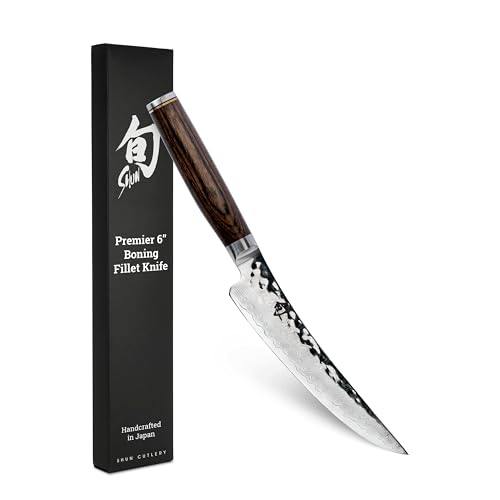
This Shun Premier boning and fillet knife pairs a 6-inch curved blade with a brown contoured Pakkawood handle. Its core features VG-MAX steel wrapped in 68 layers of Damascus cladding with a hammered tsuchime finish. Ground to a 16-degree edge and weighing 0.281 pounds, it provides a lightweight tool when you need precision cuts around bones, trim fibrous tissue, or process fish.
Pros
- VG-MAX steel core with 68-layer Damascus cladding
- Hammered tsuchime finish designed to reduce drag
- Lightweight build weighing 0.281 pounds
- Contoured Pakkawood handle shaped for both left and right hands
Cons
- Narrow curved blade unsuitable for standard vegetable prep
- 6-inch length restricts long slicing strokes on large proteins
Good fit if
- You need a curved, narrow blade to trim close to bone and cut fibrous tissue.
- You want a 16-degree Japanese edge with a brown Pakkawood grip.
Skip if
- You need a multi-purpose kitchen knife for dicing and slicing produce.
- You prefer a straight-edge boning profile over a curved blade.
Verdict: Shun Premier 6-Inch Boning and Fillet Knife combines a 16-degree VG-MAX blade with a brown Pakkawood handle for detailed butchery. Its curved, hammered profile excels at working around bone and sinew rather than all-purpose chopping.
Specifications side by side
| Spec | RAPSAKEMOH 15.7-Inch Wooden Bread Bow Knife | Pranski 14.5-Inch Acacia Wood Bread Knife | Mercer Culinary Millennia 6-Inch Narrow Boning Knife | Emojoy 8-Inch 67-Layer Damascus Chef Knife | XJHEYLZ 10.6" Sapele Wood Sourdough Bread Knife | Victorinox Wood 4.7-Inch Semi-Stiff Boning Knife | Shun Premier 8-Inch Damascus Chef's Knife | SYOKAMI 7-Inch Cleaver Knife with Herb Stripper | TUO 8-Inch Chef Knife with Pakkawood Handle | SYOKAMI 10-Inch Serrated Frozen Meat Knife | Shun Premier 7-Inch Hammered Santoku Knife | CURTA 8-Inch Commercial Chef's Knife | Dexter 6-Inch Flexible Boning Knife | Victorinox Rosewood 5-Inch Stiff Boning Knife | Shun Premier 6-Inch Boning and Fillet Knife |
|---|---|---|---|---|---|---|---|---|---|---|---|---|---|---|---|
| Blade Length | not specified | not specified | 6 in | 8 in | not specified | 5" | 8" | 7" | 8" | 10 in | 7" | 8-inch | 6" | 5-Inch | 6 in |
| Knife Type | Bread bow knife | Bread Knife | Narrow Boning Knife | Chef | Bread knife | Boning Knife | Chef's Knife | Cleaver Chef Knife | Chef Knife | Bread knife, frozen meat slicer | Santoku Knife | Chef's Knife | Boning | Boning Knife | Boning & Fillet Knife |
| Blade Material | not specified | not specified | High-carbon Japanese steel | Damascus steel | Stainless steel | not specified | VG-MAX steel | German steel | German high-carbon stainless steel | not specified | VG-MAX steel | 50 Cr MoV15 high carbon stainless | DEXSTEEL high-carbon steel | High carbon stainless-steel | VG-MAX steel |
| Construction | not specified | not specified | not specified | Hand-forged, 67-layer Damascus | not specified | not specified | 68 layers of Damascus cladding | not specified | not specified | not specified | 68 layers of Damascus cladding | Forged | not specified | Stamped | 68 layers of Damascus cladding |
| Edge Type | Serrated | Serrated | not specified | not specified | Serrated | not specified | not specified | not specified | not specified | Serrated | not specified | Straight Edge | not specified | Straight Edge | not specified |
| Edge Angle | not specified | not specified | not specified | 15° | not specified | not specified | 16-degree | 14-16 degrees per side | 14 degrees per side | not specified | 16-degree | not specified | not specified | not specified | 16-degree |
| Blade Hardness | not specified | not specified | not specified | 58 HRC | not specified | not specified | not specified | 56+ Rockwell | HRC56+2 | not specified | not specified | not specified | not specified | not specified | not specified |
| Handle Material | Wood | Acacia wood | not specified | Olive wood | Sapele wood | Wood | Pakkawood | Wenge wood | Pakkawood | Wenge, FSC-Certified Wood | Pakkawood | Polypropylene (PP) and TPR blend | Rosewood | Rosewood | Pakkawood |
| Features | not specified | not specified | not specified | not specified | not specified | not specified | not specified | not specified | not specified | not specified | not specified | Dishwasher Safe | not specified | not specified | not specified |
| Blade Flexibility | not specified | not specified | not specified | not specified | not specified | Semi-Stiff | not specified | not specified | not specified | not specified | not specified | not specified | Flexible | Stiff | not specified |
| Blade Profile | not specified | not specified | Narrow | not specified | not specified | Curved | not specified | not specified | not specified | not specified | not specified | not specified | not specified | not specified | not specified |
| Color | Brown | Brown | Brown | Brown | Brown | Brown | Brown | Brown | Brown | Brown | Brown | Brown | Brown | Brown | Brown |
| Recommended Use | not specified | not specified | Boning | not specified | not specified | Boning | not specified | not specified | not specified | Meat | not specified | not specified | Boning, Meat | Boning | Boning |
| Dimensions | 15.7 × 2.76 × 0.6 inches | not specified | 11 × 4 × 1 inches | not specified | not specified | 9.92 × 1.61 × 0.75 inches | 13.3 × 0.82 × 1.82 inches | not specified | 1 × 1 × 1 inches | not specified | 12.3 × 0.75 × 1.82 inches | not specified | 1 × 1 × 1 inches | 15 × 3.75 × 1 inches | 11.3 × 0.63 × 1.25 inches |
| Weight | 6.38 ounces | not specified | 5.33 ounces | not specified | 6.72 ounces | 3.04 ounces | 7.55 ounces | 15.2 ounces | 7.36 ounces | not specified | 7.48 ounces | not specified | 2.4 ounces | 3.84 ounces | 4.5 ounces |
| Size | 10.6" | 9.5" | 6" | 8-Inch Professional Chef Knife | 10.6" | 4.7" | 8" | 7" | 8" | 10" | 7" | 8" | 6" | 5" | 6" |
| Model | 15.7'' Bread Slicer | MBD-2025-BN | M22206BR | KC-KS61 | Bread Knife 16" | 5.6606.12 | TDM0706 | Asian Knife | TUO-TC0703 | 10 Inch Frozen meat knife | TDM0702 | not specified | 1376HBR | 47110 | TDM0774 |
Is choosing a brown knife worth it?
On these knives, brown corresponds to handle or frame materials rather than blade coatings. The color denotes natural timbers like acacia, sapele, olive wood, and rosewood, engineered Pakkawood composites, or brown synthetic grips. Selecting natural wood frames or grips means committing to hand-wash maintenance to protect the material. In contrast, commercial options provide dishwasher-safe construction or textured synthetic utility grips. Brown indicates whether the knife uses organic hardwood, resin-infused Pakkawood, or molded plastic.
Worth it if
- You prefer natural wood handles such as rosewood, acacia, sapele, or olive wood.
- You want the water-resistant grip stability of composite Pakkawood handles.
- You need a color-coded brown handle for commercial sanitary kitchen tasks.
Skip it if
- You want dishwasher-safe cutlery and avoid knives that require hand-wash wood maintenance.
- You prefer all-metal cutlery without organic timber or composite handles.
If you evaluate desk tools by published specifications, you can compare form factor and switch options for a 60 mechanical keyboard on another guide.
How We Picked Brown Knives
To select the 15 kitchen knives for this guide, we checked published Amazon listings specifying brown coloring in their title or feature lists. We evaluated blade materials, handle constructions, and dimensions directly from published manufacturer specifications. To keep your choices clear, the guide includes only one size or variant from each product family.
We do not physically handle these items. The guide arranges products in stock first, then by Amazon sales rank (better-selling products first). You can review published specifications such as blade flexibility, edge grind, and handle materials to select the brown knife suited to your prep work.
How to Choose the Right Brown Knife
-
Check Blade Flexibility
When you select a boning knife, look closely at blade flexibility specs. Knives are classified as flexible, semi-stiff, or stiff. Flexible blades bend easily to separate meat from skin and follow delicate rib bones or fish frames. Stiff blades do not flex, giving you leverage for thick joints and heavy cuts. Semi-stiff profiles balance the two. The Dexter 6-Inch Flexible Boning Knife lists flexible high-carbon steel, which fits close filleting work. If you debone dense meat around rigid bones, check for stiff ratings instead.
-
Review Factory Edge Angles
Inspect the blade angle specification to determine how the knife cuts and retains its edge. Many chef knives use acute angles between 14 and 16 degrees. Sharper 14-degree edges slice delicate vegetables and meats with minimal resistance, though they need careful handling on cutting boards. Wider angles give you a sturdier edge for heavy-duty kitchen prep. The TUO 8-Inch Chef Knife features a factory 14-degree Honbazuke edge designed for smooth slicing. Match the edge angle to whether you prefer extreme initial sharpness or broad chopping endurance.
-
Compare Steel Hardness Ratings
Look at the Rockwell hardness rating (HRC) and blade steel composition on the spec sheet. Steel rated around 58 HRC offers balanced durability that resists chipping when you chop through dense produce. High-carbon Damascus steels provide hard cutting cores wrapped in alternating layers for structural stability. The Emojoy 8-Inch Damascus Chef Knife lists 67-layer Damascus steel and a 58 HRC rating, suiting standard daily meal preparation. If you want maximum edge retention, seek harder alloys, but remember they chip more easily if twisted against bones or hard boards.
-
Check Overall Knife Weight
Check the total weight specification before buying to ensure comfortable handling for your kitchen tasks. Heavy knives near one pound rely on gravity and mass to chop through thick squash, root vegetables, or dense cuts. Lighter knives under half a pound reduce hand fatigue during long prep sessions and offer faster maneuvering. For instance, the SYOKAMI 7-Inch Cleaver Knife weighs 0.95 pounds, giving you substantial downward force for chopping and prep work. If you prefer agile, quick wrist movements, choose a knife closer to 0.3 or 0.4 pounds.
-
Verify Dishwasher Compatibility
Examine cleaning specifications to match your maintenance routine. Most knives with brown wood handles require strict hand-washing to prevent warping, cracking, and timber degradation over time. However, commercial-grade knives built for high-volume food service often feature construction safe for machine sanitation cycles. The CURTA 8-Inch Commercial Chef's Knife is explicitly listed as dishwasher safe, offering convenient cleanup for busy home or restaurant kitchens. If you want zero maintenance upkeep, verify dishwasher compatibility on the spec list; otherwise, prepare to wash and dry wooden handles by hand immediately after use.
-
Select Dedicated Edge Types
Check whether a knife has a straight cutting edge or specialized serrations. Straight edges excel at clean push cuts and chopping on vegetables and boneless proteins, but they slip on hard crusts or semi-frozen food. Serrated teeth grip tough exteriors without slipping, cutting through hard bread rinds and dense meats easily. The SYOKAMI 10-Inch Serrated Frozen Meat Knife features dual-tooth serrations and a fork tip to manage frozen items and crusty crusts. Review your standard prep ingredients so you do not choose a straight edge for tough cutting tasks.
Frequently asked questions
Can you put brown kitchen knives in the dishwasher?
Most brown kitchen knives require hand washing, especially models featuring natural wood frames or Pakkawood handles. Prolonged water exposure and heat warp wood fibers and degrade adhesive resins. An exception in this guide is the CURTA 8-Inch Commercial Chef's Knife, which lists dishwasher-safe forged stainless steel construction. For all wood-handled knives like rosewood, sapele, or acacia models, wash them manually and dry them immediately.
What cutting tasks require a bow-style bread knife?
Bow bread knives are specialized cutters designed specifically for slicing artisan loaves and crusty sourdough without crushing soft interiors. Models like the RAPSAKEMOH 15.7-Inch and XJHEYLZ 10.6-Inch use an ambidextrous frame holding a thin serrated blade under tension. This design keeps cuts straight and uniform. However, bow knives lack versatility for standard prep work, so you cannot use them to chop vegetables or butcher meat.
How do factory edge angles differ across brown chef knives?
Factory edge angles dictate how cleanly a blade slices versus how long the edge resists dulling. The TUO 8-Inch Chef Knife features an acute 14-degree Honbazuke edge, while the Emojoy 8-Inch Damascus knife is ground to 15 degrees. In comparison, Japanese cutlery like the Shun Premier 8-Inch Chef's Knife and 7-Inch Santoku utilize a 16-degree angle on their VG-MAX cores.
What makes a cleaver knife with built-in herb stripping holes useful?
A cleaver with integrated holes combines heavy chopping with quick herb preparation in a single tool. On the SYOKAMI 7-Inch Cleaver Knife, these graduated holes allow you to pull fresh stems like rosemary or thyme directly through the steel blade, stripping the leaves instantly. The wide German steel face then lets you chop the herbs and scoop them off your cutting board without switching tools.
Why choose a serrated frozen meat knife over a standard chef knife?
Standard smooth chef knives can chip or bind when cutting extremely dense, cold foods. A dedicated knife like the SYOKAMI 10-Inch Serrated Frozen Meat Knife features dual-tooth serrations and a sturdy 2mm full tang build. These teeth saw through hard crusts and boneless frozen meats without dulling or deflecting. It also includes a pointed fork tip designed for lifting cold portions directly after cutting.
What is the purpose of a hammered finish on Damascus knives?
A hammered pattern, known as tsuchime, creates shallow indentations across the face of the blade. On knives like the Shun Premier 8-Inch Damascus Chef's Knife and 7-Inch Santoku, these small pockets reduce friction while cutting. The dimples introduce tiny air pockets between the steel and the ingredient, which helps moist vegetables and meats release cleanly from the blade surface instead of sticking during repetitive kitchen prep.
What is the difference between stamped and forged brown knives?
Stamped knives are cut from a flat sheet of steel, making them lighter and often more flexible. The Victorinox Rosewood 5-Inch Boning Knife uses a stamped build that weighs 0.24 pounds. Forged knives, such as the CURTA 8-Inch Commercial Chef's Knife, are formed from a heated steel bar under pressure. Forging produces a thicker, rigid structure suited for rigorous, high-volume kitchen prep work.