15 Best Kitchen Knives for Boning, Compared
As an Amazon Associate we earn from qualifying purchases. Links on this page are affiliate links.
Finding the best kitchen knives for boning comes down to blade flexibility, steel type, and weight for separating meat cleanly from bone. We compared 15 models using the specifications published on their listings.
The Mercer Culinary Millennia 6-Inch Stiff Boning Knife takes the top spot because its lightweight 3.2-ounce build and stiff Japanese steel blade deliver rigid control for trimming dense meats. This guide helps you choose the right blade curvature, stiffness, and handle material for your kitchen tasks.
Quick picks
The best fit for you
- You need a stiff blade for rigid meat deboning Mercer Culinary Millennia 6-Inch Stiff Boning Knife Its stiff 6-inch Japanese steel blade provides dependable rigidity without flexing when separating meat from bone.
- You want extra reach for large fish and meats HOSHANHO 7-Inch Flexible Fillet Knife Its 7-inch Japanese 10Cr15CoMoV steel blade gives you extra length for filleting and large cuts.
- You need leverage around bones in dense meats Victorinox Fibrox Pro 6-Inch Curved Boning Knife Its curved semi-stiff blade profile gives you guided leverage when working along dense bones.
- You want a color-coded knife for raw meats Mercer Culinary Millennia 6-Inch Narrow Boning Knife Its bright red handle supports segregated prep stations alongside a narrow 6-inch blade profile.
Our 15 picks

Mercer Culinary Millennia 6-Inch Stiff Boning Knife
Best for: rigid deboning and trimming of meats
- Recommended Use
- Boning (what this guide is about)
- Blade Length
- 6 in
- Knife Type
- Boning Knife
- Blade Material
- High-carbon Japanese steel
- Construction
- One-piece
- Blade Flexibility
- Stiff
View on Amazon: Mercer Culinary Millennia 6-Inch Stiff Boning Knife
The Mercer Culinary Millennia 6-Inch Stiff Boning Knife gives you a dedicated tool for separating meat from bone and trimming fat. Built from one-piece high-carbon Japanese steel, it features a rigid 6-inch blade designed for working around chicken, ham, and fish. At 3.2 ounces with a textured non-slip handle, this knife suits you if you need firm blade control during routine butchering.
Pros
- One-piece high-carbon Japanese steel blade construction
- Stiff 6-inch blade profile designed for deboning chicken, ham, and fish
- Ergonomic handle with textured finger points for a non-slip grip
- Lightweight design at 3.2 ounces
Cons
- Hand wash only; not safe for dishwasher use
- Stiff blade does not flex around tighter contours
- No protective sheath or blade cover listed in specs
Good fit if
- You need a rigid 6-inch blade to separate meat from bone and trim sinew.
- You want a lightweight boning tool with a textured, slip-resistant handle.
- You prefer single-piece Japanese high-carbon steel construction for routine maintenance.
Skip if
- You need a flexible or semi-stiff blade for delicate fish skinning.
- You require dishwasher-safe kitchen knives.
Verdict: Mercer Culinary Millennia 6-Inch Stiff Boning Knife provides dependable blade rigidity and a secure grip for separating meat from bone. Its lightweight one-piece Japanese steel construction makes it a solid primary boning tool whenever flexible steel is not required.

Mercer Culinary 6-Inch Boning Knife with White Handle
Best for: trimming fat and deboning poultry or fish
- Recommended Use
- Boning (what this guide is about)
- Blade Length
- 6 in
- Knife Type
- Boning
- Blade Material
- High-carbon Japanese steel
- Color
- White
- Dimensions
- 17 × 1 × 3.5 inches
View on Amazon: Mercer Culinary 6-Inch Boning Knife with White Handle
The Mercer Culinary Ultimate White 6-Inch Boning Knife is built for trimming fat, sinew, and separating meat from bones. It features a six-inch high-carbon Japanese steel blade designed for edge retention and easy maintenance. The ergonomic handle includes textured finger points to provide a secure, non-slip grip during butchery tasks. This knife suits you if you need a dedicated deboning tool for chicken, ham, or fish.
Pros
- High-carbon Japanese steel blade
- Ergonomic handle with textured finger points for non-slip grip
- Designed to debone chicken, ham, and fish
- Six-inch blade length suited for trimming fat and sinew
Cons
- Hand-wash only; not dishwasher safe
- Cannot be submerged in water for long periods
- White handle is the only color option listed for this model
Good fit if
- You need a dedicated six-inch blade to separate meat from chicken, ham, or fish.
- You want an ergonomic handle with textured finger points for slip resistance.
- You prefer high-carbon Japanese steel for easier edge maintenance.
Skip if
- You want a knife that is safe for cleaning in the dishwasher.
- You prefer a dark handle color over white.
- You need a blade longer than six inches for large cuts.
Verdict: Mercer Culinary Ultimate White 6-Inch Boning Knife delivers precise control for butchering poultry, ham, and fish with its high-carbon Japanese steel blade. The textured grip ensures steady handling during routine trimming.

HOSHANHO 7-Inch Flexible Fillet Knife
Best for: boning large cuts and filleting whole fish
- Recommended Use
- Boning (what this guide is about)
- Blade Length
- 7 in
- Knife Type
- Fillet knife
- Blade Material
- Japanese 10Cr15CoMoV stainless steel
- Edge Angle
- 15° per side
- Handle Material
- Pakkawood
The HOSHANHO 7-Inch Japanese Steel Boning Knife is a flexible boning and fillet knife built with Japanese 10Cr15CoMoV stainless steel. Its slender seven-inch blade features a hand-polished edge sharpened to 15 degrees per side, paired with a corrosion-resistant pakkawood handle. At 10.6 ounces, it gives you extra blade reach compared to standard six-inch knives, making it a dependable choice if you frequently trim meat or fillet whole fish.
Pros
- Japanese 10Cr15CoMoV stainless steel blade
- Hand-polished edge set at 15° per side
- Durable, corrosion-resistant pakkawood handle
- Longer 7-inch flexible blade for sweeping cuts
Cons
- Heavier profile at 10.6 ounces than many boning knives
- 7-inch blade offers less agility around tight joints than shorter alternatives
Good fit if
- You process larger cuts of meat or whole fish that require a 7-inch reach.
- You prefer a pakkawood handle over synthetic grip materials.
- You want an acute 15° cutting edge made from 10Cr15CoMoV steel.
Skip if
- You need a compact 5- or 6-inch blade for detailed joint separation.
- You prefer an ultralight boning knife for repetitive daily butchery.
Verdict: HOSHANHO 7-Inch Japanese Steel Boning Knife delivers extended reach and high-grade 10Cr15CoMoV steel for cooks who need a sharp, flexible blade for both deboning and filleting.

Imarku 6-Inch High-Carbon Steel Boning Knife
Best for: deboning with a classic wooden handle
- Recommended Use
- Boning (what this guide is about)
- Blade Length
- 6 Inch
- Knife Type
- Boning / Fillet
- Blade Material
- High-carbon German stainless steel
- Blade Hardness
- 56 Rockwell
- Handle Material
- Pakkawood
View on Amazon: Imarku 6-Inch High-Carbon Steel Boning Knife
This 6-inch boning and fillet knife features high-carbon German stainless steel hardened to 56 Rockwell. Its narrow blade handles close-to-bone trimming and skinning, paired with an FSC-certified Pakkawood handle for grip control. At 10.9 ounces, it offers substantial heft compared to lighter options. It suits you if you want a classic wood-handled German steel blade for butchering poultry and trimming meat.
Pros
- High-carbon German stainless steel blade rated at 56 Rockwell hardness
- Ergonomic, FSC-certified polished Pakkawood handle
- Narrow 6-inch profile designed for deboning, skinning, and trimming
Cons
- Hand washing required; not recommended for dishwasher cleaning
- Heavier build at 10.9 ounces
Good fit if
- You prefer a finished Pakkawood handle over synthetic textured plastic.
- You want a 56 Rockwell German high-carbon stainless steel edge for boning and filleting.
- You want a knife with more physical heft during meat preparation.
Skip if
- You want a knife that is safe for machine dishwashing.
- You prefer an ultra-lightweight boning blade under 10 ounces.
Verdict: Imarku 6-Inch German Steel Boning Knife pairs a 56 Rockwell German steel blade with an ergonomic Pakkawood handle for dependable meat prep. It provides balanced deboning control if you prefer hand-wash wooden cutlery over synthetic tools.

Victorinox Fibrox Pro 6-Inch Curved Boning Knife
Best for: trimming beef, pork, and dense meats
- Recommended Use
- Boning (what this guide is about)
- Blade Length
- 6 in
- Knife Type
- Boning
- Blade Material
- Stainless steel
- Handle Material
- Fibrox Pro
- Blade Flexibility
- Semi-Stiff
View on Amazon: Victorinox Fibrox Pro 6-Inch Curved Boning Knife
The Victorinox Fibrox Pro 6-Inch Curved Boning Knife pairs a stainless steel blade with an ergonomic non-slip handle. Its curved profile and semi-stiff flex provide leverage when working around bone, particularly on thick cuts of beef or pork. Weighing 4.2 ounces, it stays light in hand during extended prep work. This knife suits you if you need a durable, NSF-certified tool for butchering larger cuts of meat.
Pros
- NSF-certified stainless steel construction
- Ergonomic Fibrox Pro handle designed for non-slip grip when wet
- Curved, semi-stiff blade suited for trimming close to bones
- Lightweight build at 4.2 ounces
Cons
- Semi-stiff blade lacks the bend needed for delicate fish skinning
- No blade sheath or edge guard included in the package
Good fit if
- You trim dense meats like beef or pork that require a sturdier blade
- You need an NSF-certified knife with a slip-resistant handle for wet prep
- You prefer a curved edge to maintain cutting angles around bone
Skip if
- You want a fully flexible blade for delicate filleting
- You prefer a straight boning knife profile
Verdict: Victorinox Fibrox Pro 6-Inch Curved Boning Knife delivers reliable leverage around bones with its semi-stiff blade and slip-resistant handle. It is a practical, NSF-certified choice for breaking down dense cuts of meat.
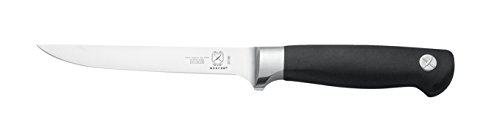
Mercer Culinary Genesis 6-Inch Forged Boning Knife
Best for: deboning meats with a forged non-slip grip
- Recommended Use
- Boning (what this guide is about)
- Blade Length
- 6 in
- Knife Type
- Boning
- Blade Material
- High-carbon German steel
- Construction
- Precision-forged
- Edge Type
- Taper-ground
View on Amazon: Mercer Culinary Genesis 6-Inch Forged Boning Knife
The Mercer Culinary Genesis 6-Inch Forged Boning Knife gives you a precision-forged high-carbon German steel blade with a taper-ground edge. Designed for deboning fish, ham, and poultry, it features a 6-inch blade paired with a non-slip ergonomic black handle. At 6.4 ounces, this knife suits you if you prepare cuts of meat frequently and prefer the durability of forged construction over stamped alternatives.
Pros
- Precision-forged high-carbon German steel blade
- Taper-ground edge for cutting efficiency
- Non-slip ergonomic handle designed for wet hands
- Weighs 6.4 ounces with a 6-inch blade
Cons
- Requires hand washing; not dishwasher safe
- Cannot be submerged in water for extended periods
Good fit if
- You want a boning knife made with precision-forged German steel.
- You need a non-slip grip when handling wet meat, fish, or poultry.
- You prefer a 6.4-ounce knife with a taper-ground edge.
Skip if
- You require a knife that is safe for dishwasher cleaning.
- You want a blade length other than 6 inches for boning tasks.
Verdict: Mercer Culinary Genesis 6-Inch Forged Boning Knife delivers durable German steel construction and a secure non-slip handle for trimming and deboning meats. It provides steady handling if you prioritize precision-forged blades that require dedicated hand washing.
MOSFiATA 6-Inch Boning Knife
Best for: Deboning poultry and meat with included accessories
- Recommended Use
- Boning (what this guide is about)
- Blade Length
- 6"
- Knife Type
- Boning knife
- Blade Material
- German stainless steel EN1.4116
- Edge Angle
- 14-16 degrees per side
- Blade Hardness
- 56 ± 2 HRC
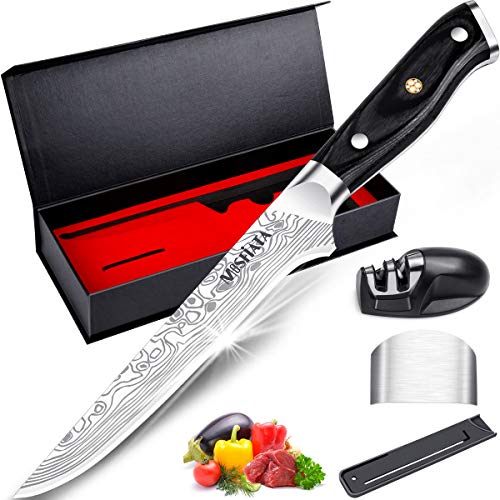
The MOSFiATA 6-Inch Boning Knife gives you a 2.5 mm thick blade made from German EN1.4116 stainless steel, tempered to 56 ± 2 HRC. Its double-beveled edge is ground to 14–16 degrees per side for trimming meat. The knife weighs 6.4 ounces and features a triple-riveted Micarta handle. It suits you if you want a complete boning package, as it includes a sheath, finger guard, and knife sharpener.
Pros
- German EN1.4116 stainless steel blade with 56 ± 2 HRC hardness
- Triple-riveted Micarta handle designed to reduce wrist tension
- Includes sheath, finger guard, and manual sharpener in the box
- Factory edge sharpened to 14–16 degrees per side
Cons
- Weighs 6.4 ounces, which is heavier than basic stamped alternatives
- 2.5 mm blade spine lacks flexibility for delicate fish skinning
Good fit if
- You want a sturdy 2.5 mm thick German steel blade for butchering poultry and meat.
- You prefer a dense, triple-riveted Micarta handle over plain molded plastic.
- You want bundled accessories including a protective blade sheath and matching sharpener.
Skip if
- You require a flexible, narrow blade specifically for delicate fish filleting.
- You want an ultra-lightweight boning knife under five ounces.
Verdict: MOSFiATA 6-Inch Boning Knife provides a robust 2.5 mm German steel blade and Micarta handle equipped with protective and sharpening accessories. It delivers solid stability for deboning poultry and dense cuts of meat.
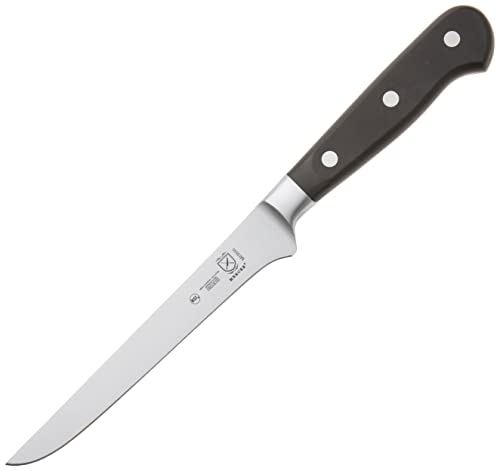
Mercer Culinary Renaissance 6-Inch Stiff Boning Knife
Best for: stiff-blade deboning and meat trimming
- Recommended Use
- Boning (what this guide is about)
- Blade Length
- 6 in
- Knife Type
- Boning
- Blade Material
- High-carbon German cutlery steel
- Construction
- Forged
- Blade Flexibility
- Stiff
View on Amazon: Mercer Culinary Renaissance 6-Inch Stiff Boning Knife
The Mercer Culinary Renaissance 6-Inch Stiff Boning Knife is a forged kitchen tool built for separating meat from bone. It pairs a rigid high-carbon German steel blade with a triple-riveted ergonomic handle and a rounded spine. At 4.97 ounces, it gives you a solid feel for deboning chicken, ham, and fish. It suits you if you want a rigid, precision-forged boning profile rather than a flexible blade.
Pros
- Forged high-carbon German cutlery steel blade
- Triple-riveted ergonomic handle
- Rounded spine designed for comfort
- Stiff 6-inch blade profile suited for cutting meat away from bone
Cons
- Not dishwasher safe and cannot be submerged for long periods
- Stiff blade does not flex around tight curves
Good fit if
- You prefer a rigid, stiff blade profile over a flexible one.
- You want a precision-forged German steel knife with a triple-riveted handle.
- You regularly debone chicken, ham, or trim sinew and fat.
Skip if
- You need a flexible blade that bends around rib cages and fish skin.
- You want a knife that is safe for dishwasher cleaning.
Verdict: Mercer Culinary Renaissance 6-Inch Stiff Boning Knife delivers a rigid forged German steel blade and a triple-riveted handle for dependable deboning. It provides firm cutting control if you prefer a non-flexing blade for trimming meat and poultry.

Mercer Culinary Millennia 6-Inch Narrow Boning Knife
Best for: raw meat prep and color-coded kitchen stations
- Recommended Use
- Boning (what this guide is about)
- Blade Length
- 6"
- Knife Type
- Narrow Boning Knife
- Blade Material
- High-carbon Japanese steel
- Construction
- One-piece
- Color
- Red
View on Amazon: Mercer Culinary Millennia 6-Inch Narrow Boning Knife
This Mercer Culinary Millennia tool is a 6-inch narrow boning knife built from one-piece high-carbon Japanese steel. At 4.2 ounces, it gives you a lightweight feel paired with a textured, non-slip red handle designed for processing raw meat. The slender profile lets you separate meat from chicken, ham, or fish and trim fat cleanly. It suits you if you want a dedicated, color-coded boning blade with minimal hand fatigue.
Pros
- One-piece high-carbon Japanese steel blade
- Textured non-slip handle with raised finger points
- Lightweight build at 4.2 ounces
- Narrow 6-inch profile for trimming fat and working around bone
Cons
- Not dishwasher safe; requires hand washing and immediate drying
- Red color-coded handle may not match standard kitchen cutlery
Good fit if
- You need a dedicated red-handled knife to identify tools used for raw meats.
- You prefer a lightweight 4.2-ounce knife with a narrow blade for boning fish, chicken, and ham.
Skip if
- You want a dishwasher-safe knife for low-maintenance cleanup.
- You prefer neutral black or traditional wooden knife handles.
Verdict: Mercer Culinary Millennia 6-Inch Narrow Boning Knife delivers precise control around bone and fat using high-carbon Japanese steel and a non-slip handle. It serves you well if you want dedicated raw-meat cutlery and do not mind washing by hand.
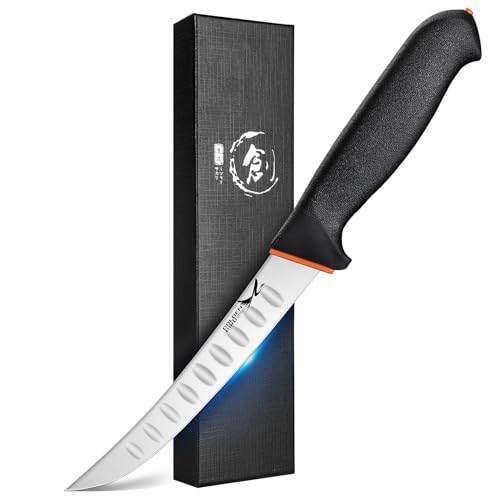
Golden Bird 6-Inch Flexible Boning Knife
Best for: flexible deboning and fish filleting
- Recommended Use
- Boning (what this guide is about)
- Blade Length
- 6 Inch
- Knife Type
- Boning Knife
- Blade Material
- stainless steel
- Edge Angle
- 14-16 degrees
- Blade Flexibility
- Flexible
The Golden Bird 6-Inch Flexible Boning Knife gives you a 6-inch stainless steel blade sharpened to a 14 to 16-degree angle per side. Its hollow blade design helps release food while slicing, paired with blade flexibility suited for working close to bones. Fitted with a textured polypropylene handle, this knife suits you if you need a slip-resistant tool for butchering, deboning, or filleting tasks.
Pros
- Hand-sharpened 14-16 degree cutting edge
- Hollow blade design prevents food sticking
- Flexible 6-inch stainless steel blade
- Textured non-slip polypropylene handle
Cons
- Specific stainless steel alloy type not disclosed
- Flexible profile unsuitable if you require a stiff blade
Good fit if
- You want a flexible 6-inch blade for maneuvering around meat and fish bones.
- You prefer a textured polypropylene handle that resists rot and mold over wood.
- You need hollow blade depressions to prevent meat from sticking during cuts.
Skip if
- You need a stiff boning knife for dense joints and heavy breaking.
- You require a documented high-carbon steel grade.
Verdict: Golden Bird 6-Inch Flexible Boning Knife combines a 14-to-16-degree edge with a hollow blade design and a molded polypropylene grip. It delivers the blade flex and release you need for detailed trimming around bone profiles.

Kitchen Perfection 6-Inch Boning Knife
Best for: all-around meat deboning and trim prep
- Recommended Use
- Boning, Meat (what this guide is about)
- Blade Length
- 6"
- Knife Type
- Boning Knife
- Blade Material
- High-carbon German steel
- Construction
- Forged
- Edge Angle
- 14-16° per side
This 6-inch boning knife from Kitchen Perfection pairs a forged high-carbon German steel blade with a triple-riveted pakkawood handle. With a 56+ Rockwell hardness and a factory edge sharpened to 14 to 16 degrees per side, it balances edge retention with durability. The tapered profile reduces drag when you trim meat, debone poultry, or fillet fish. It suits you if you want a forged build with a protective sheath for drawer storage.
Pros
- Forged high-carbon German steel rated at 56+ Rockwell hardness
- Hand-sharpened 14° to 16° edge angle per side
- Triple-riveted pakkawood handle
- Includes a custom blade sheath for safe storage
Cons
- Blade flexibility level is not specified
- Pakkawood handle is not listed as dishwasher safe
Good fit if
- You want a forged 6-inch boning knife with an included protective sheath.
- You prefer a triple-riveted pakkawood handle over synthetic plastic.
Skip if
- You need an explicitly flexible blade for delicate fish filleting.
- You prefer commercial-style nonslip rubber or plastic handles.
Verdict: Kitchen Perfection 6-Inch Forged Boning Knife provides balanced control and clean slicing with its 56+ Rockwell German steel and ergonomic pakkawood handle. It offers a sturdy build if you want an all-around boning blade complete with a protective sheath.

Victorinox Wood 4.7-Inch Semi-Stiff Boning Knife
Best for: cooks who prefer classic wooden handles
- Recommended Use
- Boning (what this guide is about)
- Blade Length
- 5"
- Knife Type
- Boning Knife
- Handle Material
- Wood
- Blade Flexibility
- Semi-Stiff
- Blade Profile
- Curved
View on Amazon: Victorinox Wood 4.7-Inch Semi-Stiff Boning Knife
The Victorinox Wood 5-Inch Curved Boning Knife pairs a compact five-inch curved blade with a traditional brown wooden handle. Its semi-stiff blade profile gives you the rigidity needed to work close to bone while maintaining enough give to trace contours cleanly. Weighing 3.04 ounces with an overall length of 9.92 inches, this lightweight boning knife suits you if you prefer natural wood grips over synthetic materials for meat preparation.
Pros
- Semi-stiff curved blade balances rigidity and flex
- Lightweight 3.04-ounce build supports agile maneuvering
- Natural wood handle provides a classic grip
- Compact 9.92-inch overall profile offers precise control
Cons
- Wood handle requires hand washing and careful maintenance
- Shorter 5-inch blade than standard 6-inch boning knives
Good fit if
- You want a curved, semi-stiff blade for precision trimming around bone.
- You prefer a natural brown wood handle over molded synthetic grips.
- You need a lightweight knife under 3.5 ounces for close detail work.
Skip if
- You prefer dishwasher-safe synthetic handles that require minimal upkeep.
- You need a longer 6-inch or 7-inch blade for larger primal cuts.
- You require a fully flexible blade for delicate fish skinning.
Verdict: Victorinox Wood 5-Inch Curved Boning Knife delivers precise control around bone contours with its semi-stiff curved blade and lightweight build. It is an ideal pick if you value traditional wooden handles over synthetic options.

Dexter Basics 6-Inch Narrow Flexible Boning Knife
Best for: trimming meat with a flexible narrow blade
- Recommended Use
- Boning (what this guide is about)
- Blade Length
- 6"
- Knife Type
- Boning Knife
- Blade Material
- 400 series stain-free high-carbon steel
- Edge Type
- Hollow ground
- Handle Material
- Polypropylene
View on Amazon: Dexter Basics 6-Inch Narrow Flexible Boning Knife
The Dexter Basics 6-Inch Flexible Boning Knife gives you a 6-inch narrow blade made from 400-series stain-free high-carbon steel. Its flexible profile maneuvers around curved bones, while the hollow-ground edge allows quick sharpening during butchery tasks. A textured white polypropylene handle provides a secure grip when processing wet proteins. If you prepare whole poultry, fish, or smaller cuts of meat, this lightweight tool offers precise control.
Pros
- 400 series stain-free high-carbon steel blade
- Hollow-ground edge designed for rapid re-sharpening
- Slip-resistant polypropylene handle
- Flexible narrow blade profile for close trimming
- Made in the USA
Cons
- Requires hand washing rather than machine washing
- No protective blade sheath included
Good fit if
- You need a flexible, narrow blade to work around bones and joints.
- You want a slip-resistant polypropylene grip for wet kitchen tasks.
- You prefer an edge profile that is quick to maintain with a sharpener.
Skip if
- You need a stiff blade for heavy butcher work.
- You prefer dishwasher-safe cutlery.
Verdict: Dexter Basics 6-Inch Flexible Boning Knife combines a maneuverable narrow profile with resilient 400-series steel. It delivers dependable flexibility and easy maintenance for everyday meat trimming.

Cutluxe 6-Inch Straight Boning Knife
Best for: trimming, filleting, and deboning meat or fish
- Recommended Use
- Boning, Meat (what this guide is about)
- Blade Length
- 6"
- Knife Type
- Boning Knife
- Blade Material
- High-carbon German steel
- Construction
- Forged
- Edge Angle
- 14-16 degrees per side
This 6-inch straight boning knife from Cutluxe features a forged German high-carbon steel blade rated at 56+ Rockwell hardness. The blade is ground to a 14-to-16-degree edge per side and attaches to a triple-riveted pakkawood handle via a full tang. Weighing 4.96 ounces with an overall length of 10.6 inches, it offers a flexible profile. You get a balanced tool tailored for trimming, skinning, and deboning meat or fish.
Pros
- Forged German high-carbon steel blade rated at 56+ Rockwell hardness
- Full-tang build with a triple-riveted pakkawood handle
- Hand-sharpened 14-to-16-degree cutting angle per side
- Flexible 6-inch blade designed for trimming, skinning, and filleting
Cons
- Flexible blade profile is not suited for splitting dense joints or thick bone
- No blade sheath or edge cover included in the specifications
Good fit if
- You want a forged high-carbon German steel blade with a full-tang construction
- You prefer a flexible 6-inch straight blade for trimming meat and filleting fish
- You like the feel of a triple-riveted pakkawood handle
Skip if
- You need a stiff boning knife for hacking through heavy joints or cartilage
- You require an NSF-certified synthetic handle for commercial kitchen standards
Verdict: Cutluxe 6-Inch Forged Boning Knife combines a flexible German steel blade with a durable full-tang pakkawood handle. It provides precise control and edge retention for regular meat trimming and filleting tasks.

Victorinox Swiss Classic 6-Inch Flexible Boning Knife
Best for: flexible deboning around poultry and fish
- Recommended Use
- Boning (what this guide is about)
- Blade Length
- 6 in
- Knife Type
- Boning
- Blade Flexibility
- Flexible
- Blade Profile
- Narrow
- Color
- Black
View on Amazon: Victorinox Swiss Classic 6-Inch Flexible Boning Knife
The Victorinox Swiss Classic 6-Inch Flexible Boning Knife features a 6-inch narrow, flexible blade paired with an S-shaped edge. Weighing 3.52 ounces, this knife remains lightweight for extended butchering sessions. Its NSF-approved handle gives you a secure grip and reduces wrist tension when separating meat, poultry, or fish from bone. It suits you if you need a flexible Swiss-made blade that follows contours closely rather than a rigid boning tool.
Pros
- Narrow, flexible 6-inch blade navigates curves closely
- Lightweight build at 3.52 ounces
- NSF-approved handle designed to reduce wrist strain
- Lifetime warranty against defects in material and workmanship
Cons
- Flexible blade profile is not suited for splitting thick joints
- No protective sheath or edge guard listed in the specs
Good fit if
- You need a flexible, narrow blade to trim around poultry and fish bones.
- You want a lightweight knife with an NSF-approved nonslip handle.
Skip if
- You prefer a stiff blade for heavy-duty butchering tasks.
- You require a knife that includes a blade cover for storage.
Verdict: Victorinox Swiss Classic 6-Inch Flexible Boning Knife offers a nimble 3.52-ounce build and a flexible narrow edge tailored for detailed deboning. It gives you precise control around poultry, meat, and fish curves.
Specifications side by side
| Spec | Mercer Culinary Millennia 6-Inch Stiff Boning Knife | Mercer Culinary 6-Inch Boning Knife with White Handle | HOSHANHO 7-Inch Flexible Fillet Knife | Imarku 6-Inch High-Carbon Steel Boning Knife | Victorinox Fibrox Pro 6-Inch Curved Boning Knife | Mercer Culinary Genesis 6-Inch Forged Boning Knife | MOSFiATA 6-Inch Boning Knife | Mercer Culinary Renaissance 6-Inch Stiff Boning Knife | Mercer Culinary Millennia 6-Inch Narrow Boning Knife | Golden Bird 6-Inch Flexible Boning Knife | Kitchen Perfection 6-Inch Boning Knife | Victorinox Wood 4.7-Inch Semi-Stiff Boning Knife | Dexter Basics 6-Inch Narrow Flexible Boning Knife | Cutluxe 6-Inch Straight Boning Knife | Victorinox Swiss Classic 6-Inch Flexible Boning Knife |
|---|---|---|---|---|---|---|---|---|---|---|---|---|---|---|---|
| Blade Length | 6 in | 6 in | 7 in | 6 Inch | 6 in | 6 in | 6" | 6 in | 6" | 6 Inch | 6" | 5" | 6" | 6" | 6 in |
| Knife Type | Boning Knife | Boning | Fillet knife | Boning / Fillet | Boning | Boning | Boning knife | Boning | Narrow Boning Knife | Boning Knife | Boning Knife | Boning Knife | Boning Knife | Boning Knife | Boning |
| Blade Material | High-carbon Japanese steel | High-carbon Japanese steel | Japanese 10Cr15CoMoV stainless steel | High-carbon German stainless steel | Stainless steel | High-carbon German steel | German stainless steel EN1.4116 | High-carbon German cutlery steel | High-carbon Japanese steel | stainless steel | High-carbon German steel | not specified | 400 series stain-free high-carbon steel | High-carbon German steel | not specified |
| Construction | One-piece | not specified | not specified | not specified | not specified | Precision-forged | not specified | Forged | One-piece | not specified | Forged | not specified | not specified | Forged | not specified |
| Edge Type | not specified | not specified | not specified | not specified | not specified | Taper-ground | not specified | not specified | not specified | not specified | not specified | not specified | Hollow ground | not specified | not specified |
| Edge Angle | not specified | not specified | 15° per side | not specified | not specified | not specified | 14-16 degrees per side | not specified | not specified | 14-16 degrees | 14-16° per side | not specified | not specified | 14-16 degrees per side | not specified |
| Blade Hardness | not specified | not specified | not specified | 56 Rockwell | not specified | not specified | 56 ± 2 HRC | not specified | not specified | not specified | 56+ Rockwell | not specified | not specified | 56+ Rockwell | not specified |
| Handle Material | not specified | not specified | Pakkawood | Pakkawood | Fibrox Pro | not specified | Micarta | not specified | not specified | not specified | Pakkawood | Wood | Polypropylene | Pakkawood | not specified |
| Blade Flexibility | Stiff | not specified | not specified | not specified | Semi-Stiff | not specified | not specified | Stiff | not specified | Flexible | not specified | Semi-Stiff | Flexible | not specified | Flexible |
| Blade Profile | not specified | not specified | not specified | not specified | Curved | not specified | not specified | not specified | Narrow | not specified | not specified | Curved | Narrow | not specified | Narrow |
| Color | Black | White | Silver | Silver with Brown | Black | Black | Silver Boning Knife | Stiff Boning Knife | Red | Gunmetal Silver | Silver | Brown | White | Silver | Black |
| Style | not specified | not specified | Japanese | German | not specified | not specified | German | not specified | not specified | not specified | not specified | not specified | not specified | not specified | not specified |
| Recommended Use | Boning | Boning | Boning | Boning | Boning | Boning | Boning | Boning | Boning | Boning | Boning, Meat | Boning | Boning | Boning, Meat | Boning |
| Dimensions | 5 × 1 × 15 inches | 17 × 1 × 3.5 inches | not specified | 12.7 × 3.2 × 1.3 inches | 11.2 × 1.77 × 0.87 inches | 2 × 1 × 11 inches | 13.2 × 5.12 × 2.09 inches | 14.8 × 0.56 × 4.13 inches | 14.8 × 1 × 4.13 inches | not specified | not specified | 9.92 × 1.61 × 0.75 inches | 4.1 × 7.4 × 39.1 inches | 10.6 × 1.17 × 0.85 inches | 11.5 × 1.42 × 0.75 inches |
| Weight | 3.2 ounces | 0.64 ounces | 10.6 ounces | 10.9 ounces | 4.2 ounces | 6.4 ounces | 6.4 ounces | 4.97 ounces | 4.2 ounces | not specified | not specified | 3.04 ounces | 4 ounces | 4.96 ounces | 3.52 ounces |
| Size | 6" | 6" | 7" | 6 inch Boning Knife | 5.5" | 6" | 6" | 6" | 6" | 6" | 6" | 4.7" | 6" | Straight Boning Knife | 6" |
| Model | M22306 | M18100 | 7 inch Fillet Knife | Imarku | 5.6603.15BK | M20106 | 6IN 骨とり包丁 | M23550 | M22206RD | GB-BoniK-B | not specified | 5.6606.12 | 31614 | ART-BON-06-1 | 6.8413.15B |
Is a dedicated boning knife worth it?
A dedicated boning knife changes how you break down whole proteins. Standard kitchen knives have wide profiles that cannot easily maneuver in tight spaces around joints. In contrast, boning knives feature narrow profiles, lengths from 4.7 to 7 inches, and curved or straight edges designed to follow bone contours. Selecting a knife built specifically for boning gives you the precision required for trimming fat, fabricating poultry, and separating meat from bone without gouging the flesh.
Worth it if
- You regularly break down whole poultry, primal cuts of meat, or whole fish.
- You need a narrow or curved blade to work close to bones and joints.
Skip it if
- You cook exclusively with boneless, pre-cut portions of meat.
- You prefer using an all-purpose chef knife for everyday trimming tasks.
How Boning Knives Were Picked
This guide identifies boning knives by checking manufacturer titles and published specifications for a boning recommendation. You see dedicated butchery tools designed for separating meat from bone and trimming fat. Only one size or variant from each product family appears on the list. All details come directly from published manufacturer specifications, without physical testing or handling.
The 15 selections are ordered with products in stock first, then by Amazon sales rank (better-selling products first). Additional published specifications help differentiate individual knives, including blade flexibility, blade profile, blade length, and steel type. Stiff blades provide rigidity for dense meat cuts, while flexible narrow profiles maneuver closely around joints. Live prices and stock status update on the page at least daily.
How to Choose a Boning Knife
-
Choose the Right Blade Profile
Examine the blade profile to match your typical cutting motions. Straight blades offer direct contact along flat surfaces, while curved designs give you leverage when sweeping along curved bones. Narrow profiles reduce blade drag when you work deep inside raw cuts. The Dexter Basics 6-Inch Narrow Flexible Boning Knife uses a narrow profile designed to maneuver through tight spaces without catching on surrounding meat. Compare listed profile specifications to choose a straight blade for clean downward trimming or a curved narrow profile for contoured separation.
-
Select a Practical Handle Material
Handle materials affect grip stability, sanitary cleaning, and general maintenance. Molded polypropylene and synthetic handles withstand commercial sanitation and resist moisture absorption during heavy butchery work. Dense wood options like pakkawood provide traditional balance and firm ergonomics but require dedicated hand washing to prevent material degradation. The Imarku 6-Inch High-Carbon Steel Boning Knife features an ergonomic Pakkawood handle for cooks who favor classic wooden cutlery over synthetic builds. Check the handle material spec to ensure it aligns with your cleaning routine and comfort preferences.
-
Review Steel Hardness Ratings
Steel hardness indicates how well a knife maintains its cutting edge under frequent butchering. Manufacturers measure this with the Rockwell hardness scale, noted as HRC. Softer steels around 56 HRC offer higher impact toughness and sharpen quickly with standard honing rods. Harder steels maintain a razor-sharp edge longer during repetitive trimming tasks. The Atumuryou 6-Inch VG10 Damascus Boning Knife features a 62 HRC Japanese core steel that holds its edge through extended meat preparation. Check the steel spec to balance edge retention against sharpening effort.
-
Compare Total Knife Weight
Review the listed product weight before deciding on a boning knife. Heavier knives weighing over six ounces provide downward momentum when separating dense meat sections. Lightweight knives reduce hand and wrist fatigue during extended butchering sessions that require prolonged dexterity. The Mercer Culinary Millennia 6-Inch Stiff Boning Knife weighs 3.2 ounces, offering an agile feel for quick trimming tasks. Check the ounces listed on the specification sheet. Pick a lighter knife if you trim meat continuously, or select a heavier model if you prefer physical heft.
-
Check Factory Edge Angles
Factory edge angles dictate cutting sharpness and overall edge durability. More acute angles, such as 12 to 14 degrees, slice through delicate connective tissues cleanly with minimal resistance. Wider angles of 15 degrees or more provide a stronger apex that withstands occasional contact with hard bone. The Golden Bird 6-Inch Flexible Boning Knife features a 14-to-16-degree edge designed for detailed trimming along bone profiles. Compare published edge angles to determine whether you need extreme razor sharpness or a slightly sturdier bevel for varied butchering.
-
Consider Color Coded Handles
Handle color provides a practical safety feature when you manage multiple food preparation tasks. Commercial kitchens use specific handle colors to designate cutlery for dedicated proteins, preventing cross-contamination between raw meats, poultry, and ready-to-eat foods. The Mercer Culinary Millennia 6-Inch Narrow Boning Knife comes with a red handle to identify it specifically for raw meat prep. Check color specifications if you organize your kitchen around dedicated prep stations, or select neutral black and silver knives if color separation is unnecessary in your kitchen.
Frequently asked questions
What blade length is standard for a boning knife?
Most boning knives feature a 6-inch blade, which balances cutting reach with close-quarters control. On this list of 15 models, lengths typically measure 6 inches, though options range from compact 4.7-inch blades like the Victorinox Wood up to 7-inch blades like the HOSHANHO. A 6-inch length provides enough clearance to trace ribs and slice around joint capsules comfortably without blade tip wobble.
What is the difference between German and Japanese steel boning knives?
German and Japanese steel boning knives differ primarily in steel composition and hardness ratings. Japanese steel knives, such as the Atumuryou VG10 Damascus model, use core steel hardened to 62 HRC for acute edge angles. German steel options, including the Imarku and Kitchen Perfection knives, feature a 56 or 56+ Rockwell hardness rating. German steel offers high impact resilience against hard bone contact, while Japanese steel holds sharper edges longer.
How much do kitchen boning knives typically weigh?
Kitchen boning knife weights vary significantly based on blade thickness and handle materials. Across the 15 knives compared here, weights range from ultra-light options at under one ounce—like the Mercer Culinary White Handle at 0.64 ounces—to heavier designs like the Imarku at 10.9 ounces and HOSHANHO at 10.6 ounces. Lighter knives reduce hand fatigue during repetitive prep, while heavier models offer solid momentum when working through thick connective tissue.
Can you use a boning knife to fillet fish?
You can use certain boning knives for fish filleting if the blade has adequate flexibility. Knives explicitly designated with flexible blades, such as the Golden Bird 6-inch or the Dexter Basics narrow flexible knife, bend along delicate skin and rib cages. Stiff boning knives struggle around fish backbones because they cannot contour flat against the carcass. If you process both fish and meat, select a flexible or hybrid model.
What handle materials are used on boning knives?
Boning knives use synthetic polymers, natural woods, or composite materials for their handles. Synthetic handles like the polypropylene grip on the Golden Bird or the textured Fibrox on Victorinox resist moisture and sanitize easily. Natural Pakkawood handles, found on models from Imarku and Kitchen Perfection, offer a classic aesthetic and dense feel in your hand. Composite Micarta handles, featured on the MOSFiATA knife, provide durable moisture resistance and balanced grip stability.
How should you clean and maintain a boning knife?
You should wash boning knives by hand with warm water and mild soap immediately after cutting meat. Raw meats expose metal and handle seams to moisture and fats that degrade blade edges and wooden scales if left dirty. Hand washing preserves wood handles like those on the Victorinox Wood and Pakkawood models. Air-drying or towel-drying right away prevents surface staining on high-carbon German and Japanese steels before storage.
What edge angle is standard for boning knives?
Boning knives generally carry edge angles ground between 12 and 16 degrees per side. Specialized Japanese steel profiles, such as the Atumuryou VG10 Damascus boning knife, feature an acute 12-degree cutting edge for fine slicing along cartilage. Models like the Golden Bird flexible boning knife utilize a 14-to-16-degree bevel. Acute angles cut meat cleanly with minimal tearing, but require consistent hone maintenance to protect the thin cutting bevel against hard bones.