Best Kitchen Knives with Pakkawood Handle in 2026: 15 Picks Ranked by Specs
As an Amazon Associate we earn from qualifying purchases. Links on this page are affiliate links.
Finding the best kitchen knives with pakkawood handle requires looking closely at blade geometry, steel type, and overall balance. We compared 15 models strictly using the specifications published on their listings.
The Imarku 8-Inch Gyutou Chef Knife takes the top spot because its 15-degree cutting edge and 6.56-ounce weight deliver dependable cutting performance for everyday kitchen tasks. This guide helps you evaluate blade lengths, steel types, and construction styles to decide which pakkawood knife best fits your everyday food preparation needs.
Quick picks
The best fit for you
- You need a versatile chef knife for everyday kitchen prep Imarku 8-Inch Gyutou Chef Knife Its 8-inch high-carbon stainless steel blade and 15-degree edge handle routine slicing and chopping tasks.
- You need a dedicated tool for peeling and trimming produce Aihomo 3.5-Inch Curved Bird Beak Paring Knife Its 3.5-inch curved blade and 2.72-ounce weight provide precise control for close hand-held peeling.
- You need a heavy tool for cutting through tough meats Mueller 7-Inch High-Carbon Full Tang Cleaver The 1-pound weight and full-tang high-carbon steel construction provide substantial downward force for butchering.
Our 15 picks

Imarku 8-Inch Gyutou Chef Knife
Best for: everyday kitchen prep requiring a pakkawood grip
- Handle Material
- Pakkawood Handle (what this guide is about)
- Blade Length
- 8 in
- Knife Type
- Gyutou Chef
- Blade Material
- High-carbon stainless steel
- Edge Angle
- 15°
- Style
- Japanese
This 8-inch Japanese-style gyutou knife features an ergonomic blue pakkawood handle built on an FSC-certified wood frame. Its blade uses high-carbon stainless steel with 0.6% to 0.75% carbon and 16% to 18% chromium, sharpened to a 15-degree edge angle. Weighing 6.56 ounces with a 13-inch overall length, it gives you a balanced general-purpose kitchen knife suitable for slicing, dicing, and chopping tasks across daily meal preparation.
Pros
- Sharp 15-degree edge angle for precision cutting
- High-carbon stainless steel with 0.6%–0.75% carbon and 16%–18% chromium
- Ergonomic blue pakkawood handle with FSC-certified wood
- Lightweight build at 6.56 ounces
Cons
- Not dishwasher safe; cannot be soaked in water
- No blade sheath or protective edge guard listed
Good fit if
- You want an 8-inch gyutou chef knife with a 15-degree factory edge.
- You prefer a pakkawood handle constructed with FSC-certified wood.
- You want a lightweight chef knife weighing under 7 ounces.
Skip if
- You require dishwasher-safe kitchen knives.
- You need a knife that includes a sheath or blade cover.
Verdict: imarku 8-Inch Gyutou Chef Knife with Pakkawood Handle delivers a sharp 15-degree edge paired with an FSC-certified pakkawood grip. Its high-carbon stainless steel composition balances cutting performance and corrosion resistance.

imarku 5-Inch Pakkawood Santoku Knife
Best for: controlled prep work and small cutting tasks
- Handle Material
- Pakkawood Handle (what this guide is about)
- Blade Length
- 5 in
- Knife Type
- Santoku
- Edge Angle
- 15–18°
- Weight
- 3.2 ounces
This is a compact kitchen knife featuring a 5-inch blade paired with an FSC-certified pakkawood handle. It carries a 15 to 18 degree hand-polished edge and a 2.3 mm blade thickness designed for detailed food prep. At just 3.2 ounces, you get a lightweight tool suited for cutting, slicing, and dicing smaller fruits, vegetables, and boneless meats without tiring your wrist during daily kitchen tasks.
Pros
- FSC-certified pakkawood handle shaped for ergonomic grip
- Hand-polished cutting edge set to 15–18 degrees
- Lightweight 3.2-ounce build for agile control
- Anti-stick blade surface designed to release sliced food
Cons
- 5-inch blade length is too short for large melons or cabbages
- Lightweight 3.2-ounce profile lacks heft for heavy butchery
- No blade sheath or storage cover included in the specifications
Good fit if
- You prefer a short 5-inch blade for detailed cutting and nimble maneuvering.
- You want an FSC-certified pakkawood handle on a compact santoku.
- You prioritize a lightweight 3.2-ounce knife to reduce wrist fatigue.
Skip if
- You need a long 8-inch or 10-inch blade to split large produce.
- You want a heavy knife that uses mass to drive through dense ingredients.
Verdict: Imarku 5-Inch Pakkawood Santoku Knife delivers precise control and lightweight handling with its 5-inch blade and 15–18° edge. It provides a compact alternative to full-sized chef knives for everyday slicing, dicing, and trimming.

Brewin Chefilosophi 5-Piece Red Knife Set
Best for: equipping a kitchen with matched pakkawood cutlery
- Handle Material
- Pakkawood Handle (what this guide is about)
- Blade Length
- 8 in
- Knife Type
- Chef
- Blade Material
- 1.4116 German stainless steel
- Construction
- Forged
- Blade Hardness
- 56+ HRC
The Brewin Chefilosophi is a five-piece kitchen knife set fitted with red pakkawood handles. Each blade uses forged 1.4116 German stainless steel rated at 56+ HRC hardness. The handles feature three anchor points for balance and stability. You get two eight-inch knives, a Japanese santoku, a five-inch utility knife, and a paring knife. This set suits you if you want a complete pakkawood collection covering multiple prep tasks.
Pros
- Forged 1.4116 German stainless steel blades rated at 56+ HRC
- Red pakkawood handles secured with three anchor points
- Includes five knives: two 8-inch blades, santoku, utility, and paring
Cons
- No storage block or blade sheaths listed in the specifications
- 56+ HRC steel is softer than higher-carbon Japanese specialty steels
- Only available as a multi-piece set rather than individual knives
Good fit if
- You want a full five-piece knife collection with matching red pakkawood handles.
- You need forged German 1.4116 stainless steel blades for everyday kitchen prep.
Skip if
- You only need a single chef knife or santoku knife rather than a multi-blade set.
- You prefer ultra-hard steel exceeding 60 HRC for edge retention.
Verdict: Brewin Chefilosophi 5-Piece Pakkawood Knife Set delivers a versatile forged German steel lineup with reinforced pakkawood handles. It gives you multiple blade profiles without purchasing individual knives separately.

PAUDIN 6-Inch High-Carbon Boning Knife
Best for: trimming meats and filleting fish
- Handle Material
- Pakkawood Handle (what this guide is about)
- Blade Length
- 6 in
- Knife Type
- Boning knife
- Blade Material
- 5Cr15MoV German stainless steel
- Edge Angle
- 15° per side
- Blade Hardness
- 56+ HRC
This 6-inch boning knife pairs a German 5Cr15MoV stainless steel blade with an ergonomic pakkawood handle. It features a factory edge ground to 15 degrees per side and a rated hardness of 56+ HRC. The narrow, flexible blade weighs 5.08 ounces, giving you precise control when trimming fat, skinning fish, and separating meat from bone. It suits cooks who need a dedicated butchering tool alongside standard kitchen cutlery.
Pros
- Narrow 6-inch flexible blade designed for filleting and trimming
- Factory edge honed to 15 degrees per side
- German 5Cr15MoV stainless steel with rust-resistant properties
- Lightweight design at 5.08 ounces
Cons
- Steel hardness of 56+ HRC requires more frequent honing than harder steels
- Surface pattern is decorative and not genuine layered Damascus steel
- Narrow profile cannot substitute for an all-purpose kitchen knife
Good fit if
- You need a dedicated narrow blade for trimming meat and filleting fish.
- You prefer a lighter 5.08-ounce knife for precision butchering work.
- You want a moisture-resistant pakkawood handle on a deboning knife.
Skip if
- You need an all-purpose knife for chopping and slicing vegetables.
- You prefer high-hardness blades rated at 60 HRC or above.
Verdict: PAUDIN 6-Inch Pakkawood Boning Knife provides a specialized flexible blade and 15-degree edge designed specifically for trimming, deboning, and filleting.

TUO 8-Inch Chef Knife with Pakkawood Handle
Best for: everyday prep requiring German steel durability
- Handle Material
- Pakkawood Handle (what this guide is about)
- Blade Length
- 8"
- Knife Type
- Chef Knife
- Blade Material
- German high-carbon stainless steel
- Edge Angle
- 14 degrees per side
- Blade Hardness
- HRC56+2
This TUO 8-inch chef knife pairs a brown Pakkawood handle with German high-carbon stainless steel. The blade features a 14-degree Honbazuke edge per side and registers at HRC56+2 hardness for rust resistance and edge maintenance. Weighing 7.36 ounces, it suits you if you want a standard full-size kitchen workhorse for slicing, dicing, and mincing with an ergonomic wooden grip and balanced bolster control.
Pros
- German high-carbon stainless steel heat-treated to HRC56+2
- Honbazuke edge sharpened to 14 degrees per side
- Ergonomic brown Pakkawood handle with polished bolster
- Includes storage case
Cons
- HRC56+2 hardness is softer than high-hardness Japanese steels
- 7.36-ounce weight is heavier than minimalist utility profiles
Good fit if
- You want an 8-inch German steel blade ground to a 14-degree edge.
- You prefer a contoured brown Pakkawood handle with a supportive bolster.
- You need a general-purpose chef knife for meat, vegetables, and herbs.
Skip if
- You want ultra-hard steel rated at HRC 60 or above.
- You prefer a lightweight knife under 6 ounces.
Verdict: TUO 8-Inch Pakkawood Chef Knife delivers a sharp 14-degree German steel blade paired with a durable brown wood handle. It gives you dependable balance and rust resistance for routine kitchen prep.

Ignited Cutlery 8-Inch AUS-10 Chef Knife
Best for: all-purpose prep with an AUS-10 blade
- Handle Material
- Pakkawood Handle (what this guide is about)
- Blade Length
- 8 in
- Knife Type
- Chef
- Blade Material
- Japanese AUS-10 carbon steel
- Construction
- Damascus
- Dimensions
- 13.4 × 2 × 1 inches
This 8-inch chef knife from Ignited Cutlery pairs a Japanese AUS-10 high-carbon stainless steel blade with an ergonomic black pakkawood handle. Built with Damascus construction, the tool measures 13.4 inches in total length and weighs 7.36 ounces. Its blade spans 2 inches in width for food prep. If you need a versatile cutting tool with a pakkawood handle for chopping meats, vegetables, and fruit, this knife suits your kitchen.
Pros
- Japanese AUS-10 high-carbon stainless steel blade construction
- Ergonomic black pakkawood handle with a non-slip design
- Two-inch blade width provides working clearance over cutting boards
- Moderate 7.36-ounce total weight balances stability and control
Cons
- No blade sheath or edge cover included in the specifications
- Overall length of 13.4 inches requires adequate storage space
Good fit if
- You want an 8-inch chef knife made with Japanese AUS-10 high-carbon steel.
- You prefer a non-slip grip paired with a black pakkawood handle.
- You need a general-purpose 7.36-ounce knife for slicing meats, vegetables, and fruit.
Skip if
- You prefer a compact utility knife or a specialized nakiri blade shape.
- You need a complete multi-knife block set rather than an individual chef knife.
Verdict: Ignited Cutlery 8-Inch Damascus Chef Knife delivers a Japanese AUS-10 carbon steel blade and a black pakkawood handle for everyday kitchen cutting tasks. Its 7.36-ounce weight and balanced dimensions make it a practical primary workhorse.

Mueller 7-Inch High-Carbon Full Tang Cleaver
Best for: heavy meat cleaving and full-tang durability
- Handle Material
- Pakkawood Handle (what this guide is about)
- Blade Length
- 6.7 in
- Knife Type
- Meat cleaver
- Blade Material
- High-carbon steel
- Construction
- Hand-forged, full-tang
- Storage Type
- Sheath
View on Amazon: Mueller 7-Inch High-Carbon Full Tang Cleaver
The Mueller 6.7-Inch Full-Tang Cleaver Knife provides a heavy-duty meat cleaver design built for chopping and slicing. It pairs a forged high-carbon steel blade with an ergonomic pakkawood handle secured by brass rivets. Weighing one pound with a continuous full-tang build, it delivers structural stability through the entire 12-inch frame. It suits you if you need a durable, balanced cleaver for heavy kitchen prep or outdoor cooking.
Pros
- Hand-forged one-piece full-tang construction
- High-carbon steel blade with black oxide rust-resistant coating
- Moisture- and heat-resistant pakkawood handle with brass rivets
- Includes a protective leather storage sheath
Cons
- Requires hand washing and immediate drying after each use
- Weighs 1 pound, which is heavier than typical chef knives
Good fit if
- You want a heavy full-tang cleaver for cutting meat and bone prep.
- You prefer a moisture-resistant pakkawood handle secured with brass rivets.
- You need a protective leather sheath for storage or outdoor travel.
Skip if
- You want a dishwasher-safe knife.
- You prefer a lightweight slicing knife under one pound.
Verdict: Mueller 6.7-Inch Full-Tang Cleaver Knife delivers solid one-piece high-carbon construction paired with a durable pakkawood grip. Its heavy one-pound weight and protective sheath make it practical for demanding butchering tasks.

Miyabi Koh 7-Inch Santoku Knife
Best for: precision slicing with an acute Japanese edge
- Handle Material
- Pakkawood Handle (what this guide is about)
- Blade Length
- 7-inch
- Knife Type
- Santoku
- Blade Material
- FC61 fine carbide stainless steel
- Edge Type
- Fine Edge
- Edge Angle
- 9.5-12 degree
The Miyabi Koh is a 7-inch Japanese santoku knife featuring an octagon-shaped pakkawood handle and FC61 fine carbide stainless steel. Its ice-hardened blade carries a 61 Rockwell hardness rating and a sharp 9.5 to 12 degree edge angle. If you need a lightweight 6.08-ounce prep knife with a thin profile and rounded spine for detailed slicing, this tool fits your everyday kitchen cutting tasks precisely.
Pros
- FC61 fine carbide stainless steel with 61 Rockwell hardness
- Acute 9.5 to 12 degree hand-honed Honbazuke edge angle
- Octagon-shaped Pakkawood handle with decorative mosaic pin
- Lightweight 6.08-ounce build with rounded spine and heel
Cons
- Requires specialized sharpening gear for acute 9.5 to 12 degree edge
- No sheath or blade guard listed in specifications
Good fit if
- You want an acute 9.5 to 12 degree cutting edge on a 7-inch santoku blade.
- You prefer an octagon-shaped Pakkawood handle paired with a light 6.08-ounce build.
- You need a 61 Rockwell hardness stainless steel blade with a rounded spine.
Skip if
- You prefer a curved Western chef knife profile over a Japanese santoku design.
- You want a heavy knife over 7 ounces for dense chopping tasks.
Verdict: Miyabi Koh 7-Inch Pakkawood Santoku Knife delivers precise cutting geometry with its 61 Rockwell FC61 steel and acute edge angle. It provides an ergonomic octagonal Pakkawood grip balanced for detailed daily prep.

TUO 10-Inch German Steel Chef Knife
Best for: slicing large foods with German stainless steel
- Handle Material
- Pakkawood Handle (what this guide is about)
- Blade Length
- 10 in
- Knife Type
- Chef
- Blade Material
- German high-carbon stainless steel
- Edge Angle
- 10–14°
- Blade Hardness
- 56+ HRC
This TUO chef knife pairs a 10-inch German high-carbon stainless steel blade with a polished Pakkawood handle. Hand-sharpened to a 10–14 degree edge per side with a 56+ Rockwell hardness rating, it delivers long cutting strokes across large ingredients. If you prepare large cuts of meat or bulky produce and need an ergonomic, riveted handle with a bolster finger notch, this extended-length knife gives you steady control on your cutting board.
Pros
- 10-inch German high-carbon stainless steel blade with cryogenic treatment
- Hand-sharpened cutting edge angled between 10° and 14° per side
- Riveted Pakkawood handle with an integrated bolster finger notch
- Blade hardness rated at 56+ HRC to resist rust and corrosion
Cons
- Overall length of 15.2 inches requires large cutting boards and storage blocks
- 56+ HRC rating provides lower hardness than specialized Japanese high-carbon blades
- Large 10-inch blade profile is not suited for delicate peeling or paring tasks
Good fit if
- You want an extended 10-inch blade for single-stroke slicing through bulky foods.
- You prefer German stainless steel paired with a moisture-resistant Pakkawood handle.
- You use a pinch grip and benefit from a dedicated bolster finger notch.
Skip if
- You prefer a standard 8-inch or smaller blade for compact kitchen workstations.
- You want ultra-hard steel rated above 60 HRC for edge retention.
Verdict: TUO 10-Inch German Steel Chef Knife provides extended reach and durable German stainless steel for tackling large cutting jobs. Its riveted Pakkawood handle and bolster notch offer steady control during high-volume kitchen prep.

Aihomo 3.5-Inch Curved Bird Beak Paring Knife
Best for: in-hand peeling and detailed fruit trimming
- Handle Material
- Pakkawood Handle (what this guide is about)
- Blade Length
- 3.5 in
- Knife Type
- Bird Beak Paring Knife
- Blade Material
- X50CR15MOV Stainless Steel
- Edge Angle
- 18°
- Blade Hardness
- 54 HRC
View on Amazon: Aihomo 3.5-Inch Curved Bird Beak Paring Knife
The Aihomo 3.5-Inch Bird Beak Paring Knife provides a specialized curved blade paired with a D-shaped Pakkawood handle. Made from X50Cr15MoV stainless steel rated at 54 HRC, its 3.5-inch inward profile follows rounded fruit and vegetable contours. Weighing 2.72 ounces with an 18-degree edge per side, it gives you close control for detailed peeling, coring, and trimming tasks off the cutting board.
Pros
- Inward curved 3.5-inch bird-beak blade for peeling and coring
- D-shaped Pakkawood handle shaped for palm grip
- X50Cr15MoV stainless steel blade
- Lightweight 2.72-ounce total weight
Cons
- Moderate 54 HRC hardness rating
- 18-degree edge angle per side is wider than typical Japanese profiles
- Curved shape prevents standard flat cutting board slicing
Good fit if
- You need an inward curved profile for hand-held peeling and coring.
- You prefer a D-shaped Pakkawood grip for close detail work.
Skip if
- You want a straight-edge knife for flat cutting board tasks.
- You prefer harder steel above 54 HRC for extended edge retention.
Verdict: Aihomo 3.5-Inch Bird Beak Paring Knife is an accurate peeling tool with a curved blade and Pakkawood handle for hand-held trimming. Its 54 HRC steel offers everyday toughness for close produce prep.

Senken Imperial 8-Piece Knife Set
Best for: full-set Japanese style cutlery with pakkawood handles
- Handle Material
- Pakkawood Handle (what this guide is about)
- Blade Material
- High-Carbon Stainless Steel
- Construction
- Forged
- Style
- Japanese
- Dimensions
- 14 × 2 × 1 inches
The Senken Imperial set provides eight Japanese-style kitchen knives equipped with pakkawood handles and forged high-carbon stainless steel blades. Each blade features a laser-etched Damascus pattern and heat-treated construction. The package includes key profiles such as a chef knife, santoku, bread knife, and paring knife, all stored in an included gift box. You will find this set practical if you want full kitchen cutlery coverage with matching wooden handles in one package.
Pros
- Eight-piece assortment covers chef, santoku, bread, and paring knives
- Forged high-carbon stainless steel construction
- Pakkawood handles with smooth finish
- Includes storage gift box
Cons
- Damascus finish is laser-etched rather than multi-layer steel
- Uses a storage box instead of a countertop knife block
Good fit if
- You want an eight-piece matching knife collection with pakkawood handles.
- You need core kitchen blades including chef, bread, and santoku options.
- You prefer forged high-carbon stainless steel construction.
Skip if
- You want authentic folded Damascus steel instead of a laser-etched pattern.
- You require an upright countertop block for everyday knife storage.
Verdict: Senken Imperial 8-Piece Knife Set delivers comprehensive cutlery coverage featuring forged high-carbon stainless steel blades and pakkawood handles. It serves cooks who want multiple Japanese-style blade profiles stored together in a presentation box.
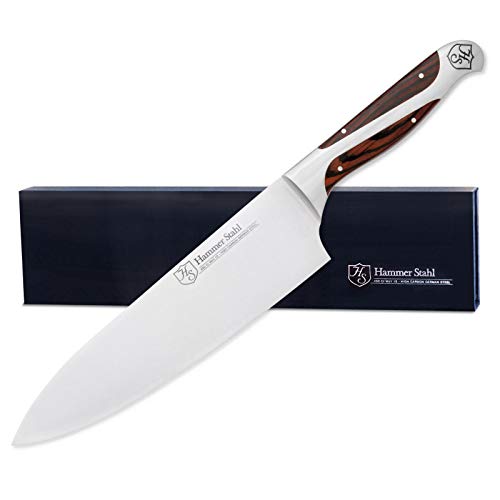
Hammer Stahl 8-Inch Forged Pakkawood Chef Knife
Best for: cooks seeking a heavy German-steel chef knife
- Handle Material
- Pakkawood Handle (what this guide is about)
- Blade Length
- 8 in
- Knife Type
- Chef Knife
- Blade Material
- German X50CrMoV15
- Construction
- Forged
- Blade Hardness
- Rockwell 55–57
View on Amazon: Hammer Stahl 8-Inch Forged Pakkawood Chef Knife
This Hammer Stahl 8-inch chef knife pairs a forged German X50CrMoV15 steel blade with a pakkawood handle. Its steel is tempered to a Rockwell hardness of 55 to 57, prioritizing edge durability and ease of sharpening over extreme hardness. The handle features a quad-tang assembly to distribute its 1-pound weight across your hand. It suits you if you want a traditional German-style workhorse for chopping, mincing, and slicing everyday kitchen ingredients.
Pros
- Forged German X50CrMoV15 high-carbon stainless steel blade
- Pakkawood handle with balanced quad-tang construction
- Rockwell hardness of 55–57 offers high chip resistance
- Covered by a manufacturer lifetime warranty
Cons
- Heavier total weight at 1 pound
- Lower Rockwell hardness than typical high-hardness Japanese steels
Good fit if
- You want a heavy 1-pound forged German steel chef knife.
- You prefer a pakkawood handle with a quad-tang design.
- You need a general-purpose 8-inch blade for chopping and slicing meat and produce.
Skip if
- You prefer a lightweight knife significantly under 1 pound.
- You want an ultra-hard steel edge rated at 60 HRC or higher.
Verdict: Hammer Stahl 8-Inch Forged Chef Knife delivers German X50CrMoV15 steel and a pakkawood quad-tang handle for robust everyday prep. It is a dependable choice if you prioritize balanced heft and durable steel over brittle, ultra-hard edges.

MIYABI Artisan 7-Inch Santoku Knife
Best for: precise vegetable prep requiring ultra-hard steel
- Handle Material
- Pakkawood Handle (what this guide is about)
- Blade Length
- 7"
- Knife Type
- Santoku
- Blade Material
- Sg2 micro-carbide powder steel
- Edge Type
- Fine Edge
- Edge Angle
- 9.5 to 12 degree
The Miyabi Artisan 7-inch Santoku pairs a rosewood Pakkawood D-shaped handle with an SG2 micro-carbide powder steel blade. Hardened to 63 Rockwell, the thin fine edge is hand-honed to a 9.5 to 12-degree angle using the Honbazuke process. If you want a specialized Japanese blade profile with high core hardness and a moisture-resistant wood-composite handle for detailed slicing and chopping tasks, this knife fits your kitchen.
Pros
- SG2 micro-carbide powder steel blade construction
- High 63 Rockwell hardness for prolonged edge retention
- Hand-honed 9.5 to 12 degree Honbazuke edge angle
- D-shaped rosewood Pakkawood handle
Cons
- Weighs 9.6 ounces, which is relatively heavy for a Japanese santoku
- Acute 9.5 to 12 degree edge angle requires careful cutting technique
Good fit if
- You want an SG2 powder steel blade rated at 63 Rockwell hardness.
- You prefer a D-shaped rosewood Pakkawood handle.
- You need an acute 9.5 to 12 degree edge for precision cutting.
Skip if
- You want a softer European steel blade designed for heavy bone contact.
- You prefer a lightweight santoku well under 9 ounces.
Verdict: Miyabi Artisan 7-Inch Santoku Knife delivers an exceptionally hard SG2 steel blade paired with an acute Honbazuke edge and a rosewood Pakkawood handle. It provides precise vegetable prep and fine slicing for cooks who prioritize hard Japanese steel.

Hammer Stahl 3-Inch Bird's Beak Paring Knife
Best for: detailed peeling and in-hand produce trimming
- Handle Material
- Pakkawood Handle (what this guide is about)
- Blade Length
- 3 in
- Knife Type
- Bird's Beak Paring Knife
- Blade Material
- German X50CrMoV15
- Construction
- Forged
- Edge Angle
- 20 degree
View on Amazon: Hammer Stahl 3-Inch Bird's Beak Paring Knife
The Hammer Stahl 3-Inch Bird's Beak Paring Knife gives you a compact, forged German X50CrMoV15 stainless steel blade paired with a quad tang Pakkawood handle. Sharpened to a 20-degree bevel angle with a 55 to 57 Rockwell hardness, its curved profile targets peeling, trimming, and shaping spherical produce. It suits you if you need a durable, specialized peeling blade built specifically for detailed in-hand fruit and vegetable preparation.
Pros
- Forged German X50CrMoV15 high-carbon stainless steel construction
- Phenolic resin-infused Pakkawood handle with quad tang design
- Curved 3-inch bird's beak profile designed for peeling and coring
- Rockwell hardness rating of 55 to 57
Cons
- Curved blade profile cannot flat-chop on a standard cutting board
- Wider 20-degree bevel angle than standard 15-degree paring profiles
- Listed weight of 7.2 ounces is heavy for a compact paring tool
Good fit if
- You need a dedicated curved blade for peeling, seeding, and spherical trimming.
- You want durable German steel paired with a resin-reinforced Pakkawood handle.
Skip if
- You need a straight edge for standard cutting board work.
- You prefer an acute cutting angle below 20 degrees.
Verdict: Hammer Stahl 3-Inch Bird's Beak Paring Knife delivers solid German steel construction and a quad tang handle for controlled in-hand peeling and seeding tasks.

MUCHWIN 7-Inch Damascus Nakiri Knife
Best for: push-cut vegetable prep and chopping
- Handle Material
- Pakkawood Handle (what this guide is about)
- Blade Length
- 7 Inch
- Knife Type
- Nakiri Knife
- Blade Material
- 10Cr15CoMoV core
- Construction
- Forged, 67-layer Damascus
- Edge Angle
- 16°
If you prepare large volumes of produce, the MUCHWIN 7-Inch Damascus Nakiri Knife provides a dedicated flat blade profile designed for push-cutting vegetables. Its cutting core uses 10Cr15CoMoV steel hardened to HRC 60±2 and clad in 67 layers of Damascus steel. A moisture-sealed emerald Pakkawood handle features full-tang triple-rivet construction, balancing the 252-gram tool for everyday chopping, slicing, and dicing without rocking cuts.
Pros
- Core of 10Cr15CoMoV steel hardened to HRC 60±2
- Full-tang emerald Pakkawood handle with triple rivets
- Flat 7-inch Nakiri profile with 16-degree edge angle
- Includes protective velvet sheath and magnetic storage box
Cons
- Requires hand-washing, immediate drying, and regular oiling
- Flat blade profile is not designed for rocking cuts
Good fit if
- You focus primarily on prepping vegetables with push-cut techniques.
- You prefer a full-tang moisture-sealed Pakkawood handle with triple rivets.
- You want a high-hardness core rated at HRC 60±2.
Skip if
- You prefer rocking cuts that require a curved blade belly.
- You want low-maintenance knives that are dishwasher safe.
Verdict: MUCHWIN 7-Inch Damascus Nakiri Knife delivers a flat cutting edge and a full-tang emerald Pakkawood handle tailored for vegetable preparation.
Specifications side by side
| Spec | Imarku 8-Inch Gyutou Chef Knife | imarku 5-Inch Pakkawood Santoku Knife | Brewin Chefilosophi 5-Piece Red Knife Set | PAUDIN 6-Inch High-Carbon Boning Knife | TUO 8-Inch Chef Knife with Pakkawood Handle | Ignited Cutlery 8-Inch AUS-10 Chef Knife | Mueller 7-Inch High-Carbon Full Tang Cleaver | Miyabi Koh 7-Inch Santoku Knife | TUO 10-Inch German Steel Chef Knife | Aihomo 3.5-Inch Curved Bird Beak Paring Knife | Senken Imperial 8-Piece Knife Set | Hammer Stahl 8-Inch Forged Pakkawood Chef Knife | MIYABI Artisan 7-Inch Santoku Knife | Hammer Stahl 3-Inch Bird's Beak Paring Knife | MUCHWIN 7-Inch Damascus Nakiri Knife |
|---|---|---|---|---|---|---|---|---|---|---|---|---|---|---|---|
| Blade Length | 8 in | 5 in | 8 in | 6 in | 8" | 8 in | 6.7 in | 7-inch | 10 in | 3.5 in | not specified | 8 in | 7" | 3 in | 7 Inch |
| Knife Type | Gyutou Chef | Santoku | Chef | Boning knife | Chef Knife | Chef | Meat cleaver | Santoku | Chef | Bird Beak Paring Knife | not specified | Chef Knife | Santoku | Bird's Beak Paring Knife | Nakiri Knife |
| Blade Material | High-carbon stainless steel | not specified | 1.4116 German stainless steel | 5Cr15MoV German stainless steel | German high-carbon stainless steel | Japanese AUS-10 carbon steel | High-carbon steel | FC61 fine carbide stainless steel | German high-carbon stainless steel | X50CR15MOV Stainless Steel | High-Carbon Stainless Steel | German X50CrMoV15 | Sg2 micro-carbide powder steel | German X50CrMoV15 | 10Cr15CoMoV core |
| Construction | not specified | not specified | Forged | not specified | not specified | Damascus | Hand-forged, full-tang | not specified | not specified | not specified | Forged | Forged | not specified | Forged | Forged, 67-layer Damascus |
| Edge Type | not specified | not specified | not specified | not specified | not specified | not specified | not specified | Fine Edge | not specified | not specified | not specified | not specified | Fine Edge | not specified | not specified |
| Edge Angle | 15° | 15–18° | not specified | 15° per side | 14 degrees per side | not specified | not specified | 9.5-12 degree | 10–14° | 18° | not specified | not specified | 9.5 to 12 degree | 20 degree | 16° |
| Blade Hardness | not specified | not specified | 56+ HRC | 56+ HRC | HRC56+2 | not specified | not specified | 61 Rockwell | 56+ HRC | 54 HRC | not specified | Rockwell 55–57 | 63 Rockwell hardness | Rockwell 55 - 57 | HRC 60±2 |
| Handle Material | Pakkawood | Pakkawood | Pakkawood | Pakkawood | Pakkawood | Black Pakkawood | Pakkawood | Pakkawood | Pakkawood | Pakkawood | Wood | Pakkawood | Rosewood Pakkawood | Pakkawood | Emerald Pakkawood |
| Storage Type | not specified | not specified | not specified | not specified | not specified | not specified | Sheath | not specified | not specified | not specified | not specified | not specified | not specified | not specified | not specified |
| Blade Profile | not specified | not specified | not specified | not specified | not specified | not specified | not specified | not specified | not specified | Curved | not specified | not specified | not specified | Bird's Beak | not specified |
| Color | Blue | Black Ebony | Red | 6 Inch Boning Knife | Brown | slivery | Brown-Black | Silver | Black | Silver | Natural Wood Handles | Steel | Silver | Silver | Damascus |
| Style | Japanese | not specified | Japanese | German | not specified | Japanese | not specified | Japanese | German | not specified | Japanese | German | Japanese | German | Japanese |
| Size | 8" | 5" | 8 Inch | 6.1" | 8" | 8" | 7 Inch | 7" | 10" | 3.5" | 14x2x1 | 8" | 7" | 3" | 7" |
| Recommended Use | not specified | not specified | not specified | Boning, Meat | not specified | not specified | Meat | not specified | not specified | Peeling | not specified | not specified | not specified | Vegetables, Fruit | Vegetables |
| Dimensions | 13 × 0.1 × 1.7 inches | not specified | 5.12 × 6.3 × 9.84 inches | 11 × 0.59 × 0.08 inches | 1 × 1 × 1 inches | 13.4 × 2 × 1 inches | not specified | 14.8 × 3 × 1 inches | 15.2 × 2.05 × 0.9 inches | 7.87 × 0.87 × 0.87 inches | 14 × 2 × 1 inches | 4.2 × 1.3 × 17 inches | 3 × 1.13 × 14.8 inches | 10 × 2.5 × 1 inches | 13.3 × 3.54 × 1.38 inches |
| Weight | 6.56 ounces | 3.2 ounces | 2.6 pounds | 5.08 ounces | 7.36 ounces | 7.36 ounces | 1 pounds | 6.08 ounces | 7.52 ounces | 2.72 ounces | not specified | 1 pounds | 9.6 ounces | 7.2 ounces | 10.6 ounces |
| Length | not specified | not specified | not specified | not specified | not specified | not specified | 12 inches | not specified | not specified | not specified | not specified | not specified | not specified | not specified | not specified |
| Model | 8 Inch Chef Knife | P5 | not specified | N10 | TUO-TC0703 | b206-dama | FBK-735 | 1019668 | TC1302 | Paring Knife | Imperial | HS-6308 | 34074-183 | HS-6446 | Nakiri-VG10-GR |
Is a Pakkawood Handle Worth It?
Pakkawood handles appear across both Japanese and German knife designs in this guide. The material adapts to diverse shapes, including octagonal grips, riveted scales with bolster notches, full-tang assemblies, and quad-tang configurations. Listings note reinforced builds, FSC-certified options, and colors ranging from black ebony and brown to red and emerald. You find pakkawood mounted on light 2.72-ounce paring knives and heavy 1-pound cleavers alike. It provides a structured wood grip paired with steel tang construction across multiple blade styles for daily prep.
Worth it if
- You want a wood grip formatted in octagonal Japanese or riveted Western quad-tang styles.
- You prefer color options beyond plain steel, such as red, blue, black ebony, or emerald.
- You want reinforced or FSC-certified wood handles paired with full-tang blades.
Skip it if
- You prefer an all-stainless steel blade and handle build with no wood components.
- You want synthetic handle materials rather than wood.
If you need compact kitchen storage options, you can compare specifications for the best cookware sets with detachable handle across different brands.
How We Picked These Knives
To select kitchen knives for 2026, we evaluated cutlery listings on Amazon that specify a pakkawood handle in the product title or feature list. We do not physically test knives. Instead, you get comparisons based strictly on manufacturer specifications, including blade material, blade length, and handle build. Only one size or variant from each product family is shown to keep the list focused.
The 15 picks on this page are ordered with products in stock first, then by Amazon sales rank, with better-selling products first. Availability refreshes at least daily on the page. You can compare these published specifications to find the right pakkawood tool for your kitchen cutting tasks.
How to Choose the Right Pakkawood Knife
-
Choose Blade Steel Type
Check the blade alloy specification before you buy. German stainless steels prioritize corrosion resistance and toughness against chipping, which works well for rough prep. Japanese alloys like the SG2 micro-carbide powder steel on the MIYABI Artisan 7-Inch Santoku provide higher hardness ratings and hold acute edges longer. You trade some impact resistance for prolonged sharpness. If you want a workhorse that handles accidental bone contact without chipping, pick standard stainless steel. If you want razor-sharp slicing on boneless proteins and vegetables, choose high-carbon or powdered Japanese steel.
-
Match Blade Length to Tasks
Look at the blade length spec to suit your cutting board area and ingredients. A 5-inch utility or santoku knife offers tight control for small trimming and hand tasks. An 8-inch blade serves as a versatile baseline for daily slicing and chopping. If you regularly split large melons, squash, or large roasts, look at extended lengths. The TUO 10-Inch German Steel Chef Knife gives you 15.2 inches of overall length, providing the reach needed to divide large items in single strokes without sawing.
-
Evaluate Blade Flexibility
Check whether the knife listing specifies a flexible or rigid blade profile. General chef knives and cleavers feature rigid spines that do not bend under downward force, ensuring straight, predictable cuts through root vegetables and dense meats. Specialized boning knives, like the PAUDIN 6-Inch High-Carbon Boning Knife, specify a flexible blade. This flex allows the steel to bend around bones, joints, and fish ribs to separate meat with minimal waste. Choose rigid blades for chopping and board prep, and choose flexible steel if you butcher whole proteins.
-
Select Blade Profile
Inspect the curvature of the cutting edge to match your prep technique. Western chef knives feature a rounded belly that rocks back and forth on the cutting board. In contrast, Japanese nakiri knives provide a squared, flat edge profile. The MUCHWIN 7-Inch Damascus Nakiri Knife utilizes this straight edge geometry to make full contact with the cutting board across its entire length. This design eliminates accordion cuts when slicing vegetables via vertical push-cuts. Pick curved profiles for rocking motions and flat profiles for clean push-chopping.
-
Choose Straight or Serrated Edges
Check the edge type specification to determine whether a straight or serrated blade fits your cutting needs. Straight-edge knives make smooth, clean cuts through produce and meats, but they can slide off tough crusts or slippery skins. Knives with scalloped serrations saw through hard crusts and soft interiors without compressing the crumb. The Ergo Chef Pro Series 2.0 8-Inch Offset Bread Knife pairs serrations with an offset blade profile that lifts your knuckles above the board. Choose serrated edges for crusty breads and delicate pastries.
-
Compare Sets Against Individual Knives
Decide whether to buy a single standalone knife or an all-in-one cutlery set. If your kitchen already has reliable utility blades, purchasing a single chef knife upgrades your daily workhorse without adding redundant tools. However, if you need to stock a kitchen from scratch or prefer matched handles, a set is more practical. The Brewin Chefilosophi 5-Piece Red Knife Set provides multiple blade profiles with matching pakkawood grips in one package. Check set piece counts to confirm every blade matches a task you actually perform regularly.
Frequently asked questions
What is the lightest knife with a pakkawood handle on this list?
The Aihomo 3.5-Inch Curved Bird Beak Paring Knife is the lightest option at 2.72 ounces. If you need a compact prep knife, the Imarku 5-Inch Santoku weighs only 3.2 ounces with its Black Ebony pakkawood handle. Both models keep hand fatigue low during detailed, extended peeling and trimming sessions.
Can you get pakkawood knife handles in different colors?
Yes, manufacturers provide pakkawood handles in several distinct colors across these selections. You can choose blue on the Imarku 8-Inch Gyutou, red on the Brewin Chefilosophi 5-Piece Set, or emerald on the MUCHWIN Nakiri. Other knives feature traditional brown on the TUO 8-inch, black on the TUO 10-inch, and rosewood on the MIYABI Artisan.
Which pakkawood kitchen knife has the longest overall length?
The TUO 10-Inch German Steel Chef Knife provides the longest total reach, measuring 15.2 inches from tip to end. It pairs a 10-inch blade with a riveted black pakkawood handle. This extended length gives you the blade surface required to slice large roasts or produce without running short on cutting stroke.
Which kitchen knife with a pakkawood handle is designed for butchering and meat prep?
The PAUDIN 6-Inch High-Carbon Boning Knife is tailored specifically for meat trimming and filleting tasks. It features a flexible high-carbon stainless steel blade sharpened to a 15-degree cutting angle. At 5.08 ounces with an overall length of 11 inches, it gives you maneuverability when working closely around bones and joints.
Are there serrated pakkawood knives available for cutting bread?
Yes, you can choose between two serrated pakkawood options on this list. The Hammer Stahl 8-Inch Serrated Bread Knife weighs 1 pound and features a quad-tang handle assembly. If you prefer knuckle clearance above the cutting board, the Ergo Chef Pro Series 2.0 features an offset serrated blade weighing 8.96 ounces.
Which pakkawood knife is specifically designed for chopping vegetables?
The MUCHWIN 7-Inch Damascus Nakiri Knife is engineered specifically for vegetable prep. It pairs a flat cutting profile with a full-tang emerald pakkawood grip to make flush contact with your cutting board. The blade measures 3.54 inches wide, 13.3 inches overall, and weighs 10.6 ounces to assist straight downward chopping.
What blade edge angles do pakkawood chef knives have?
The chef knives on this list feature factory edge angles ranging between 14 and 18 degrees. The TUO 8-Inch Chef Knife comes sharpened to a 14-degree angle on German steel, while the Imarku 8-Inch Gyutou uses a 15-degree edge. Smaller blades like the Imarku 5-Inch Santoku list edge profiles between 15 and 18 degrees.