Best Japanese Kitchen Knives in 2026: 15 Picks Ranked by Specs
As an Amazon Associate we earn from qualifying purchases. Links on this page are affiliate links.
Finding the best japanese kitchen knives comes down to matching blade steel, edge angle, and knife weight to your prep style. We compared 15 models based on the specifications published on their product listings.
The Imarku 8-Inch Japanese Chef Knife leads the list because its 6.56-ounce weight and 56–58 HRC rust-resistant high-carbon steel provide an ideal balance of durability and easy handling for everyday prep. This guide helps you choose the right blade profile, steel hardness, and knife dimensions for your specific cutting tasks.
Quick picks
The best fit for you
- You need a lightweight everyday Japanese chef knife Imarku 8-Inch Japanese Chef Knife Its 6.56-ounce weight and 8-inch high-carbon steel blade deliver balanced everyday cutting.
- You prefer a heavier chef knife for prep work HOSHANHO 8-Inch Japanese High-Carbon Chef Knife Its 12.3-ounce weight provides solid cutting heft paired with a 13-degree edge and 60 HRC steel.
- You want a dedicated blade for deboning fish HOSHANHO 7-Inch Flexible Fillet Knife Its 7-inch flexible 10Cr15CoMoV blade features a 15-degree edge profile tailored for boning.
- You need a complete set with magnetic block storage Yatoshi 6-Piece Damascus Steel Knife Block Set This 6-piece set pairs VG-10 Damascus steel blades with an upright magnetic acacia block.
Our 15 picks

Imarku 8-Inch Japanese Chef Knife
Best for: everyday multipurpose cutting and low-maintenance prep
- Style
- Japanese (what this guide is about)
- Blade Length
- 8"
- Knife Type
- Chef Knife
- Blade Material
- High-Carbon Stainless Steel
- Blade Hardness
- 56-58 HRC
- Handle Material
- Pakka
This 8-inch Japanese gyuto chef knife from Imarku pairs a high-carbon stainless steel blade with an ergonomic Pakka wood handle. The steel contains 0.6 to 0.75 percent carbon and 16 to 18 percent chrome, rated at 56 to 58 HRC for reliable toughness. At 6.56 ounces and 13 inches overall, it suits you if you want a balanced, corrosion-resistant all-purpose kitchen workhorse for chopping, slicing, and dicing.
Pros
- High-carbon steel with 16–18% chrome offers strong corrosion resistance
- 56–58 HRC hardness provides chip-resistant durability
- FSC-certified Pakka wood handle designed for comfort and stability
- Lightweight 6.56-ounce overall weight reduces hand fatigue
Cons
- 56–58 HRC rating is softer than traditional 60+ HRC Japanese cutlery
- Includes only the single knife without a protective sheath or block
- Logo markings on blade may vary due to manufacturer brand updates
Good fit if
- You want a versatile 8-inch gyuto knife for multi-purpose kitchen tasks.
- You prefer low-maintenance, stain-resistant stainless steel over reactive carbon.
- You want an ergonomic, lightweight wood-handled knife for daily cutting.
Skip if
- You prefer ultra-hard Japanese steel rated at 60 HRC or higher.
- You need a complete multi-piece knife set instead of a standalone blade.
Verdict: Imarku 8-Inch Japanese Chef Knife delivers dependable everyday cutting versatility with its rust-resistant high-carbon steel and balanced 6.56-ounce build. It gives you Japanese gyuto styling paired with practical, durable 56–58 HRC steel.

HOSHANHO 8-Inch Japanese High-Carbon Chef Knife
Best for: cooks wanting high-carbon steel with heavier heft
- Style
- Japanese (what this guide is about)
- Blade Length
- 8 inch
- Knife Type
- Chef's Knife
- Blade Material
- 10Cr15CoMoV
- Edge Angle
- 13 degree
- Blade Hardness
- up to 60 HRC
View on Amazon: HOSHANHO 8-Inch Japanese High-Carbon Chef Knife
The HOSHANHO 8-Inch High-Carbon Steel Chef Knife gives you a classic profile built from 10Cr15CoMoV Japanese steel hardened to 60 HRC. It features a sharp 13-degree edge per side for slicing precision and an ice-tempered matte finish. The wooden handle includes a sloped bolster engineered for pinch grips. At 12.3 ounces, it suits you if you want acute Japanese blade angles paired with substantial heft.
Pros
- Forged from 10Cr15CoMoV high-carbon steel at 60 HRC hardness
- Sharpened to an acute 13-degree angle per side
- Sloped bolster profile supports a balanced pinch grip
- Ice-tempered blade treatment with a matte finish
Cons
- Weighs 12.3 ounces, making it heavier than many traditional Japanese blades
- Wood handle requires hand washing and prompt drying
- No protective blade guard or sheath included
Good fit if
- You want an acute 13-degree edge crafted from 10Cr15CoMoV steel.
- You prefer a heftier 12.3-ounce knife for chopping vegetables and slicing meats.
- You naturally use a pinch grip supported by a sloped bolster.
Skip if
- You prefer a lightweight Japanese gyuto weighing under 8 ounces.
- You want a synthetic or dishwasher-safe handle.
Verdict: HOSHANHO 8-Inch High-Carbon Steel Chef Knife combines acute 13-degree edge geometry and 60 HRC steel with a sturdy, heavier build. It delivers reliable cutting stability if you prefer solid heft in your prep work.

HOSHANHO 7-Inch Flexible Fillet Knife
Best for: deboning meat and filleting whole fish
- Style
- Japanese (what this guide is about)
- Blade Length
- 7 in
- Knife Type
- Fillet knife
- Blade Material
- Japanese 10Cr15CoMoV stainless steel
- Edge Angle
- 15° per side
- Handle Material
- Pakkawood
This Japanese-style boning and fillet knife features a slender 7-inch flexible blade forged from 10Cr15CoMoV stainless steel. Ground to a 15-degree cutting angle per side, the profile targets precision work like trimming meat, skinning fish, and navigating around bones. The moisture-resistant pakkawood handle provides grip stability during wet prep tasks. If you frequently break down whole fish or deconstruct poultry, this specialized knife offers dedicated geometry for delicate butchery work.
Pros
- Japanese 10Cr15CoMoV stainless steel blade
- Thin, flexible 7-inch profile designed for filleting
- 15-degree hand-polished edge angle per side
- Ergonomic pakkawood handle resists corrosion and wear
Cons
- Weighs 10.6 ounces, heavier than standard filleting knives
- Flexible blade design unsuitable for chopping hard bones or dense vegetables
- No sheath or blade guard listed in specifications
Good fit if
- You need a dedicated flexible blade for trimming meat and skinning fish.
- You prefer a fine 15-degree edge profile made from 10Cr15CoMoV steel.
- You want a moisture-resistant pakkawood handle for wet butchery tasks.
Skip if
- You need an all-purpose knife for daily board chopping and dicing.
- You require a rigid blade to split heavy joints or dense bones.
- You prefer an ultralight fillet knife under 10 ounces.
Verdict: HOSHANHO 7-Inch Japanese Fillet Boning Knife delivers the thin, flexible blade profile and sharp 15-degree edge required for clean meat trimming and fish prep. Its specialized 10Cr15CoMoV steel construction makes it a focused addition to any seafood or butcher prep station.
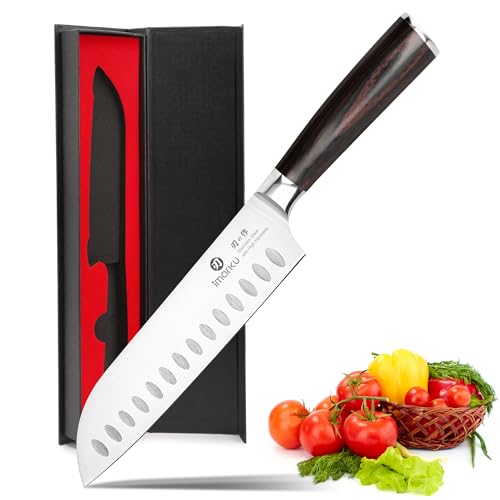
imarku 7-Inch High-Carbon Santoku Knife
Best for: routine vegetable slicing with reduced food sticking
- Style
- Japanese (what this guide is about)
- Blade Length
- 7 Inch
- Knife Type
- Santoku Knife
- Blade Material
- Japanese high carbon stainless steel
- Edge Type
- Hollow edge
- Edge Angle
- 15-18 degrees per side
This Japanese Santoku knife pairs a 7-inch high-carbon stainless steel blade with an ergonomic Pakkawood handle. You get a hand-polished edge sharpened to 15 to 18 degrees per side and a 2.5-millimeter blade thickness. The scalloped hollow edge creates air pockets while you work, preventing sliced food from clinging to the steel. At 6.88 ounces, it gives you a balanced option for daily dicing, slicing, and chopping tasks across meat, vegetables, and fruit.
Pros
- Scalloped hollow edge reduces food sticking during slicing
- Japanese high-carbon stainless steel resists rust and discoloration
- Pakkawood handle resists cracking and expansion
- Hand-polished blade edge set at 15 to 18 degrees per side
Cons
- Edge angle of 15 to 18 degrees is wider than some traditional 12-degree Japanese profiles
- No protective sheath or blade guard included
Good fit if
- You want a hollow-edge design to prevent sliced food from clinging to the blade
- You prefer a moisture-resistant Pakkawood handle that resists cracking
- You do routine kitchen prep covering meat, vegetables, and fruit
Skip if
- You prefer an acute cutting edge below 15 degrees per side
- You need a longer 8-inch or 10-inch blade profile
Verdict: imarku 7-Inch Japanese Santoku Knife delivers dependable food release through its scalloped hollow edge and balanced stainless steel build. It provides comfortable, controlled handling for everyday kitchen prep work.

HOSHANHO 7-Inch Japanese Nakiri Knife
Best for: straight vegetable push-cutting and dense produce prep
- Style
- Japanese (what this guide is about)
- Blade Length
- 7 in
- Knife Type
- Nakiri
- Blade Material
- 10Cr15CoMoV high carbon steel
- Edge Type
- Hollow edge
- Edge Angle
- 15°
The HOSHANHO 7-Inch Nakiri Knife is a Japanese-style vegetable knife built with a 7-inch 10Cr15CoMoV high-carbon steel blade. It features a 15-degree hollow edge ground to reduce food sticking during prep. Hardened to 60 HRC, the blade pairs with an ergonomic pakkawood handle, bringing the total weight to 12.3 ounces. You will find it well suited for chopping, slicing, and dicing produce without rocking motions.
Pros
- 10Cr15CoMoV high-carbon steel blade heat-treated to 60 HRC
- 15-degree cutting edge with scallop-shaped hollow indentations
- Ergonomic moisture-resistant pakkawood handle
- Available in both 7-inch and 5.5-inch lengths
Cons
- Weight of 12.3 ounces is heavy for a 7-inch nakiri
- Square nakiri profile cannot perform rocking cuts
- No blade sheath or protective guard listed in specifications
Good fit if
- You want a dedicated vegetable knife with hollow sides to minimize produce sticking.
- You prefer a substantial 12.3-ounce weight and an ergonomic pakkawood grip.
- You need a 60 HRC high-carbon steel edge sharpened to 15 degrees.
Skip if
- You prefer a curved gyuto or chef knife profile for rocking cuts.
- You want a lightweight knife under 10 ounces for long prep sessions.
- You need a blade designed to butcher bone-in cuts of meat.
Verdict: HOSHANHO 7-Inch High-Carbon Nakiri Knife delivers 60 HRC steel and a 15-degree hollow edge tailored for straight vegetable chopping. Its 12.3-ounce heft and flat edge profile make it an effective prep tool if you do not use rocking cuts.

HOSHANHO LOONG 3.75-Inch Paring Knife
Best for: handheld peeling and slicing of small fruits
- Style
- Japanese (what this guide is about)
- Blade Length
- 3.75 in
- Knife Type
- Paring knife
- Blade Material
- Japanese 10Cr15CoMoV stainless steel
- Construction
- Forged
- Edge Angle
- 15°
This HOSHANHO paring knife is a compact Japanese-style fruit knife built for detailed handheld cutting. It features a forged 3.75-inch Japanese 10Cr15CoMoV stainless steel blade hardened to 60 HRC with a 15-degree edge. Weighing 3.84 ounces, the knife includes a smooth pakkawood handle designed for stability. You will find it suits peeling apples, slicing citrus, and prepping small produce when larger kitchen knives feel too bulky for fine control.
Pros
- Forged Japanese 10Cr15CoMoV stainless steel blade
- Blade treated to 60 HRC hardness
- Hand-sharpened 15-degree edge
- Ergonomic pakkawood handle
- Lightweight 3.84-ounce total weight
Cons
- Short 3.75-inch blade cannot handle large vegetables or cuts of meat
- No protective storage sheath listed in the specifications
Good fit if
- You need a short, agile blade for peeling and paring fruit in hand.
- You want Japanese 10Cr15CoMoV stainless steel with a factory 15-degree edge.
- You prefer a lightweight tool with a smooth pakkawood grip.
Skip if
- You need an all-purpose blade length for slicing large produce or proteins.
- You require a protective blade cover for drawer storage.
Verdict: HOSHANHO 3.75-Inch Paring Knife provides a hard 60 HRC blade and lightweight balance for detailed fruit prep. It serves you well when you need close precision that longer kitchen knives cannot deliver.

Brewin Chefilosophi 5-Piece Red Knife Set
Best for: five-piece Japanese-style sets with red handles
- Style
- Japanese (what this guide is about)
- Blade Length
- 8 in
- Knife Type
- Chef
- Blade Material
- 1.4116 German stainless steel
- Construction
- Forged
- Blade Hardness
- 56+ HRC
This Brewin Chefilosophi set gives you five forged kitchen blades fitted with red pakkawood handles. The lineup includes two 8-inch knives, a Japanese santoku, a 5-inch utility knife, and a paring knife. Made from 1.4116 German high-carbon stainless steel rated at 56+ HRC, each blade resists rust while maintaining structural toughness. It suits cooks who want a multi-piece Japanese-style setup with distinctive red wooden handles and balanced three-rivet construction.
Pros
- Forged from 1.4116 German high-carbon stainless steel
- Complete five-piece set including a santoku, two 8-inch blades, utility, and paring knife
- Durable red pakkawood handles secured with three anchor points
- 56+ HRC hardness rating balances edge retention with durability
Cons
- At 56+ HRC, steel hardness is lower than traditional high-hardness Japanese cutlery
- No storage block or blade sheaths listed in specifications
Good fit if
- You want a five-piece knife collection featuring matching red pakkawood handles.
- You prefer 1.4116 German stainless steel with a 56+ HRC rating for rust resistance and durability.
- You need a versatile mix of Japanese santoku, utility, paring, and 8-inch knives.
Skip if
- You want a single standalone Japanese knife rather than a five-piece set.
- You prefer ultra-hard Japanese core steel rated above 60 HRC.
Verdict: Brewin Chefilosophi 5-Piece Red Knife Set delivers a versatile five-blade arrangement built with 1.4116 German steel and triple-riveted pakkawood handles. It serves home cooks who need everyday durability across multiple blade styles with a cohesive red aesthetic.

Yatoshi 6-Piece Damascus Steel Knife Block Set
Best for: cooks seeking a full VG-10 Damascus set
- Style
- Japanese (what this guide is about)
- Blade Length
- 8 in, 7 in, 5 in, 3.5 in
- Knife Type
- Chef, Bread, Santoku, Utility, Paring
- Blade Material
- VG-10
- Construction
- 67-layer Damascus
- Edge Type
- Double-bevel
View on Amazon: Yatoshi 6-Piece Damascus Steel Knife Block Set
This 6-piece kitchen set provides five Japanese-style knives alongside a double-sided magnetic acacia wood block. Each blade uses a VG-10 steel core wrapped in 67-layer Damascus cladding, hardened to 60-61 Rockwell. The edges feature a 16-degree double bevel paired with olive wood handles. You get an 8-inch chef, 8-inch bread, 7-inch santoku, 5-inch utility, and 3.5-inch paring knife for complete daily prep.
Pros
- VG-10 steel cutting core enveloped in 67-layer Damascus cladding
- 60-61 Rockwell blade hardness for edge retention
- Double-sided magnetic acacia wood block with anti-skid pad
- Includes five distinct blade profiles from paring to bread knives
Cons
- 16-degree edge angle is wider than traditional 12- to 15-degree Japanese grinds
- Concealed-tang handle build rather than a full exposed tang
Good fit if
- You want a matched five-knife setup with an open magnetic display block.
- You prefer VG-10 steel with 60-61 Rockwell hardness.
- You want natural olive wood handles across all primary kitchen knives.
Skip if
- You prefer traditional, steeper Japanese cutting angles below 15 degrees.
- You require full-tang knife construction with exposed rivets.
Verdict: Yatoshi 6-Piece VG-10 Damascus Knife Block Set combines high-hardness VG-10 steel blades with an upright magnetic acacia storage block. It gives you five distinct knife shapes suited for comprehensive kitchen prep.

HOSHANHO 8-Inch Gyuto Chef Knife
Best for: cooks wanting an octagonal-handle Japanese gyuto
- Style
- Japanese (what this guide is about)
- Blade Length
- 8.11 in
- Knife Type
- Gyuto Chef
- Blade Material
- 10Cr15CoMoV, composite steel
- Construction
- Hand-forged, 9 layers
- Edge Type
- V-shaped
The HOSHANHO 8-Inch Gyuto Chef Knife is a Japanese-style primary kitchen knife built for slicing, dicing, and chopping. You get an 8.11-inch blade with a 10Cr15CoMoV steel core wrapped in eight outer composite layers. Its V-shaped edge sits at 12 to 15 degrees per side for precise cutting. At 7.8 ounces with a 6.1-inch octagonal rosewood handle, this knife suits you if you want a balanced, traditional Japanese grip.
Pros
- 9-layer composite blade with 10Cr15CoMoV steel core
- Sharpened to a 12-15 degree angle per side
- Traditional octagonal rosewood handle with dual copper accents
- Weighs 7.8 ounces with an 8.11-inch cutting edge
Cons
- Rosewood handle requires dedicated hand drying and wood care
- Blade length of 8.11 inches can feel large for tight counter spaces
Good fit if
- You want a classic gyuto with a traditional octagonal wood handle.
- You prefer an acute factory edge ground between 12 and 15 degrees per side.
- You need an 8-inch high-carbon core blade for general prep tasks.
Skip if
- You prefer a Western-style contoured synthetic handle.
- You want a complete knife block set instead of a single gyuto.
Verdict: HOSHANHO 8-Inch Gyuto Chef Knife provides an acute 12-to-15-degree edge and layered 10Cr15CoMoV steel paired with a classic octagonal handle. It delivers dependable cutting balance for standard kitchen prep.

imarku 10-Inch Serrated Bread Knife
Best for: slicing sourdough loaves and delicate baked goods
- Style
- Japanese (what this guide is about)
- Blade Length
- 10 in
- Knife Type
- Bread
- Blade Material
- 10Cr15CoMoV + 430# composite
- Construction
- Triple-layer composite
- Edge Type
- Wavy, single-bevel serrated
The imarku 10-Inch Serrated Bread Knife gives you a dedicated cutting tool for crusty loaves and soft pastries. Its 10-inch blade uses a triple-layer 10Cr15CoMoV and 430 stainless steel composite rated at HRC 59±2 hardness. The single-bevel wavy edge is sharpened to 12 degrees for clean cuts without tearing bread interiors. A moisture-stabilized pakkawood handle provides grip, making this knife well suited if you regularly bake or portion delicate baked goods.
Pros
- Triple-layer 10Cr15CoMoV and 430 composite steel blade rated at HRC 59±2
- Single-bevel wavy serrated edge ground to 12°±2°
- 10-inch blade length handles large loaves, cakes, and melons
- Moisture-stabilized pakkawood handle with dual stainless steel bolsters
Cons
- Requires hand-washing rather than dishwasher cleaning
- Single-bevel serrations require specialized tools to resharpen
- No storage sheath or blade guard included
Good fit if
- You need a long 10-inch serrated blade to slice crusty sourdough and baguettes.
- You want a hard HRC 59 composite steel edge designed for extended sharpness.
- You prefer a moisture-treated pakkawood handle with reinforced steel bolsters.
Skip if
- You want a general-purpose chef knife with a straight cutting edge.
- You prefer dishwasher-safe cutlery.
- You need a compact knife under 8 inches for small cutting boards.
Verdict: imarku 10-Inch Serrated Bread Knife delivers high edge retention and a sharp 12-degree wavy profile for slicing tough crusts and soft crumb cleanly. Its 10-inch composite steel construction makes it the standout serrated option on our list.

HOSHANHO 7-Inch Japanese Santoku Knife
Best for: precise slicing with reduced food stick
- Style
- Japanese (what this guide is about)
- Blade Length
- 7 Inch
- Knife Type
- Santoku
- Blade Material
- Japanese steel 10Cr15CoMoV
- Construction
- Forged triple-layer laminated steel
- Edge Type
- Double-side groove
The HOSHANHO 7-inch Santoku is a Japanese-style kitchen knife forged from triple-layer 10Cr15CoMoV laminated steel. You get a 62 HRC hardness rating and a hand-sharpened 15-degree edge paired with double-sided grooves to reduce food sticking. It weighs 12.3 ounces and features an African pakkawood handle. This knife suits you if you need a rigid, wear-resistant blade for daily slicing, dicing, and chopping.
Pros
- Triple-layer 10Cr15CoMoV laminated steel core hardened to 62 HRC
- Hand-sharpened 15-degree cutting angle for thin cuts
- Double-sided groove design reduces cutting drag and sticking
- African pakkawood handle designed to resist thermal expansion
Cons
- Weighs 12.3 ounces, which is heavier than standard Japanese santoku knives
- No protective blade sheath or edge guard included
Good fit if
- You want a hard 62 HRC laminated blade with sharp 15-degree geometry.
- You frequently prep dense vegetables and need blade grooves to prevent sticking.
- You prefer a substantial 12.3-ounce weight in a 7-inch knife.
Skip if
- You prefer an ultralight knife for extended prep work.
- You need a longer 8-inch chef knife profile for cutting large roasts.
Verdict: HOSHANHO 7-Inch Laminated Steel Santoku Knife pairs a hard 62 HRC edge with recessed blade grooves for clean food release. It serves well if you want durable laminated construction in a hefty 7-inch frame.

FAMCÜTE 5-Inch Forged Paring Knife
Best for: delicate peeling, trimming, and small prep tasks
- Style
- Japanese (what this guide is about)
- Blade Length
- 5"
- Knife Type
- Paring Knife
- Blade Material
- 9CR18MOV Japanese steel
- Construction
- Hand-Forged
- Blade Hardness
- HRC 58-62
The FAMCÜTE 5-inch paring knife gives you a hand-forged Japanese-style petty blade for detailed prep work. Built from 9CR18MOV steel hardened to HRC 58–62, it features a dimpled clad surface and weighs 4.66 ounces. Its 12.5-centimeter African rosewood handle balances an 11.7-centimeter cutting edge for both left- and right-handed grips. You will find it well suited for peeling fruit, trimming herbs, and precise culinary tasks.
Pros
- Hand-forged 9CR18MOV steel with HRC 58–62 hardness
- Contoured African rosewood handle fits left- and right-handed users
- Dimpled clad blade profile aids food release
- Lightweight construction at 4.66 ounces
Cons
- 5-inch blade length is not designed for large cutting tasks
- Natural rosewood handle requires hand washing and careful drying
- No blade sheath listed in specifications
Good fit if
- You need a compact 5-inch blade for intricate peeling and slicing.
- You want hand-forged high-carbon steel with a natural wood handle.
- You prefer a lightweight knife weighing under 5 ounces.
Skip if
- You need an all-purpose 8-inch chef knife for large meats and produce.
- You prefer dishwasher-safe synthetic handles over natural timber.
Verdict: FAMCÜTE 5-Inch Hand-Forged Paring Knife provides a balance of high-hardness steel and natural wood ergonomics for precise slicing. It serves as a dependable companion tool when full-sized blades are too unwieldy for delicate prep work.

Emojoy 3-Piece Damascus Steel Knife Set
Best for: three-piece Damascus prep essentials
- Style
- Japanese (what this guide is about)
- Blade Material
- Damascus steel
- Construction
- Hand-forged, 67-layer Damascus
- Edge Angle
- 15°
- Blade Hardness
- 58 HRC
- Handle Material
- Olive wood
This 3-piece Japanese-style set provides an 8-inch chef knife, a 7-inch santoku knife, and a 3.5-inch paring knife. Each blade features 67-layer Damascus steel forged to 58 HRC with a 15-degree edge. Fitted with brown Calabrian olive wood handles and half bolsters, the knives arrive in a wooden storage box. It suits you if you want essential prep knives with natural wood aesthetics and acute cutting angles.
Pros
- 67-layer Damascus steel blades with 58 HRC hardness
- Precision 15-degree cutting edges
- Calabrian olive wood handles with half-bolster design
- Includes 8-inch chef, 7-inch santoku, and 3.5-inch paring blades
Cons
- Lacks bread knife, kitchen shears, and honing rod
- Packaged in a flat wooden box instead of a countertop block
- 58 HRC steel is softer than many traditional Japanese blades
Good fit if
- You want primary kitchen blades covering chef, santoku, and paring tasks.
- You prefer natural olive wood handles with half bolsters.
- You need factory 15-degree blade edges for daily slicing.
Skip if
- You need an upright countertop block rather than a flat wooden box.
- You require a larger knife set with bread and utility knives.
Verdict: Emojoy 3-Piece Damascus Olive Wood Knife Set delivers core cutting blades with 15-degree edges and natural wood handles. It gives you 67-layer Damascus construction in a compact three-knife boxed lineup.

Sunnecko 5.5-Inch High-Carbon Chef Knife
Best for: compact prep tasks requiring safe sheath storage
- Style
- Japanese (what this guide is about)
- Blade Length
- 5.5 in
- Knife Type
- Chef knife
- Blade Material
- High carbon stainless steel
- Construction
- Forged
- Edge Angle
- 12-15° per side
The Sunnecko 5.5-Inch Chef Knife with Sheath gives you a compact Japanese-style cutting tool built with forged high-carbon stainless steel. It features an acute edge sharpened to 12 to 15 degrees per side, a full-tang pakkawood handle with a steel bolster, and an included PVC sheath for drawer or travel protection. You will find it well suited if you need controlled slicing on vegetables and meat without wielding a full-sized chef knife.
Pros
- Includes a custom-fit PVC blade sheath for safe storage and transport
- Hand-sharpened 12–15° edge angle per side for precise slicing
- Forged high-carbon stainless steel blade with full-tang construction
- Ergonomic pakkawood handle with a protective steel bolster
Cons
- Shorter 5.5-inch blade lacks the reach needed for large roasts or melons
- Surface pattern is laser-etched rather than genuine folded Damascus steel
Good fit if
- You want a compact 5.5-inch prep knife that includes a dedicated protective sheath.
- You prefer a full-tang forged knife with an ergonomic pakkawood handle and steel bolster.
- You need a sharp 12–15° edge angle for controlled cutting on meat and vegetables.
Skip if
- You need a standard 8-inch chef knife for handling high-volume prep or large cuts of meat.
- You prefer genuine folded Damascus steel over laser-etched surface patterning.
Verdict: Sunnecko 5.5-Inch Chef Knife with Sheath pairs a compact high-carbon forged blade with an acute edge angle and a dedicated sheath for safe storage. It delivers controlled maneuverability for daily vegetable and meat prep when an 8-inch knife is too large.
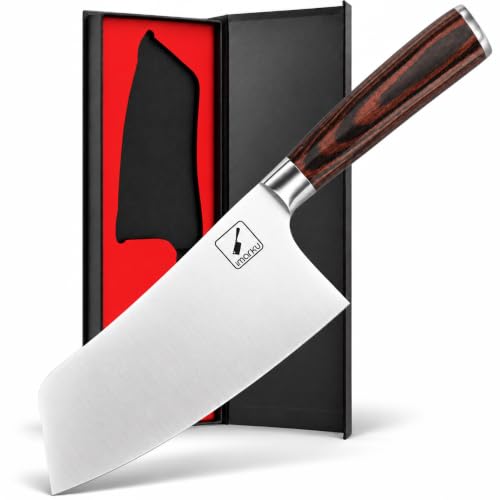
imarku 7-Inch Japanese SUS440A Steel Meat Cleaver
Best for: Chopping meat, small bones, and dense vegetables
- Style
- Japanese (what this guide is about)
- Blade Length
- 7 in
- Knife Type
- Meat Cleaver
- Blade Material
- Japanese SUS440A Steel
- Construction
- Forged
- Edge Angle
- 14-16° per side
View on Amazon: imarku 7-Inch Japanese SUS440A Steel Meat Cleaver
This 7-inch meat cleaver gives you a heavy-duty Japanese-style option for tough prep work. Forged from Japanese SUS440A stainless steel hardened to HRC 58+, the blade features a 14 to 16 degree cutting angle per side. Weighing 1.08 pounds with a 4-inch blade width, it suits you if you need leverage for cutting through small bones, hard squashes, and dense meats.
Pros
- Forged Japanese SUS440A high-carbon stainless steel blade
- Double-beveled edge sharpened to 14 to 16 degrees per side
- Dense pakkawood handle resists cracking
- Wide 4-inch profile handles small bones and tough tubers
Cons
- Weighs 1.08 pounds, making it heavier than standard Japanese chef knives
- Four-inch blade width is too bulky for fine peeling or nimble trimming
Good fit if
- You need a heavy blade to chop through small bones and dense produce.
- You prefer an ergonomic pakkawood handle for butchering tasks.
- You want a sharp 14 to 16 degree edge on a heavy cleaver.
Skip if
- You want an agile, lightweight knife for delicate slicing.
- You prefer a narrow Gyuto or Santoku blade shape.
Verdict: Imarku 7-Inch SUS440A Meat Cleaver delivers substantial chopping weight and a sharp 14 to 16 degree edge for heavy butchery. It is built for dense cuts rather than intricate slicing work.
Specifications side by side
| Spec | Imarku 8-Inch Japanese Chef Knife | HOSHANHO 8-Inch Japanese High-Carbon Chef Knife | HOSHANHO 7-Inch Flexible Fillet Knife | imarku 7-Inch High-Carbon Santoku Knife | HOSHANHO 7-Inch Japanese Nakiri Knife | HOSHANHO LOONG 3.75-Inch Paring Knife | Brewin Chefilosophi 5-Piece Red Knife Set | Yatoshi 6-Piece Damascus Steel Knife Block Set | HOSHANHO 8-Inch Gyuto Chef Knife | imarku 10-Inch Serrated Bread Knife | HOSHANHO 7-Inch Japanese Santoku Knife | FAMCÜTE 5-Inch Forged Paring Knife | Emojoy 3-Piece Damascus Steel Knife Set | Sunnecko 5.5-Inch High-Carbon Chef Knife | imarku 7-Inch Japanese SUS440A Steel Meat Cleaver |
|---|---|---|---|---|---|---|---|---|---|---|---|---|---|---|---|
| Blade Length | 8" | 8 inch | 7 in | 7 Inch | 7 in | 3.75 in | 8 in | 8 in, 7 in, 5 in, 3.5 in | 8.11 in | 10 in | 7 Inch | 5" | not specified | 5.5 in | 7 in |
| Knife Type | Chef Knife | Chef's Knife | Fillet knife | Santoku Knife | Nakiri | Paring knife | Chef | Chef, Bread, Santoku, Utility, Paring | Gyuto Chef | Bread | Santoku | Paring Knife | not specified | Chef knife | Meat Cleaver |
| Blade Material | High-Carbon Stainless Steel | 10Cr15CoMoV | Japanese 10Cr15CoMoV stainless steel | Japanese high carbon stainless steel | 10Cr15CoMoV high carbon steel | Japanese 10Cr15CoMoV stainless steel | 1.4116 German stainless steel | VG-10 | 10Cr15CoMoV, composite steel | 10Cr15CoMoV + 430# composite | Japanese steel 10Cr15CoMoV | 9CR18MOV Japanese steel | Damascus steel | High carbon stainless steel | Japanese SUS440A Steel |
| Construction | not specified | not specified | not specified | not specified | not specified | Forged | Forged | 67-layer Damascus | Hand-forged, 9 layers | Triple-layer composite | Forged triple-layer laminated steel | Hand-Forged | Hand-forged, 67-layer Damascus | Forged | Forged |
| Edge Type | not specified | not specified | not specified | Hollow edge | Hollow edge | not specified | not specified | Double-bevel | V-shaped | Wavy, single-bevel serrated | Double-side groove | not specified | not specified | not specified | not specified |
| Edge Angle | not specified | 13 degree | 15° per side | 15-18 degrees per side | 15° | 15° | not specified | 16° per side | 12°–15° per side | 12°±2° | 15 degree | not specified | 15° | 12-15° per side | 14-16° per side |
| Blade Hardness | 56-58 HRC | up to 60 HRC | not specified | not specified | 60 HRC | 60 HRC | 56+ HRC | 60-61 Rockwell | not specified | HRC 59±2 | 62HRC | HRC 58-62 | 58 HRC | not specified | HRC 58+ |
| Handle Material | Pakka | Wood | Pakkawood | Pakkawood | Pakkawood | Pakkawood | Pakkawood | Olive wood | Rosewood | Pakkawood | African pakkawood | African rosewood | Olive wood | Pakkawood | Pakkawood |
| Storage Type | not specified | not specified | not specified | not specified | not specified | not specified | not specified | Knife Block | not specified | not specified | not specified | not specified | not specified | Sheath | not specified |
| Color | Deep Brown | 8 inch Chef Knife | Silver | Brown and Silver | Silver | Silver | Red | Olive | Gray | Rich Brown and Black | Silver | Clad | Brown | 5.5 inch Small Chef Knife | Bronze |
| Style | Japanese | Japanese | Japanese | Japanese | Japanese | Japanese | Japanese | Japanese | Japanese | Japanese | Japanese | Japanese | Japanese | Japanese | Japanese |
| Size | 8" | 8" | 7" | 7" | 7" | 3.7" | 8 Inch | 6-Piece | 8" | 10" | 7" | 5" Utility Knife | 3-Piece Chef Knife Set | 5.5 inch | 7" |
| Recommended Use | not specified | not specified | Boning | not specified | not specified | Fruit | not specified | not specified | not specified | not specified | not specified | not specified | not specified | Vegetables, Meat | Meat |
| Dimensions | 13 × 3 × 1 inches | not specified | not specified | 12 × 3 × 1 inches | 10 × 2 × 2.7 inches | not specified | 5.12 × 6.3 × 9.84 inches | 9.5 × 4 × 15 inches | not specified | not specified | 1.97 × 1.97 × 11.8 inches | not specified | not specified | not specified | 13 × 4 × 1 inches |
| Weight | 6.56 ounces | 12.3 ounces | 10.6 ounces | 6.88 ounces | 12.3 ounces | 3.84 ounces | 2.6 pounds | 7 pounds | 7.8 ounces | not specified | 12.3 ounces | 4.66 ounces | 2.69 pounds | not specified | 1.08 pounds |
| Length | not specified | 13.5 inches | not specified | not specified | not specified | not specified | not specified | not specified | not specified | not specified | not specified | not specified | not specified | not specified | not specified |
| Model | 8-inch chef knife | 8 inch Chef Knife | 7 inch Fillet Knife | I-KSK0064DB | 7 inch Nakiri Knife | 3.75 inch Paring Knife | not specified | MO6 | 8 inch Chef Knife | TS03 | 7 inch Santoku Knife | SHG-0005 | KC-KS61 | A34 | imarku |
Is a Japanese-Style Knife Worth It?
Choosing a Japanese-style knife gives you access to acute edge angles, typically ground between 12 and 15 degrees, paired with hard steels rated up to 60 or 62 HRC. This combination supports fine, precise cutting through produce and meats with less resistance than blunter bevels. You also get specialized geometries such as recessed blade flutes for food release and traditional octagonal handles. However, hard edges require controlled cutting techniques. If you want broad, durable edges designed for rough chopping or prying bones, Japanese styling may not match your habits.
Worth it if
- You prioritize acute cutting angles between 12 and 15 degrees for clean, low-resistance slicing.
- You want high-hardness blade steel rated between 56 and 62 HRC, such as VG-10 or 10Cr15CoMoV.
Skip it if
- You prefer softer, blunt bevels designed to withstand rough chopping against bone or frozen items.
- You do not want to maintain specialized acute edges that require careful sharpening upkeep.
If you also need ergonomic support at a desk, you can examine caster specs and dimensions for the best steelcase gaming chairs for hard floors.
How We Picked Japanese Knives
To build this 2026 guide of 15 Japanese kitchen knives, we select models whose listing titles or feature lists confirm Japanese styling. You see only one size or variant per product family to keep comparisons clear. All details come directly from published manufacturer specifications. Products are not physically handled or tested in any kitchen.
We order products in stock first, then by Amazon sales rank (better-selling products first). The page refreshes availability data at least daily so you see current stock status. This spec-focused layout helps you compare blade lengths, steels, weights, and handle materials to find the exact Japanese knife you need.
How to Choose Japanese Kitchen Knives
-
Compare Blade Steel Types
Check the blade material specification before buying. High-carbon stainless steel options like the Imarku 8-Inch Japanese Chef Knife offer rust resistance and 56 to 58 HRC durability for low-maintenance daily cutting. Damascus steel builds, such as 67-layer or VG-10 compositions, prioritize edge retention and hardness up to 60 or 62 HRC. If you want easy maintenance, select high-carbon stainless steel. If you want maximum edge retention and do not mind attentive cleaning, choose Damascus or laminated high-hardness carbon steels.
-
Select the Blade Length
Check the blade length specification to match your cutting board space and ingredient sizes. Knives with 3.7-inch or 5-inch lengths handle detailed peeling and trimming. Standard 7-inch and 8-inch knives handle daily chopping, while extended options like the Imarku 8.5-Inch Composite Chef Knife provide additional reach for larger cutting tasks. If you work on small boards or prep compact produce, choose blades under 6 inches. If you slice broad proteins or large vegetables in bulk, choose blades measuring 8 inches or longer.
-
Evaluate Knife Overall Weight
Look at the knife weight specification to balance hand fatigue and cutting power. Japanese-style knives vary widely in mass. Lighter models like the HOSHANHO 8-Inch Gyuto Chef Knife weigh 7.8 ounces, which allows swift, agile movement during extended cutting sessions without tiring your wrist. In contrast, heavier options weigh up to 12.3 ounces, using downward mass to press through firm ingredients. Choose a knife under 8 ounces for fast control. Choose a knife over 10 ounces if you prefer solid cutting heft.
-
Examine Handle Material Specs
Review the handle material specification to determine grip durability and care requirements. The Brewin Chefilosophi 5-Piece Red Knife Set features triple-riveted pakkawood handles, which blend wood and resin to resist moisture absorption during routine washing. Other knives feature natural olive wood handles that require occasional oiling to prevent drying. If you prefer low-maintenance prep tools that resist humidity and regular sink contact, select treated pakkawood handles. If you prefer natural organic textures and traditional grip aesthetics, pick natural wood handles instead.
-
Decide on Set Size
Check the set piece count specification to decide between a focused single blade and a bundled lineup. Standalone blades suit cooks who already own prep tools and only need a specific profile. Multi-piece options, like the Yatoshi 6-Piece Damascus Steel Knife Block Set, provide five different blade styles alongside dedicated magnetic storage. Choose an individual knife if you want to fill a single prep gap. Choose a multi-piece set if you are outfitting a full kitchen and need matched blade styles immediately.
-
Check Storage Method Options
Check the storage type specification before choosing where to house your blades. The Sunnecko 5.5-Inch High-Carbon Chef Knife includes a custom fitted sheath, which protects the sharp cutting edge when you store the blade flat inside a drawer. Other models include countertop wooden blocks or boxed storage. If your counter space is limited or you carry tools offsite, choose a knife that includes a protective sheath. If you prefer fast visual access on your countertop, select models with upright magnetic blocks.
Frequently asked questions
What is the difference between a santoku knife and a gyuto knife?
A gyuto functions as an all-purpose chef knife with a curved belly, whereas a santoku has a flatter profile designed for slicing, dicing, and mincing. Models like the Imarku 8-Inch Japanese Chef Knife offer longer reach and standard curvature for rocking cuts. In contrast, the imarku 7-Inch Santoku features a shorter length and hollow indentations to prevent food from clinging during downward push cuts.
Why do some Japanese kitchen knives have hollow ground indentations?
Hollow indentations reduce surface suction and prevent thin vegetable slices from sticking to the blade face. Recessed scallops create small air pockets between the steel and the food during slicing. For example, the imarku 7-Inch High-Carbon Santoku Knife uses these indentations along its 2.5 mm blade, while the HOSHANHO 7-Inch Santoku incorporates recessed grooves to maintain smooth food release through repetitive cutting.
What handle materials are used on Japanese kitchen knives?
Japanese kitchen knives typically use treated woods, composite materials, or natural hardwoods for their handles. Moisture-resistant pakkawood appears frequently, featured on the imarku 7-Inch Santoku and the Brewin Chefilosophi 5-Piece Set. Other models feature natural wood ergonomics, such as the olive wood handles on the Emojoy 3-Piece Damascus Knife Set, or traditional geometry like the octagonal grip on the HOSHANHO 8-Inch Gyuto.
How much do Japanese chef knives typically weigh?
Japanese chef knives span a wide weight range depending on their steel thickness and handle construction. Lightweight models offer agile handling, such as the Imarku 8-Inch Chef Knife at 6.56 ounces or the HOSHANHO 8-Inch Gyuto at 7.8 ounces. If you prefer blade weight to assist downward cutting, heavier builds like the HOSHANHO 8-Inch High-Carbon Chef Knife weigh up to 12.3 ounces.
When should you choose a Japanese nakiri knife instead of a chef knife?
You should choose a nakiri knife specifically for clean push-cutting through dense produce without rocking the blade. Unlike curved chef knives, a nakiri features a rectangular profile with a flat cutting edge. The HOSHANHO 7-Inch Japanese Nakiri Knife, for instance, uses a 15-degree hollow edge and a 12.3-ounce weight to chop directly down, ensuring full blade contact across the cutting board.
What knife storage options work best for Japanese blades?
Japanese blades require storage solutions that shield acute cutting edges from contact with other metal objects. Dedicated sheaths provide portable edge protection, like the fitted sheath paired with the Sunnecko 5.5-Inch Chef Knife. For countertop organization, magnetic holders protect bevels from slot friction. The Yatoshi 6-Piece Damascus Set utilizes an upright magnetic acacia block that holds knife faces flat against wood.
What edge angles do Japanese kitchen knives use?
Japanese blades feature acute edge angles typically ground between 12 and 18 degrees per side. A more acute bevel, such as the 12-degree edge on the Imarku 8.5-Inch Composite Chef Knife or the 13-degree edge on the HOSHANHO 8-Inch High-Carbon Chef Knife, delivers low cutting resistance. Multipurpose blades like the imarku 7-Inch Santoku employ slightly broader 15-to-18-degree angles for greater edge stability.