15 Best High-Carbon Steel Kitchen Knives, Compared
As an Amazon Associate we earn from qualifying purchases. Links on this page are affiliate links.
A high carbon steel kitchen knife gives you superior edge retention and sharp cutting performance across daily prep tasks. We evaluated 15 models using only the specifications published on their listings. The Mercer Culinary Millennia 7-Inch High-Carbon Usuba Knife takes the top spot due to its lightweight 0.13-pound Japanese high-carbon steel construction tailored for precise vegetable chopping and mincing.
Different tasks require distinct blade geometries, from flexible boning tools to traditional chef profiles. This guide helps you decide which blade length, weight, and handle material match your food prep needs.
Quick picks
The best fit for you
- You need a dedicated lightweight knife for chopping vegetables Mercer Culinary Millennia 7-Inch High-Carbon Usuba Knife Its 0.13-pound weight and 7-inch Japanese high-carbon usuba blade give you agile control for produce prep.
- You want a complete cutlery set with integrated sharpening Imarku 14-Piece High-Carbon Steel Knife Block Set This 14-piece high-carbon steel set includes built-in block sharpening and acute 10–15 degree blade edges.
- You prefer a compact chef knife for smaller hands SANMEIHO 6-Inch High-Carbon Chef Knife The compact 6-inch blade and lightweight 0.25-pound construction offer easy handling for smaller grips.
Our 15 picks

Mercer Culinary Millennia 7-Inch High-Carbon Usuba Knife
Best for: precise vegetable chopping and mincing
- Blade Material
- High-Carbon Steel (what this guide is about)
- Blade Length
- 7-inch
- Knife Type
- Usuba Knife
- Color
- Black
- Dimensions
- 5 × 1 × 18 inches
- Weight
- 2.08 ounces
View on Amazon: Mercer Culinary Millennia 7-Inch High-Carbon Usuba Knife
The Mercer Culinary Millennia 7-Inch Usuba Knife gives you a dedicated vegetable prep tool built from one-piece high-carbon Japanese steel. At 0.13 pounds, it features a 7-inch blade designed for chopping, mincing, and slicing produce. The textured black handle provides a non-slip grip with dedicated finger points. It suits you if you prepare heavy volumes of vegetables and want a lightweight, single-piece high-carbon edge for daily meal preparation.
Pros
- One-piece Japanese high-carbon steel construction
- Ergonomic handle with textured non-slip finger points
- Lightweight build at 0.13 pounds
- Dedicated 7-inch blade profile for chopping, mincing, and slicing vegetables
Cons
- Requires hand washing and cannot go into a dishwasher
- Cannot be submerged in water for extended periods
- No protective sheath or blade guard listed in specifications
Good fit if
- You want a dedicated 7-inch blade designed for slicing and chopping vegetables.
- You prefer an ultra-lightweight knife weighing 0.13 pounds.
- You want a textured, non-slip handle for kitchen prep.
Skip if
- You require dishwasher-safe kitchen cutlery.
- You prefer a heavier knife with substantial heft.
- You need an all-purpose curved chef knife rather than a flat vegetable blade.
Verdict: Mercer Culinary Millennia 7-Inch High-Carbon Usuba Knife delivers efficient produce cutting with its lightweight Japanese high-carbon steel construction and textured grip. It serves as a focused vegetable tool for cooks who prioritize precise slicing and easy edge maintenance.

Imarku 14-Piece High-Carbon Steel Knife Block Set
Best for: full-kitchen prep with built-in block sharpening
- Blade Material
- High-Carbon Steel (what this guide is about)
- Construction
- Precision-forged
- Edge Angle
- 10–15°
- Storage Type
- Knife Block
- Dimensions
- 10.1 × 7.09 × 14.6 inches
- Weight
- 9.04 pounds
View on Amazon: Imarku 14-Piece High-Carbon Steel Knife Block Set
This 14-piece set equips you with precision-forged high-carbon steel cutlery ground to an acute 10 to 15-degree edge. Unlike individual knives on this list, it provides six prep blades, six steak knives, kitchen shears, and an FSC-certified hardwood storage block with an integrated pull-through sharpener. Its full-tang construction and contoured non-slip handles suit home cooks who need an all-in-one setup for comprehensive cutting tasks without buying separate storage.
Pros
- Complete 14-piece package includes prep knives, steak knives, shears, and block
- Blades ground to an acute 10–15° angle with full-tang construction
- FSC-certified hardwood block includes a built-in pull-through sharpener
- Contoured non-slip handles designed to reduce grip fatigue
Cons
- Requires significant counter space with a 14.57-inch height and 10.06-inch length
- Heavier overall footprint at 9.04 pounds for the full set
Good fit if
- You want a full 14-piece cutlery collection with dedicated block storage.
- You prefer acute 10–15° edges with an integrated sharpener for quick maintenance.
Skip if
- You need a single standalone knife rather than a multi-piece block set.
- You lack counter clearance for a 14.57-inch-tall storage block.
Verdict: Imarku 14-Piece High-Carbon Steel Knife Block Set delivers a complete cutlery collection centered on acute 10–15° blades and built-in block sharpening. It provides an all-in-one setup for cooks wanting full food prep coverage.

HOSHANHO 8-Inch Japanese High-Carbon Chef Knife
Best for: pinch-grip cutting and wrist-neutral kitchen prep
- Blade Material
- High-Carbon Steel (what this guide is about)
- Blade Length
- 8 inch
- Knife Type
- Chef's Knife
- Edge Angle
- 13 degree
- Blade Hardness
- up to 60 HRC
- Handle Material
- Wood
View on Amazon: HOSHANHO 8-Inch Japanese High-Carbon Chef Knife
The HOSHANHO 8-Inch Chef Knife gives you a traditional Japanese-style profile made from 10Cr15CoMoV high-carbon steel hardened up to 60 HRC. Its standout feature is an ergonomic curved wood handle paired with a sloped bolster, engineered specifically to support a safe pinch grip without straining your wrist. Sharpened to a thin 13-degree angle per side, it suits home cooks seeking acute edge geometry and comfortable balance during extended cutting sessions.
Pros
- Japanese 10Cr15CoMoV high-carbon steel blade rated up to 60 HRC
- Sloped bolster profile supports ergonomic pinch-grip cutting
- Acutely ground 13-degree cutting edge per side
- Ice-tempered and heat-treated blade with matte finish
Cons
- Weight of 0.77 pounds is heavier than many Japanese-style knives
- Natural wood handle requires hand washing and drying
- Includes a gift box but lacks an everyday protective blade sheath
Good fit if
- You use a pinch grip and want a sloped bolster to reduce wrist fatigue.
- You prefer acute 13-degree factory edge angles for everyday slicing and dicing.
- You want a high-carbon blade with 60 HRC hardness and ice tempering.
Skip if
- You prefer a lightweight knife under half a pound.
- You want a dishwasher-safe synthetic handle rather than wood.
Verdict: HOSHANHO 8-Inch Chef Knife with Sloped Bolster pairs hard 10Cr15CoMoV steel with an ergonomic grip designed for effortless pinch-grip chopping. It delivers a fine 13-degree factory edge alongside a robust 0.77-pound build.

SHAN ZU 8-Inch 10Cr15MoV Chef Knife
Best for: precise slicing with traditional Japanese octagonal handling
- Blade Material
- High-Carbon Steel (what this guide is about)
- Blade Length
- 8 Inch
- Knife Type
- Chef Knife
- Construction
- 9-layer forged
- Edge Angle
- 12°
- Blade Hardness
- 62 HRC
This 8-inch Japanese-style chef knife features a 9-layer forged construction centered on a 10Cr15MoV high-carbon steel core. The blade reaches a 62 HRC hardness rating and uses an acute 12-degree cutting edge for slicing, dicing, and chopping tasks. Its octagonal natural red sandalwood handle provides directional control during prep. A non-reflective matte finish covers the blade. This tool suits you if you need a hard Japanese core edge with traditional handle geometry.
Pros
- 9-layer forged construction with 10Cr15MoV high-carbon core
- 62 HRC steel hardness rating for edge retention
- 12-degree blade angle reduces cutting drag
- Octagonal handle made of natural red sandalwood
- Matte finish on blade surface limits visible fingerprints
Cons
- No blade sheath or edge guard listed in specifications
- Natural wood handle requires dry storage instead of dishwasher cleaning
Good fit if
- You want a 62 HRC high-carbon core with an acute 12-degree edge.
- You prefer an octagonal wooden handle for directional cutting grip.
- You want an 8-inch knife featuring a low-glare matte blade surface.
Skip if
- You prefer synthetic dishwasher-safe handle materials.
- You require an included sheath or counter storage block.
Verdict: SHAN ZU 8-Inch 10Cr15MoV Chef Knife pairs a hard 62 HRC high-carbon core and acute 12-degree edge with an octagonal wood handle. It delivers traditional Japanese gyuto geometry for detailed slicing and chopping.
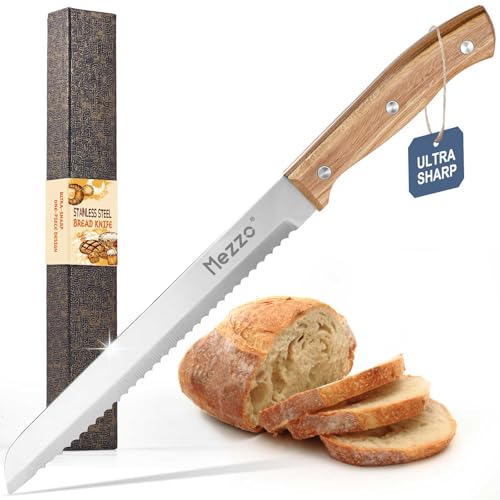
Mezzo 8-Inch Serrated Bread Knife
Best for: Slicing homemade sourdough and crusty breads
- Blade Material
- High-Carbon Steel (what this guide is about)
- Blade Length
- 8"
- Knife Type
- Bread Knife
- Construction
- Fully forged
- Edge Type
- Serrated
- Handle Material
- Acacia wood
The Mezzo 8-Inch Serrated Bread Knife is a dedicated slicing tool built with a high-carbon steel serrated blade. Its fully forged full-tang construction connects directly to a triple-riveted acacia wood handle. At 0.41 pounds, it provides lightweight balance for your food prep. You will find it useful if you regularly cut sourdough loaves, baguettes, cakes, or large fruits and need a purpose-built serrated knife instead of a chef knife.
Pros
- Fully forged full-tang construction
- Triple-rivet acacia wood handle
- Lightweight 0.41-pound build
- Serrated 8-inch blade for bread and cakes
Cons
- Serrated edge profile is not suited for fine mincing or chopping
- Acacia wood handle requires hand washing care
Good fit if
- You want an 8-inch serrated knife for sourdough, baguettes, and cakes.
- You prefer a full-tang forged knife with a triple-riveted wooden handle.
Skip if
- You need an all-purpose straight-edge chef knife for general cutting.
- You want a blade longer than 8 inches for oversized loaves.
Verdict: Mezzo 8-Inch Serrated Bread Knife provides a forged, full-tang serrated option for slicing crusty loaves and delicate baked goods. Its 0.41-pound weight and acacia wood handle make it a dedicated slicing tool for your kitchen.

SANMEIHO 6-Inch High-Carbon Chef Knife
Best for: cooks with small hands wanting precise control
- Blade Material
- High-Carbon Steel (what this guide is about)
- Blade Length
- 6"
- Knife Type
- Chef
- Handle Material
- Red sandalwood
- Color
- White
- Style
- Japanese
This Japanese-style chef knife pairs a 6-inch high-carbon steel blade with a lightweight 0.25-pound profile. At 1.85 inches wide and 0.1 inches thick, it offers a compact cutting surface designed for agility. The ergonomic red sandalwood handle suits cooks with smaller hands who need maneuverability for slicing, chopping, dicing, and sashimi prep without hand fatigue. You get high-carbon steel performance in a scaled-down format.
Pros
- Lightweight 0.25-pound build reduces hand fatigue
- Japanese high-carbon steel provides edge retention
- Ergonomic red sandalwood handle
- Compact 6-inch length allows precise control
Cons
- Shorter 6-inch reach compared to standard 8-inch chef knives
- Lightweight 0.25-pound frame provides less heft for heavy butchering tasks
Good fit if
- You have smaller hands and want a compact 6-inch blade.
- You prioritize a lightweight 0.25-pound knife for detailed slicing and prep work.
- You want a Japanese high-carbon steel knife with a red sandalwood handle.
Skip if
- You prefer a standard 8-inch or 10-inch chef knife for larger food items.
- You want a heavier blade with more mass behind each cut.
Verdict: SANMEIHO 6-Inch Japanese High-Carbon Chef Knife delivers high-carbon steel cutting performance in a lightweight, compact footprint tailored for smaller hands. Its 0.25-pound build and red sandalwood handle provide easy control for detailed kitchen prep.

TUO 8-Inch Chef Knife with Pakkawood Handle
Best for: cooks wanting an ergonomic pakkawood grip
- Blade Material
- High-Carbon Steel (what this guide is about)
- Blade Length
- 8"
- Knife Type
- Chef Knife
- Edge Angle
- 14 degrees per side
- Blade Hardness
- HRC56+2
- Handle Material
- Pakkawood
The TUO 8-Inch Pakkawood Chef Knife combines an 8-inch German high-carbon steel blade with an ergonomic pakkawood handle. Its edge is sharpened to 14 degrees per side using the Honbazuke method and heat-treated to HRC 56±2. Weighing 0.46 pounds, it provides a balanced profile with a polished bolster. It suits you if you want standard kitchen knife proportions with wood composite handling.
Pros
- German high-carbon steel heat-treated to HRC 56±2
- Honbazuke edge ground to 14 degrees per side
- Ergonomic pakkawood handle with a polished bolster
- Lightweight construction at 0.46 pounds
Cons
- Lower steel hardness than typical Japanese alternatives
- Does not include an individual blade sheath
Good fit if
- You want an 8-inch chef knife paired with a moisture-resistant pakkawood handle.
- You prefer German high-carbon steel sharpened to an acute 14-degree angle per side.
Skip if
- You need ultra-hard steel rated above HRC 60 for edge retention.
- You prefer synthetic or non-wood handle materials.
Verdict: TUO 8-Inch Pakkawood Chef Knife delivers a sharp 14-degree cutting edge backed by a solid pakkawood grip. Its HRC 56±2 German steel provides dependable everyday resilience.

HOSHANHO 8-Inch 10Cr15MoV Chef Knife
Best for: acute 12-degree precision slicing and chopping
- Blade Material
- High-Carbon Steel (what this guide is about)
- Blade Length
- 8"
- Knife Type
- Chef Knife
- Construction
- 9 layers composite
- Edge Angle
- 12°
- Blade Hardness
- 62 HRC
This 8-inch chef knife features a 9-layer composite blade with a 10Cr15MoV high-carbon steel core hardened to 62 HRC. It has a hand-polished 12-degree cutting edge designed for both left- and right-handed users. The handle is made from rosewood with brass studs, bringing total weight to roughly 0.48 pounds. It suits you if you want a hard Japanese-style blade with a balanced rosewood grip.
Pros
- 10Cr15MoV high-carbon steel core rated at 62 HRC hardness
- Hand-sharpened 12-degree edge built for left- and right-handed cutting
- Nine-layer composite structure with a Kurouchi Tsuchime hammered finish
- Ergonomic rosewood handle accented with brass studs
Cons
- Rosewood handle requires hand washing and natural wood care
- No storage sheath or protective blade guard included
Good fit if
- You want a hard 62 HRC core with an acute 12-degree cutting edge.
- You prefer a natural hardwood rosewood handle over synthetic materials.
- You need an ambidextrous knife suitable for left- or right-handed use.
Skip if
- You want a dishwasher-safe knife with a synthetic handle.
- You require a chef knife that includes a sheath or storage block.
Verdict: HOSHANHO 8-Inch 10Cr15MoV Chef Knife pairs an acute 12-degree cutting edge with a 62 HRC high-carbon core. It gives you a balanced rosewood grip suited for precise slicing and chopping.

HOSHANHO 6-Inch Viking Knife
Best for: heavy meat trimming and outdoor cooking prep
- Blade Material
- High-Carbon Steel (what this guide is about)
- Blade Length
- 6"
- Knife Type
- Viking Chef Knife
- Construction
- Hand-forged
- Edge Angle
- 15°
- Blade Hardness
- 58-60HRC
This 6-inch specialty knife features Japanese high-carbon steel heat-treated to 58-60 HRC with a 15-degree cutting edge. At 0.7 pounds, it provides solid heft alongside a full-tang handle fastened by three stainless steel rivets. The curved blade profile and upward tip suit butcher tasks, chopping, and slicing meat or vegetables. If you want a compact, heavy-duty cleaver-style tool with a curved edge profile, this knife fits your kitchen workflow.
Pros
- Japanese high-carbon steel hardened to 58–60 HRC
- Full-tang construction secured with three stainless steel rivets
- Factory 15° cutting angle for sharp slicing
- Curved butcher profile with an upward piercing tip
Cons
- Weighs 0.7 pounds, heavier than standard 6-inch prep knives
- Curved profile is less practical for flat push-cutting on boards
- Carbon content is specified at 0.12%–0.20%
Good fit if
- You need a compact 6-inch blade designed for butcher work and meat cutting.
- You prefer a full-tang tool with a 15-degree edge angle and riveted wooden handle.
- You want a sturdy curved blade for jointing, slicing, or camp cooking.
Skip if
- You want a standard flat-profile chef knife or gyuto for everyday dicing.
- You prefer an ultralight knife under half a pound for prolonged prep work.
Verdict: HOSHANHO 6-Inch Viking Knife delivers a rigid full-tang build and 58–60 HRC steel tailored for heavy meat prep and outdoor cooking. Its curved edge and 0.7-pound weight give you controlled cutting leverage in a compact format.

PAUDIN 12-Inch High-Carbon Steel Carving Knife
Best for: slicing brisket, turkey, and large roasts
- Blade Material
- High-Carbon Steel (what this guide is about)
- Blade Length
- 12 in
- Knife Type
- Carving knife
- Construction
- Forged
- Edge Type
- Granton
- Edge Angle
- 15°
View on Amazon: PAUDIN 12-Inch High-Carbon Steel Carving Knife
This 12-inch carving knife gives you a long, high-carbon steel blade designed for slicing large cuts of meat like brisket, roasts, and turkey. It features a 56+ Rockwell hardness rating, a hand-sharpened 15-degree edge, and a granton blade pattern to reduce drag. The 17.13-inch overall length and pakkawood handle suit you if you prepare whole barbecue cuts or holiday roasts and need clean single-stroke slices.
Pros
- 12-inch blade with granton dimples to prevent food sticking
- High-carbon steel forged to 56+ Rockwell hardness
- Hand-sharpened 15-degree edge for precise cuts
- Ergonomic pakkawood handle for grip stability
Cons
- Long 17.13-inch footprint requires substantial storage space
- Narrow slicing profile lacks versatility for general kitchen prep
Good fit if
- You frequently portion large cuts such as brisket, turkey, or roasts.
- You want a granton-edge blade to prevent slices from clinging to the steel.
Skip if
- You need an everyday multipurpose chef knife for dicing vegetables.
- You lack storage space for a knife measuring over 17 inches long.
Verdict: PAUDIN 12-Inch High-Carbon Steel Carving Knife delivers an extended granton-edge blade engineered for clean, continuous meat slicing. It provides the reach and edge geometry needed for barbecue and roasts without unnecessary weight.

BOLEXINO 10-Inch High-Carbon Chef Knife
Best for: cutting large produce and large meat cuts
- Blade Material
- High-Carbon Steel (what this guide is about)
- Blade Length
- 10 in
- Knife Type
- Chef knife
- Color
- White
- Weight
- 8.48 ounces
The BOLEXINO 10-Inch High-Carbon Chef Knife gives you a 10-inch Japanese SUS420J2 high-carbon stainless steel blade with a 2.1 mm thickness. Weighing 0.53 pounds, it provides extra leverage and reach over standard 8-inch chef knives for breaking down large items like melons or roasts. The non-slip handle includes an integrated finger guard. It suits you if you need a longer blade for single-stroke slicing during heavy kitchen prep.
Pros
- Long 10-inch blade delivers high cutting leverage for large foods
- Japanese SUS420J2 high-carbon stainless steel resists rust and wear
- Slim 2.1 mm blade spine profile cuts with minimal resistance
- Ergonomic handle includes a built-in protective finger guard
Cons
- Large 10-inch length is harder to maneuver in compact prep spaces
- Requires hand drying and care despite listed dishwasher compatibility
Good fit if
- You regularly cut large items like watermelons, cabbages, or large roasts.
- You prefer the leverage and stroke length of a 10-inch blade over an 8-inch knife.
- You want an ergonomic non-slip handle with built-in finger protection.
Skip if
- You have limited counter space and need a more compact 6- or 8-inch knife.
- You prefer dedicated thin-blade Japanese prep knives for fine detail work.
Verdict: BOLEXINO 10-Inch High-Carbon Chef Knife delivers extended reach and leverage via its 2.1 mm Japanese SUS420J2 steel blade. It serves as an effective workhorse when standard 8-inch chef knives fall short on oversized foods.

WICKWILLOW 5-Inch High-Carbon Utility Knife
Best for: everyday mid-sized cutting and precision trimming
- Blade Material
- High-Carbon Steel (what this guide is about)
- Blade Length
- 5 in
- Knife Type
- Utility knife
- Construction
- Forged
- Blade Hardness
- 56-58 HRC
- Style
- German
The WICKWILLOW 5-Inch High-Carbon Utility Knife gives you a compact 5-inch blade forged from German X50CrMoV15 steel. Tempered to 56–58 HRC, it resists rust and corrosion while holding an edge through daily kitchen prep. Weighing just 0.22 pounds with a 9.9-inch overall length, this knife suits you if you need a lightweight, maneuverable tool for smaller slicing and trimming tasks where full-sized chef knives feel too bulky.
Pros
- Forged from German X50CrMoV15 high-carbon stainless steel
- Tempered to 56–58 HRC for rust and corrosion resistance
- Lightweight build weighing 0.22 pounds
Cons
- 5-inch blade is too short for large butchering or slicing tasks
- No blade sheath or edge guard included in specs
Good fit if
- You want a lightweight 0.22-pound blade for mid-sized cutting tasks.
- You need German X50CrMoV15 steel with corrosion resistance.
Skip if
- You need a broad 8-inch chef knife for carving and heavy chopping.
- You prefer ultra-hard steel tempered above 60 HRC.
Verdict: WICKWILLOW 5-Inch High-Carbon Utility Knife provides German X50CrMoV15 steel in a nimble, 0.22-pound profile. It handles daily mid-sized slicing tasks where larger kitchen blades are impractical.

SHAN ZU 8-Inch 67-Layer Damascus Chef Knife
Best for: everyday slicing with layered Damascus steel
- Blade Material
- High-Carbon Steel (what this guide is about)
- Blade Length
- 8 inch
- Knife Type
- Chef Knife
- Construction
- 67 Layers of Steel Forged
- Edge Type
- V-shaped
- Edge Angle
- 15°
This 8-inch chef knife features a 10Cr15MoV high-carbon steel core surrounded by 66 layers of folded Damascus steel. Rated at 62 HRC, it carries a 15-degree edge bevel on both sides for symmetrical slicing. A 4.5-inch G10 fiberglass handle provides moisture resistance and balance. If you want a hard, wear-resistant high-carbon steel blade with layered Damascus construction for everyday kitchen prep, this knife matches your cutting needs.
Pros
- 10Cr15MoV high-carbon core hardened to 62 HRC
- 67-layer Damascus steel construction
- Symmetrical 15-degree double-bevel cutting edge
- Durable, moisture-resistant G10 fiberglass handle
Cons
- Not suitable for cutting bones or frozen foods
- Blade requires immediate drying after washing to prevent corrosion
Good fit if
- You want an 8-inch chef knife with a hard 62 HRC high-carbon core.
- You need a double-bevel edge suitable for left- or right-handed use.
- You prefer a non-porous G10 fiberglass handle over wood.
Skip if
- You need a cleaver or blade rated for chopping bones and frozen items.
- You prefer a knife with a traditional wooden handle.
Verdict: SHAN ZU 8-Inch 67-Layer Damascus Chef Knife delivers high hardness and edge retention through its 62 HRC 10Cr15MoV steel core and layered Damascus cladding. Its durable G10 handle and symmetrical bevel make it a versatile tool for daily slicing tasks.

KAWAHIRO 8-Inch VG10 Hand-Forged Chef Knife
Best for: precision slicing with high-hardness Japanese steel
- Blade Material
- High-Carbon Steel (what this guide is about)
- Blade Length
- 8 in
- Knife Type
- Chef Knife
- Construction
- Hand-forged, San Mai
- Edge Angle
- 15°
- Blade Hardness
- 60–62 HRC
The KAWAHIRO 8-inch chef knife features a three-layer San Mai construction with a VG10 high-carbon steel core. The blade reaches a 60–62 HRC hardness rating and is ground to a 15-degree edge angle. At 6.72 ounces, it balances lightweight handling with a 13.2-inch total length. If you want a traditional Kuro-uchi finish paired with an octagonal wood handle, this knife matches everyday slicing needs.
Pros
- VG10 high-carbon steel core with 60–62 HRC hardness
- Three-layer San Mai forged build with a black-forged Kuro-uchi finish
- Acute 15-degree cutting edge angle
- Octagonal handle crafted from ebony, turquoise, and ruby wood
Cons
- High-hardness 60–62 HRC steel requires careful handling to prevent chipping
- Includes a display box rather than a daily-use blade guard or sheath
Good fit if
- You want an acute 15-degree cutting edge for detailed slicing tasks.
- You prefer a hard 60–62 HRC high-carbon core for prolonged edge retention.
- You favor a classic Japanese octagonal handle profile.
Skip if
- You need a softer steel blade suited for rough tasks like cutting through bones.
- You prefer an ergonomic contoured Western handle over straight octagonal wood.
Verdict: KAWAHIRO 8-Inch San Mai VG10 Chef Knife provides high edge retention and precise 15-degree geometry with its 60–62 HRC core. The traditional octagonal handle gives you balanced control during daily slicing tasks.

Dexter 9-Inch Offset Scalloped Slicer
Best for: slicing crusty bread and roasts with clearance
- Blade Material
- High-Carbon Steel (what this guide is about)
- Blade Length
- 9"
- Knife Type
- Offset Scalloped Slicer
- Edge Type
- Scalloped
- Handle Material
- Polypropylene, Santoprene
- Dimensions
- 19.6 × 4.88 × 4.13 inches
This Dexter slicer gives you a 9-inch high-carbon steel blade with an offset profile and a scalloped cutting edge. The raised handle design keeps your knuckles clear of the board while slicing crusty bread, roasts, or melons. Weighing 7.2 ounces, it pairs a stain-free high-carbon blade with a slip-resistant polypropylene and Santoprene grip. It suits you if you need leverage and hand clearance for slicing baked goods and meats.
Pros
- Offset blade profile keeps knuckles above the cutting board
- 9-inch stain-free high-carbon steel blade
- Scalloped edge slices crusts and rinds without crushing interiors
- Polypropylene and Santoprene handle with integrated finger guard
Cons
- Scalloped edge profile is unsuitable for chopping or mincing
- Offset blade design limits compatibility with standard knife blocks
Good fit if
- You need knuckle clearance when slicing wide loaves or roasts on a flat board.
- You want a serrated high-carbon blade specifically shaped for leverage.
- You prefer a textured synthetic handle with an integrated finger guard.
Skip if
- You want a flat-edged chef knife for general prep work and chopping.
- You prefer a traditional in-line blade profile rather than an offset design.
Verdict: Dexter 9-Inch Offset Scalloped Slicer provides dependable knuckle clearance and clean cutting on crusty breads and meats with its stain-free high-carbon steel blade.
Specifications side by side
| Spec | Mercer Culinary Millennia 7-Inch High-Carbon Usuba Knife | Imarku 14-Piece High-Carbon Steel Knife Block Set | HOSHANHO 8-Inch Japanese High-Carbon Chef Knife | SHAN ZU 8-Inch 10Cr15MoV Chef Knife | Mezzo 8-Inch Serrated Bread Knife | SANMEIHO 6-Inch High-Carbon Chef Knife | TUO 8-Inch Chef Knife with Pakkawood Handle | HOSHANHO 8-Inch 10Cr15MoV Chef Knife | HOSHANHO 6-Inch Viking Knife | PAUDIN 12-Inch High-Carbon Steel Carving Knife | BOLEXINO 10-Inch High-Carbon Chef Knife | WICKWILLOW 5-Inch High-Carbon Utility Knife | SHAN ZU 8-Inch 67-Layer Damascus Chef Knife | KAWAHIRO 8-Inch VG10 Hand-Forged Chef Knife | Dexter 9-Inch Offset Scalloped Slicer |
|---|---|---|---|---|---|---|---|---|---|---|---|---|---|---|---|
| Blade Length | 7-inch | not specified | 8 inch | 8 Inch | 8" | 6" | 8" | 8" | 6" | 12 in | 10 in | 5 in | 8 inch | 8 in | 9" |
| Knife Type | Usuba Knife | not specified | Chef's Knife | Chef Knife | Bread Knife | Chef | Chef Knife | Chef Knife | Viking Chef Knife | Carving knife | Chef knife | Utility knife | Chef Knife | Chef Knife | Offset Scalloped Slicer |
| Blade Material | High-carbon Japanese steel | High-carbon stainless steel | 10Cr15CoMoV | 10Cr15MoV high carbon steel | High carbon stainless steel | Japanese high carbon steel | German high-carbon stainless steel | 10CR15MOV steel | Japanese high carbon stainless steel | High-carbon steel | Japanese SUS420J2 stainless steel | X50CrMoV15 German high-carbon steel | Japanese damascus steel 10Cr15MoV | VG10 high-carbon steel | High-Carbon Steel |
| Construction | not specified | Precision-forged | not specified | 9-layer forged | Fully forged | not specified | not specified | 9 layers composite | Hand-forged | Forged | not specified | Forged | 67 Layers of Steel Forged | Hand-forged, San Mai | not specified |
| Edge Type | not specified | not specified | not specified | not specified | Serrated | not specified | not specified | not specified | not specified | Granton | not specified | not specified | V-shaped | not specified | Scalloped |
| Edge Angle | not specified | 10–15° | 13 degree | 12° | not specified | not specified | 14 degrees per side | 12° | 15° | 15° | not specified | not specified | 15° | 15° | not specified |
| Blade Hardness | not specified | not specified | up to 60 HRC | 62 HRC | not specified | not specified | HRC56+2 | 62 HRC | 58-60HRC | 56+ HRC | not specified | 56-58 HRC | 62 HRC | 60–62 HRC | not specified |
| Handle Material | not specified | not specified | Wood | Red sandalwood | Acacia wood | Red sandalwood | Pakkawood | Rosewood | Wood | Pakkawood | not specified | not specified | G10 fiberglass | Ebony, turquoise, ruby wood | Polypropylene, Santoprene |
| Storage Type | not specified | Knife Block | not specified | not specified | not specified | not specified | not specified | not specified | not specified | not specified | not specified | not specified | not specified | not specified | not specified |
| Blade Profile | not specified | not specified | not specified | not specified | not specified | not specified | not specified | not specified | not specified | not specified | not specified | not specified | not specified | not specified | Offset |
| Color | Black | Silver/Brown | 8 inch Chef Knife | Chef Knife | Acacia | White | Brown | Silver | Silver | Silver, Brown | White | Black - Utility Knife | 67-Layer Damascus Steel | 8" Chef Knife | Yellow |
| Style | not specified | not specified | Japanese | Japanese | not specified | Japanese | not specified | not specified | not specified | not specified | not specified | German | not specified | Japanese | not specified |
| Dimensions | 5 × 1 × 18 inches | 10.1 × 7.09 × 14.6 inches | not specified | 33.5 × 4.5 × 1.5 inches | not specified | 6 × 1.85 × 0.1 inches | 1 × 1 × 1 inches | not specified | not specified | 17.1 × 1.18 × 0.09 inches | not specified | 9.9 × 1 × 0.7 inches | 14.2 × 2.17 × 0.1 inches | 13.2 × 1.9 × 0.14 inches | 19.6 × 4.88 × 4.13 inches |
| Weight | 2.08 ounces | 9.04 pounds | 12.3 ounces | 9.59 ounces | 6.56 ounces | 4 ounces | 7.36 ounces | 7.69 ounces | 11.2 ounces | 9.12 ounces | 8.48 ounces | 3.52 ounces | 1.6 ounces | 6.72 ounces | 7.2 ounces |
| Length | not specified | not specified | 13.5 inches | not specified | not specified | not specified | not specified | not specified | not specified | not specified | not specified | not specified | not specified | not specified | not specified |
| Size | 7" | 14 Pcs | 8" | 8" | 8" | 6" | 8" | 8" | 6" | 12" | 10" | 5" | 8" | 8" | 9" |
| Model | M22907 | ZCD-0292-Brown | 8 inch Chef Knife | SZES-2025-001-1 | ME002 | SMHCS-2025-07-2 | TUO-TC0703 | 8 Inch Chef Knife | 6 Inch Viking Knife | not specified | 10 inch | WWVELINA105 | SZPCS-2018-001 | KH-6603 | 36008Y |
Is High-Carbon Steel Worth It for Your Kitchen?
High-carbon steel alters how your knife holds an edge during daily cutting. Listings in this lineup feature hardness levels spanning from 56±2 HRC German steel up to 62 HRC in 10Cr15MoV cores. This structural hardness allows manufacturers to grind factory bevels to acute angles, ranging from 14 degrees down to 10 to 12 degrees. In practical kitchen use, these narrow bevel angles reduce cutting resistance through meat and dense produce. The steel retains these acute factory profiles through repeated prep work, provided you match the blade hardness to your cutting task.
Worth it if
- You want factory cutting edges ground to acute 10- to 14-degree angles for low-resistance slicing.
- You target hard steel specifications between 58 and 62 HRC for sustained cutting performance.
Skip it if
- You regularly cut through hard bone rather than focusing on boneless meal prep and vegetable slicing.
- You prefer standard stainless formulations over designated high-carbon alloys like 10Cr15MoV or X50CrMoV15.
If you need outdoor equipment built to resist corrosion, compare the metal thickness and burner specs across the best stainless steel grills.
How We Picked These Knives
You find 15 high-carbon steel kitchen knives in this guide. Each model comes from Amazon listings where the title or feature list states high-carbon steel blade material. Only one size or variant from each product family is shown. All details come directly from published specifications and feature lists. Products are not physically handled.
The guide ranks products in stock first, then by Amazon sales rank (better-selling products first), and finally by how many guide criteria their published specifications meet. Stock availability updates live on the page and refreshes at least daily. This approach ensures you see available high-carbon options based purely on verified catalog data.
How to Choose High-Carbon Kitchen Knives
-
Select the Right Blade Length
Blade length determines how much cutting surface you control at once. Compact blades between 5 and 6 inches suit delicate trimming and tight cutting boards. Standard 8-inch blades handle routine chopping tasks. If you frequently prep oversized proteins or large produce, consider an extended blade length. The BOLEXINO 10-Inch High-Carbon Chef Knife provides extra reach and leverage with its 10-inch blade. Check your counter space and cutting board dimensions before buying to make sure a longer blade fits your kitchen work area.
-
Compare Knife Weight for Control
Knife weight alters cutting rhythm and hand fatigue during meal preparation. Lightweight models under 0.3 pounds allow swift, agile maneuvering for detailed trimming. Heavier knives use gravity to glide through firm foods with less downward hand pressure. For example, the HOSHANHO 8-Inch Japanese High-Carbon Chef Knife weighs 0.77 pounds, providing substantial heft for downward chopping strokes. Check the product weight specification to match your hand strength. Choose lighter blades for prolonged prep sessions and heavier tools for denser ingredients.
-
Check the Cutting Edge Angle
High-carbon steel allows manufacturers to grind blade edges to acute bevels without sacrificing steel stability. Narrow angles, such as 12 degrees per side, create razor-sharp profiles that slice soft foods cleanly with minimal resistance. Moderate angles, such as the 14-degree edge on the TUO 8-Inch Chef Knife, trade a fraction of sharpness for greater edge stability against repeated board contact. Check the bevel angle specification to match your cutting style. Choose lower angles for fine slicing and slightly wider angles for general daily prep.
-
Choose Serrated or Plain Edges
Blade edge style determines how the knife engages with food surfaces. Standard straight edges produce clean, smooth slices through meats and vegetables when you apply push or pull strokes. In contrast, serrated profiles feature pointed teeth designed to grip tough exterior crusts without squashing soft interiors. The Mezzo 8-Inch Serrated Bread Knife provides a dedicated serrated edge specifically configured for crusty sourdough and delicate baked goods. Check the edge type specification to ensure you get the right profile for your prep tasks.
-
Evaluate Handle Material and Grip
Handle materials affect grip comfort, balance, and moisture resistance during extended food prep. Natural woods like rosewood, acacia, and red sandalwood provide traditional warmth and distinct textures but require dry storage. Synthetic materials and composites offer uniform density and resist water absorption. The SHAN ZU 8-Inch 67-Layer Damascus Chef Knife incorporates a durable G10 composite handle designed for stable handling. Check the handle material specification to determine whether you prefer the feel of natural hardwood or the resilient moisture tolerance of composite materials.
Frequently asked questions
What handle materials are used on high-carbon steel kitchen knives?
High-carbon kitchen knives feature synthetic composites and treated natural woods. Synthetic options like the G10 handle on the SHAN ZU Damascus chef knife provide moisture resistance and structural durability. Natural wood options include the red sandalwood handle on the SANMEIHO 6-inch knife, acacia wood on the Mezzo bread knife, and pakkawood on the TUO 8-inch chef knife. Octagonal profiles, found on FINDKING and SHAN ZU models, offer traditional Japanese ergonomics.
How do you maintain high-carbon steel blades to prevent rust?
You must wash high-carbon blades by hand and dry them immediately after use. High-carbon steel contains less chromium than standard stainless steel, making it susceptible to moisture and oxidation. Avoid machine dishwashers and standing water. For routine edge upkeep, sets like the Imarku 14-Piece collection include built-in block sharpening to realign edges without needing separate stones. Always store blades completely dry in a wooden block or protective sheath.
What blade edge angles do high-carbon knives feature?
High-carbon steel kitchen knives typically feature factory edge angles ranging between 10 and 15 degrees per side. For example, the HOSHANHO 8-inch 10Cr15MoV and SHAN ZU 8-inch models feature acute 12-degree cutting angles, while the TUO 8-inch knife uses a 14-degree profile. The Imarku 14-piece set blades are sharpened between 10 and 15 degrees. These narrow angles provide sharper cutting edges compared to wider Western profiles.
What is the difference between a high-carbon usuba knife and a chef knife?
An usuba knife is engineered specifically for chopping vegetables, whereas a chef knife serves as an all-purpose tool for slicing meats and produce. The Mercer Culinary Millennia 7-inch usuba knife weighs only 0.13 pounds and focuses entirely on produce mincing and slicing. In contrast, 8-inch high-carbon chef knives provide curved belly profiles and weights between 0.46 and 0.77 pounds to handle varied prep tasks across proteins and root vegetables.
Can you cut bones with a high-carbon steel kitchen knife?
You should avoid cutting through dense animal bones with standard high-carbon chef knives. Hardened cores, such as the 62 HRC steel in SHAN ZU and HOSHANHO knives, prioritize edge sharpness and retention over impact resistance, risking chips against bone. For meat preparation involving poultry joints or trimming near bone, use specialized designs like the Dexter 6-inch flexible boning knife or the HOSHANHO 6-inch Viking knife designed for meat trimming.
Why do blade weights vary significantly among high-carbon kitchen knives?
Blade weight varies based on blade dimensions, tang construction, and intended cutting tasks. Ultra-light models like the 0.1-pound SHAN ZU Damascus or the 0.13-pound Mercer usuba prioritize maneuverability and reduce fatigue during fine vegetable work. Conversely, heavier tools like the 0.77-pound HOSHANHO chef knife or the 0.7-pound Viking knife provide extra downward mass and robust full-tang construction, delivering greater leverage when cutting through thick produce or dense meat.
What steel grades are commonly found in high-carbon kitchen knives?
Manufacturers use several specific high-carbon alloy formulations depending on desired hardness and corrosion resistance. Models on this list utilize Chinese 10Cr15CoMoV and 10Cr15MoV compositions reaching 62 HRC, such as those from HOSHANHO and SHAN ZU, alongside 9Cr18MoV in FINDKING knives. Other knives feature German alloys like X50CrMoV15 in the WICKWILLOW utility knife and 56±2 HRC steel in the TUO chef knife, or Japanese SUS420J2 steel in the BOLEXINO knife.