High-Carbon Stainless Steel vs Damascus Steel Cleavers in 2026: Key Differences
As an Amazon Associate we earn from qualifying purchases. Links on this page are affiliate links.
Choosing between a high carbon stainless steel vs damascus steel cleaver depends on your specific kitchen needs. Both the imarku and KYOKU models are 7-inch forged Japanese-style cleavers designed for precision chopping and slicing. They share a focus on sharpness and ergonomic handling. The main difference lies in their blade composition. The imarku uses a single high-carbon stainless steel alloy, while the KYOKU features a VG10 core wrapped in Damascus layers. This structural variation affects hardness, maintenance, and visual appeal.
Key differences
| Aspect | imarku 7-Inch High-Carbon Steel Cleaver | KYOKU Shogun Series 7" Forged Damascus Cleaver |
|---|---|---|
| Blade Material | Japanese high carbon stainless steel | VG10 Japanese Damascus steel core |
| Hardness | 57+1 HRC | 58-60 HRC |
| Handle Material | FSC certified Pakkawood | Triple-riveted G10 |
| Edge Angle | 15° double side | 8-12° double side |
| Included Storage | Gift box | Sheath and case |
Which one should you choose?
Choose imarku 7-Inch High-Carbon Steel Cleaver if
- You prefer a blade that is easier to resharpen with basic tools
- You want a handle made from natural wood for a traditional feel
- You prioritize rust resistance with minimal maintenance effort
Choose KYOKU Shogun Series 7" Forged Damascus Cleaver if
- You need extreme hardness and edge retention for heavy daily use
- You want a handle that is impervious to heat, cold, and moisture
- You prefer a sharper factory edge with a protective sheath included
Verdict: The imarku cleaver suits users who want low-maintenance durability and a natural wood handle. The KYOKU cleaver is better for those seeking maximum sharpness, a waterproof G10 handle, and included storage. Your choice depends on whether you value ease of care or peak performance specs.
High-Carbon vs Damascus Cleaver Specs
Blade Material
The imarku cleaver uses Japanese high carbon stainless steel, a single-piece alloy chosen for its balance of hardness and corrosion resistance. This material is designed to resist rust while holding a reliable edge for daily tasks. The KYOKU cleaver features a VG-10 Japanese Damascus steel core. This construction involves a hard steel core wrapped in softer layers, creating a layered pattern. The VG-10 core is cryogenically treated to enhance its structural integrity and edge retention. While both steels are Japanese-made, the imarku offers a uniform stainless composition, whereas the KYOKU provides the distinct layered aesthetic and core hardness of Damascus steel. Each material serves different preferences for maintenance and visual appeal.
Hardness
Blade hardness significantly impacts edge retention and sharpening difficulty. The imarku cleaver has a hardness rating of 57+1 HRC. This level provides good wear resistance and is generally easier to sharpen for home users. The KYOKU cleaver boasts a higher hardness range of 58-60 HRC. This increased hardness comes from the VG-10 core and cryogenic treatment, offering superior edge retention for longer periods between sharpenings. The higher HRC on the KYOKU model means it stays sharper longer but may require more care during sharpening to avoid chipping. For users prioritizing long-lasting sharpness, the KYOKU offers a technical advantage, while the imarku provides a more moderate hardness suitable for frequent maintenance.
Edge Angle
The cutting angle determines how sharp the blade feels and how durable the edge is. The imarku cleaver is hand-sharpened to a 15° angle on each side. This double-sided angle offers a balance between sharpness and durability, making it suitable for general chopping and slicing tasks. The KYOKU cleaver is sharpened to an even finer 8-12° angle using the traditional Honbazuke method. This extremely acute angle provides superior initial sharpness and precision, allowing for cleaner cuts through delicate vegetables and meats. However, such a thin edge may require more careful handling to prevent rolling or chipping. The KYOKU offers a sharper cutting experience, while the imarku provides a more robust edge angle for tougher jobs.
Handle Material
The handle material affects grip comfort, durability, and moisture resistance. The imarku cleaver features an FSC certified Pakkawood handle. This wood-based material is known for its sturdiness and corrosion resistance, offering a traditional look and comfortable ergonomic shape that reduces hand fatigue. The KYOKU cleaver uses a triple-riveted G10 handle. G10 is a fiberglass-based laminate that is extremely impervious to heat, cold, and moisture. It is often preferred in professional environments for its durability and low maintenance. The KYOKU handle also includes a mosaic pin for added aesthetic detail. While Pakkawood offers a classic feel, G10 provides superior resistance to environmental factors and wear.
Included Storage
Storage options are important for blade protection and kitchen organization. The imarku cleaver does not list any included storage accessories in its specifications. It is sold as a standalone knife, requiring you to provide your own sheath or storage block. The KYOKU cleaver includes a protective sheath and case. These accessories help preserve the blade's sharpness and keep it secure when not in use. The included guard and case ensure the knife remains clean and protected. This addition provides immediate value for safety and maintenance. The imarku leaves storage to the user, while the KYOKU offers a complete package with built-in protection for the blade.
Which Cleaver Suits Your Needs
Budget-conscious home cooks
The imarku cleaver uses Japanese high carbon stainless steel at 57+1 HRC hardness. Its 2.4 mm blade thickness and 15-degree edge angle provide reliable chopping power for daily tasks. The FSC certified Pakkawood handle offers corrosion resistance and comfort. This model balances durability with ease of maintenance for everyday kitchen use without premium costs.
Serious enthusiasts seeking sharpness
The KYOKU cleaver features a VG-10 Damascus steel core hardened to 58-60 HRC. Its 8-12 degree double-sided edge delivers superior sharpness for precise slicing. The triple-riveted G10 handle resists moisture and heat, ensuring a secure grip. This construction prioritizes edge retention and cutting performance for users who demand professional-grade results in their vegetable and meat prep.
Users wanting protective storage
The KYOKU cleaver includes a protective sheath and case to keep the blade safe. Its full tang construction and VG-10 Damascus steel core offer robust durability. The G10 handle provides stability during heavy chopping. This inclusion ensures the knife remains secure and clean when not in use, making it ideal for those who value organized and protected tool storage.
Quick picks
| # | Product | Best for | Price |
|---|---|---|---|
| 1 | imarku 7-Inch High-Carbon Steel Cleaver | Daily chopping and versatile kitchen tasks | Check price of imarku 7-Inch High-Carbon Steel Cleaver on Amazon |
| 2 | KYOKU Shogun Series 7" Forged Damascus Cleaver | Lightweight vegetable and meat slicing | Check price of KYOKU Shogun Series 7" Forged Damascus Cleaver on Amazon |
The products compared

imarku 7-Inch High-Carbon Steel Cleaver
Best for: Daily chopping and versatile kitchen tasks
- Blade Material
- High-Carbon Stainless Steel (what this guide is about)
- Blade Length
- 7 Inch
- Intended Use
- Meat and vegetable
- Blade Steel
- Japanese high carbon stainless steel
- Handle Material
- Pakkawood
- Construction
- Forged
View on Amazon: imarku 7-Inch High-Carbon Steel Cleaver Affiliate link
This imarku cleaver uses Japanese high carbon stainless steel forged into a 7-inch blade. The steel reaches 57+1 HRC for hardness, while the 2.4mm thickness balances strength with maneuverability. You get a 15-degree double-edge angle for sharpness. The FSC certified Pakkawood handle offers corrosion resistance and comfort. It suits those who want a versatile, easy-to-maintain tool for daily chopping and slicing tasks.
Pros
- Forged from Japanese high carbon stainless steel
- 57+1 HRC hardness rating for edge retention
- 15-degree double-side sharpening angle
- 2.4mm blade thickness for durability
- FSC certified Pakkawood handle
Cons
- Heavier at 11.8 ounces compared to lighter options
- No full tang construction specified in data
- Limited to single blade thickness of 2.4mm
Good fit if
- You want a versatile knife for chopping and boning
- You prefer the balance of a forged blade
- You need a knife that is easy to resharpen
Skip if
- You require a ultra-thin blade for delicate slicing
- You prefer a lighter weight tool under 10 ounces
- You need a Damascus steel pattern finish
Verdict: The imarku 7" Japanese High Carbon Cleaver delivers reliable performance through its 57+1 HRC steel and ergonomic Pakkawood handle. It fits home cooks who value a sturdy, multi-purpose tool for daily prep work.
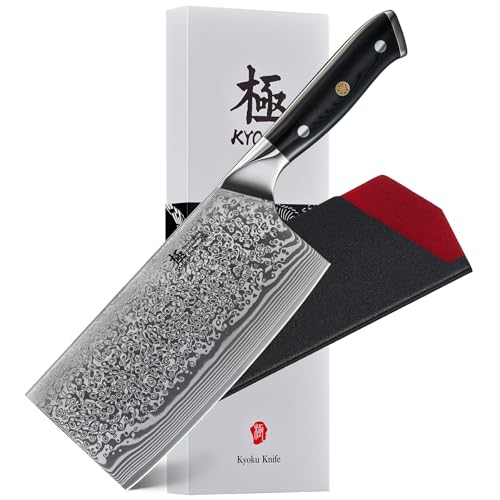
KYOKU Shogun Series 7" Forged Damascus Cleaver
Best for: Lightweight vegetable and meat slicing
- Blade Material
- Damascus Steel (what this guide is about)
- Blade Length
- 7 in
- Intended Use
- Vegetable slicing, meat slicing
- Blade Steel
- Japanese VG-10 Damascus
- Handle Material
- G10
- Construction
- Forged, full tang
View on Amazon: KYOKU Shogun Series 7" Forged Damascus Cleaver Affiliate link
This 7-inch vegetable cleaver uses a Japanese VG-10 Damascus steel core for sharpness and edge retention. The forged, full-tang blade is hardened to 58-60 HRC and features a triple-riveted G10 handle for durability. It weighs 0.35 ounces and includes a protective sheath and case. The design aims to reduce fatigue during long slicing sessions. It suits those who need a specialized tool for precise vegetable and meat work.
Pros
- VG-10 Damascus steel core with 58-60 HRC hardness
- Forged, full-tang construction for balance
- Triple-riveted G10 handle resists moisture and heat
- Includes protective sheath and case
Cons
- Very light weight at 0.35 ounces may feel insubstantial
- Limited to vegetable and meat slicing tasks
- No mention of a lifetime warranty in specs
Good fit if
- You want a lightweight cleaver for precise vegetable prep
- You prefer a forged full-tang blade for balance
- You need a dedicated tool for meat slicing
Skip if
- You need a heavy-duty bone cleaver
- You prefer high-carbon stainless steel over Damascus
- You want a multi-purpose chef knife
Verdict: KYOKU Shogun 7" Damascus Cleaver offers sharp VG-10 performance for light slicing tasks. It fits users who prioritize edge retention and a balanced, lightweight feel for vegetable prep.
Specifications side by side
| Spec | imarku 7-Inch High-Carbon Steel Cleaver | KYOKU Shogun Series 7" Forged Damascus Cleaver |
|---|---|---|
| Blade Length | 7 Inch | 7 in |
| Intended Use | Meat and vegetable | Vegetable slicing, meat slicing |
| Blade Steel | Japanese high carbon stainless steel | Japanese VG-10 Damascus |
| Handle Material | Pakkawood | G10 |
| Construction | Forged | Forged, full tang |
| Hardness | 57+1 HRC | 58-60 HRC |
| Blade Thickness | 2.4mm | not stated |
| Included Storage | not stated | Sheath and case |
| Blade Material | High-Carbon Stainless Steel | Damascus Steel |
| Storage Type | not stated | Sheath |
| Style | Japanese | Japanese |
| Recommended Use | Vegetables, Meat | Vegetables, Meat |
| Dimensions | 12 × 3.3 × 0.8 inches | 14.6 × 2 × 1 inches |
| Weight | 11.8 ounces | 0.35 ounces |
| Size | 7" | 7" |
| Color | Light Black | Life-time Warranty, Japanese VG10 Steel Core, Full Tang, G10 Handle with Engraved Rivet & Mosaic Pin, Included Guard, Ice Tempered & Heat Treated, Superior Sharpness, Ergonomic handle & well-balanced design |
| Model | I-KC0009 | not stated |
Frequently asked questions
Is high-carbon stainless steel better than Damascus for daily chopping?
High-carbon stainless steel offers reliable performance for daily tasks. The imarku cleaver uses this material at 57+1 HRC hardness. It resists rust while holding a sharp edge. This makes it a sturdy choice for versatile kitchen prep work without excessive maintenance.
Does Damascus steel provide superior edge retention for slicing?
Damascus steel can offer excellent edge retention. The KYOKU cleaver features a VG-10 steel core. This construction is designed for superior sharpness. It is ideal for users who prioritize precise slicing of vegetables and meat with a lightweight, balanced feel.
Which cleaver is lighter for vegetable prep?
The KYOKU Damascus cleaver is designed for a lightweight feel. It weighs 0.35 ounces. This balance supports light slicing tasks. The imarku model weighs 11.8 ounces, offering a heavier, more substantial feel for general chopping rather than delicate vegetable work.
How do the blade widths compare between these models?
Blade width affects stability and cutting surface. The imarku cleaver has a 3.3-inch width. The KYOKU model is narrower at 2 inches. The wider blade provides more surface area for chopping, while the narrower design may offer better control for specific slicing techniques.
What handle materials are used in these Japanese cleavers?
Handle materials impact grip and durability. The imarku cleaver uses an ergonomic Pakkawood handle. This material is known for stability and comfort. The KYOKU cleaver features a G10 handle with engraved rivets and a mosaic pin. Both designs prioritize ergonomic handling for user comfort.
Are these cleavers suitable for heavy bone chopping?
These models are optimized for precision rather than heavy bone work. The imarku is best for daily chopping and versatile tasks. The KYOKU is recommended for light vegetable and meat slicing. Neither is explicitly designed for heavy-duty bone chopping, which requires specialized cleaver construction.