High-Carbon Stainless Steel or Damascus Steel Kitchen Knives? Compared by Specs
As an Amazon Associate we earn from qualifying purchases. Links on this page are affiliate links.
Choosing between high carbon stainless steel vs damascus steel kitchen knife options depends on your specific needs. Both the Imarku paring knife and the SHAN ZU chef knife use Japanese steel for sharpness. The main difference lies in their construction and intended use. One is a single-piece forged paring tool, while the other is a layered Damascus chef knife. You need to decide which blade profile and handle material best fit your daily cooking tasks.
Key differences
| Aspect | Imarku 3.5-Inch Japanese Steel Paring Knife | SHAN ZU 8-Inch Damascus Chef Knife |
|---|---|---|
| Blade Material | Japanese high carbon stainless steel | 10Cr15Mov Damascus Japanese steel |
| Construction | Forged | Forged, 67 layers |
| Blade Length | 3.5 inches | 8 inches |
| Blade Hardness | 58 HRC | 62 HRC |
| Edge Angle | 9°-15° per side | 15° |
| Handle Material | Pakkawood | Frosted glass fiber G10 |
Which one should you choose?
Choose Imarku 3.5-Inch Japanese Steel Paring Knife if
- You need a small, precise knife for peeling and detailed work.
- You prefer a lighter tool that is easier to control for fine tasks.
- You want a knife with a slightly sharper initial edge angle for precision cutting.
Choose SHAN ZU 8-Inch Damascus Chef Knife if
- You require a versatile all-purpose knife for chopping and slicing larger ingredients.
- You prefer a harder blade that resists wear and maintains its edge longer.
- You want a handle made from durable, moisture-resistant glass fiber.
Verdict: The Imarku paring knife is the better choice for detailed, small-scale prep work due to its size and sharp edge angle. The SHAN ZU chef knife is more suitable for general cooking tasks, offering greater hardness and a durable G10 handle. Your decision should hinge on whether you need precision or versatility.
Specs: Carbon Steel vs Damascus
Blade material
The Imarku 3.5-Inch Japanese Steel Paring Knife uses high-carbon stainless steel. This single-layer blade contains 0.6g to 0.75g carbon to boost robustness. It relies on a single steel type for performance. The SHAN ZU 8-Inch Damascus Chef Knife uses 10Cr15Mov Damascus steel. This construction layers sheets of carbon steel through repeated folding and forging. The result is a 67-layer blade that enhances wear resistance and toughness. You get a complex composite structure in the SHAN ZU model versus the simpler single steel in the Imarku. Both use Japanese steel origins, but the Damascus build offers more layers.
Blade hardness
Hardness determines how well a blade holds an edge over time. The Imarku knife reaches 58 on the Rockwell Hardness scale. This level provides good durability for a high-carbon stainless steel paring knife. The SHAN ZU chef knife is significantly harder at 62 HRC. This higher hardness comes from the advanced forging technique and the specific 10Cr15Mov core. A higher HRC rating generally means the blade stays sharper longer during heavy use. You will notice a clear difference in the potential edge retention between the 58 HRC Imarku and the 62 HRC SHAN ZU.
Edge angle
The cutting angle affects how easily the knife slices through food. The Imarku paring knife features a razor-sharp band-sharpened edge at 9° to 15° per side. This taper-ground design ensures precision cutting for delicate tasks like peeling and dicing. The SHAN ZU chef knife has a cutting angle of 15°. While still sharp, this angle is slightly more robust than the lower end of the Imarku range. The Imarku offers a potentially sharper initial edge for fine work, while the SHAN ZU provides a consistent 15° angle suitable for general chef duties.
Handle material
Handle choice impacts comfort and grip stability during extended use. The Imarku knife uses an FSC-Certified Pakkawood handle. This material originates from Africa and is known for comfort, strength, and stability. It minimizes finger numbness during long periods of holding. The SHAN ZU knife features a frosted glass fiber G10 handle. G10 is described as more comfortable and solid than wood handles. It provides a top-balanced, ergonomic design for professional performance. You can choose between the traditional feel of Pakkawood or the rugged durability of G10.
Blade length
Blade length determines the scope of tasks the knife can handle. The Imarku is a paring knife with a 3.5-inch blade. Its small size makes it easier to operate for detailed work such as chopping, slicing, peeling, dicing, and mincing vegetables and fruit. The SHAN ZU is an 8-inch chef knife. This longer blade allows for broader chopping and slicing motions typical of main kitchen tasks. The Imarku excels in precision and control for small items, while the SHAN ZU offers versatility for larger ingredients and general preparation.
Which knife matches your cooking style
Need a precise tool for small tasks
The Imarku paring knife features a 3.5-inch blade with a 9° to 15° edge angle per side. This narrow profile allows for detailed work like peeling and dicing. Its 58 HRC hardness provides a balance of sharpness and durability. The Pakkawood handle offers a comfortable grip for extended use on delicate ingredients.
Want a durable main kitchen workhorse
The SHAN ZU chef knife uses a 67-layer Damascus construction with a 62 HRC hardness. This higher hardness retains an edge longer during heavy chopping. The 15° edge angle and 2.2 mm blade thickness provide stability for slicing larger items. The G10 handle ensures a solid, moisture-resistant grip for daily professional tasks.
Prefer lightweight tools for quick prep
Weighing only 2.88 ounces, the Imarku knife is significantly lighter than the SHAN ZU option. Its 3.5-inch blade length reduces fatigue during quick peeling or trimming tasks. The ergonomic Pakkawood handle fits smaller hands well. This lightness makes it ideal for users who prioritize agility and control over heavy-duty cutting power.
Quick picks
| # | Product | Best for | Price |
|---|---|---|---|
| 1 | Imarku 3.5-Inch Japanese Steel Paring Knife | Precision peeling and dicing tasks | Check price of Imarku 3.5-Inch Japanese Steel Paring Knife on Amazon |
| 2 | SHAN ZU 8-Inch Damascus Chef Knife | Heavy chopping and durable daily use | Check price of SHAN ZU 8-Inch Damascus Chef Knife on Amazon |
The products compared

Imarku 3.5-Inch Japanese Steel Paring Knife
Best for: Precision peeling and dicing tasks
- Blade Material
- High-Carbon Stainless Steel (what this guide is about)
- Blade Length
- 3.5 in
- Knife Type
- Paring knife
- Construction
- Forged
- Edge Angle
- 9°–15° per side
- Blade Hardness
- 58 HRC
View on Amazon: Imarku 3.5-Inch Japanese Steel Paring Knife Affiliate link
This imarku paring knife is a 3.5-inch blade made from Japanese high-carbon stainless steel. It features a forged construction and a Rockwell hardness of 58. The edge is sharpened to 9°–15° per side for precision. You get an ergonomic Pakkawood handle for comfort. This tool is ideal for detailed tasks like peeling and dicing small fruits and vegetables.
Pros
- Forged Japanese high-carbon stainless steel blade
- 58 Rockwell hardness for durability
- 9°–15° per side edge angle
- Ergonomic FSC-Certified Pakkawood handle
Cons
- 3.5-inch blade limits use to small tasks
- Hand wash only; not dishwasher safe
- Single knife, not a full set
Good fit if
- You need a precise tool for peeling and dicing
- You prefer a lightweight knife under 3 ounces
- You want a forged blade with high hardness
Skip if
- You require a full knife set for general chopping
- You prefer dishwasher-safe convenience for cleaning
- You need a larger blade for slicing meats
Verdict: imarku 3.5" Japanese High Carbon Paring Knife offers a sharp, hard edge in a small, lightweight package. It is best for users who prioritize precision cutting for small ingredients over versatility.
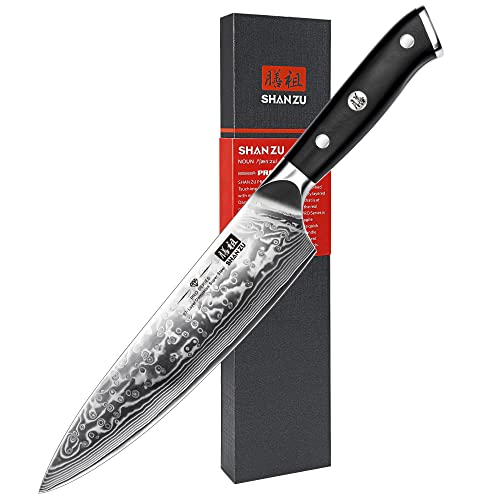
SHAN ZU 8-Inch Damascus Chef Knife
Best for: Heavy chopping and durable daily use
- Blade Material
- Damascus Steel (what this guide is about)
- Blade Length
- 8 in
- Knife Type
- Chef Knife
- Construction
- Forged, 67 layers
- Edge Angle
- 15°
- Blade Hardness
- 62 HRC
View on Amazon: SHAN ZU 8-Inch Damascus Chef Knife Affiliate link
This SHAN ZU chef knife uses 10Cr15Mov Damascus steel with a 62 HRC hardness rating. The blade features 67 forged layers and a 15-degree edge angle for precision. You get an 8-inch blade with a G10 handle for a solid grip. It suits those who want high hardness and a traditional Damascus look without the maintenance of plain carbon steel.
Pros
- 62 HRC blade hardness for long-lasting sharpness
- 67-layer forged Damascus construction
- 15-degree edge angle for precision cutting
- G10 handle material resists moisture and wear
Cons
- Heavier build at 270 grams may cause fatigue
- Blade thickness of 2.2 mm limits thin slicing
- 12-month warranty is shorter than standard industry terms
Good fit if
- You prefer a heavier knife for chopping tasks
- You want a high-hardness blade that resists rust
- You like the aesthetic of forged Damascus patterns
Skip if
- You need a lightweight knife for delicate work
- You require a thinner blade for paper-thin slices
- You want a longer warranty period than 12 months
Verdict: SHAN ZU 8 Inch Damascus Chef Knife delivers high hardness and a robust build for users who prioritize durability and a classic look. It fits cooks who do not mind extra weight for stable chopping power.
Specifications side by side
| Spec | Imarku 3.5-Inch Japanese Steel Paring Knife | SHAN ZU 8-Inch Damascus Chef Knife |
|---|---|---|
| Blade Length | 3.5 in | 8 in |
| Knife Type | Paring knife | Chef Knife |
| Blade Material | Japanese high-carbon stainless steel | 10Cr15Mov Damascus steel |
| Construction | Forged | Forged, 67 layers |
| Edge Angle | 9°–15° per side | 15° |
| Blade Hardness | 58 HRC | 62 HRC |
| Handle Material | Pakkawood | G10 |
| Style | Japanese | Japanese |
| Recommended Use | Peeling, Fruit | not stated |
| Length | 8 inches | not stated |
| Weight | 2.88 ounces | 9.17 ounces |
| Dimensions | not stated | 13.2 × 1.18 × 1 inches |
| Size | 3.5" | 8" |
| Color | Brown Handle | Chef Knife |
| Model | I-GPD001 | SZPCS-2017-002 |
Frequently asked questions
Is high carbon stainless steel better than Damascus for everyday use?
High carbon stainless steel offers a simpler, single-layer construction that is easier to maintain. The Imarku paring knife uses this material for consistent performance in precision tasks. Damascus steel provides a multi-layered build that adds weight and durability. The SHAN ZU chef knife uses this for heavy chopping. Choose stainless for lightweight precision and Damascus for robust daily power.
What is the difference in weight between these two steel types?
Damascus steel knives typically weigh more due to their layered construction. The SHAN ZU Damascus chef knife weighs 9.17 ounces, providing stable chopping power. High carbon stainless steel knives are lighter. The Imarku paring knife weighs only 2.88 ounces. This makes it easier to handle for detailed work. You should choose based on whether you prefer a heavier tool for stability or a lighter one for control.
Does Damascus steel require more maintenance than high carbon stainless steel?
Damascus steel often requires more care to prevent staining due to its layered structure. The SHAN ZU knife uses this material for durability and a classic look. High carbon stainless steel resists corrosion better while maintaining hardness. The Imarku knife uses this for a sharp, hard edge. If you want low maintenance, high carbon stainless is the practical choice. Damascus offers aesthetic appeal and robustness for those willing to care for it.
Which steel type holds an edge longer?
Both materials can hold sharp edges well, but they achieve this differently. High carbon stainless steel uses added carbon for robustness and hardness. The Imarku knife achieves a sharp edge in a small package. Damascus steel layers multiple steels to enhance toughness and sharpness. The SHAN ZU knife delivers high hardness for daily use. Your choice depends on whether you prioritize the specific hardness of stainless or the toughness of layered Damascus.
Can I use Damascus steel for precision tasks?
Damascus steel is versatile but often designed for heavier tasks. The SHAN ZU Damascus chef knife is 8 inches long and weighs over 9 ounces. It is best for heavy chopping and durable daily use. High carbon stainless steel knives like the Imarku are smaller and lighter. They are better for precision peeling and dicing. You should select Damascus for general chopping and high carbon stainless for detailed, small-ingredient work.
How does the blade material affect the knife's style?
Blade material influences both performance and visual style. High carbon stainless steel offers a clean, single-layer look. The Imarku knife features a Japanese style with a brown handle. Damascus steel creates a distinctive wavy pattern from layered metals. The SHAN ZU knife also follows a Japanese style but with a robust build. Your choice affects the knife's appearance as much as its function. Pick Damascus for a classic look and stainless for a modern, simple aesthetic.