MASAMOTO 5.7" VG Honesuki Boning vs MASAMOTO AT 5.7" Honesuki Boning (2026): Key Differences
As an Amazon Associate we earn from qualifying purchases. Links on this page are affiliate links.
This guide compares the masamoto 5 7 vg honesuki boning vs at 5 7 honesuki boning. Both are 5.7-inch Japanese boning knives designed for poultry and precision meat work. They share a full tang construction and a pointed triangular blade profile. The main difference lies in the steel hardness and handle material. The VG model uses a harder steel with a polymer handle, while the AT model uses slightly softer steel with a wood handle. You will see how these specs affect performance.
Key differences
| Aspect | MASAMOTO 5.7" VG Honesuki Boning Knife | MASAMOTO AT 5.7" Honesuki Boning Knife |
|---|---|---|
| Blade Material | Hyper Molybdenum Vanadium stainless steel | Molybdenum Vanadium stainless steel |
| Blade Hardness | 58-59 HRC | 57 HRC |
| Handle Material | POM Duracon | Pakkawood |
| Weight | 6.2 ounces | 6.1 ounces |
| Series | VG (Professional) | AT (Home) |
Which one should you choose?
Choose MASAMOTO 5.7" VG Honesuki Boning Knife if
- You prefer a harder blade edge that holds its sharpness longer during heavy use.
- You want a handle made of durable, water-resistant polymer material.
- You are looking for a knife from the professional product line.
Choose MASAMOTO AT 5.7" Honesuki Boning Knife if
- You prioritize ease of sharpening over maximum edge retention.
- You prefer the traditional feel and appearance of a wood handle.
- You want a slightly lighter knife for extended prep sessions.
Verdict: The VG model suits users who need maximum edge retention and a durable polymer handle for professional or frequent use. The AT model is better for those who value easier maintenance and a traditional wooden grip. Both knives offer the same blade length and core design for poultry breakdown.
VG vs AT Honesuki Comparison
Blade steel composition
The MASAMOTO 5.7" VG Honesuki Boning Knife uses Hyper Molybdenum Vanadium stainless steel, a professional-grade alloy designed for superior cutting performance. The MASAMOTO AT 5.7" Honesuki Boning Knife utilizes standard Molybdenum Vanadium stainless steel from the home kitchen line. While both are high-carbon stainless steels, the VG series adds hyper treatment for enhanced durability and edge retention. You should choose the VG model if you prioritize long-term edge stability and professional-grade material properties. The AT model offers solid performance for general home use but lacks the specific hyper treatment found in the VG variant.
Blade hardness rating
Blade hardness directly impacts how long a knife holds an edge and how easily it can be sharpened. The MASAMOTO 5.7" VG Honesuki Boning Knife has a Rockwell C scale (HRC) rating of 58-59. The MASAMOTO AT 5.7" Honesuki Boning Knife is rated at 57 HRC. A higher HRC rating generally means the blade stays sharper longer but may be more brittle. The VG model offers greater hardness, which is beneficial for precise deboning tasks. The AT model is slightly softer, which can make it easier to sharpen at home, though it may require more frequent honing.
Handle material type
The handle material affects grip comfort and durability in wet kitchen environments. The MASAMOTO 5.7" VG Honesuki Boning Knife features a handle made from Duracon POM, a synthetic polymer known for high durability and resistance to moisture. The MASAMOTO AT 5.7" Honesuki Boning Knife uses Pakkawood, a layered wood composite that is non-slip and comfortable. Pakkawood offers a traditional aesthetic and tactile feel, while Duracon POM provides a consistent, maintenance-free surface that is highly resistant to warping or cracking over time. Your choice depends on whether you prefer synthetic resilience or natural wood texture.
Knife weight
Weight influences control and fatigue during extended prep work. The MASAMOTO 5.7" VG Honesuki Boning Knife weighs 6.2 ounces. The MASAMOTO AT 5.7" Honesuki Boning Knife weighs 6.1 ounces. The difference is minimal, at just 0.1 ounce. This slight variance is unlikely to impact your cutting experience significantly. Both knives are designed to be thin and light for precision tasks. You will find both models easy to maneuver for delicate poultry work. The weight difference is negligible, so you should decide based on other factors like steel type or handle feel rather than weight alone.
Construction style
Both knives share the same fundamental build quality and structural design. The MASAMOTO 5.7" VG Honesuki Boning Knife and the MASAMOTO AT 5.7" Honesuki Boning Knife both feature full tang construction. This means the metal extends through the entire handle, providing balance and strength. Both also include a stainless steel bolster covered handle for comfort and safety. The construction is heavy-duty in both cases, ensuring durability during rigorous use. Since the build quality is identical, you do not need to worry about structural differences affecting the longevity or stability of either knife during normal kitchen operations.
Which Masamoto Honesuki Suits You
Professional chefs needing maximum edge retention
The VG model features Hyper Molybdenum Vanadium steel with a hardness of 58-59 HRC. This higher hardness provides superior cutting performance and durability for heavy daily use. The POM Duracon handle offers high durability and a secure grip. It is the better choice for professionals who require a tough, long-lasting edge for precise deboning tasks.
Home cooks preferring easier maintenance
The AT series uses standard Molybdenum Vanadium stainless steel with a 57 HRC hardness. This specification makes the blade easier to sharpen while maintaining excellent sharpness and durability. The Pakkawood handle provides a comfortable, non-slip grip. This knife is ideal for home users who value ease of maintenance and comfortable handling during poultry preparation.
Buyers seeking the lightest possible tool
The AT model weighs 6.1 ounces, which is slightly lighter than the VG version at 6.2 ounces. This marginal weight reduction can reduce hand fatigue during extended prep sessions. Both knives share the same 5.7-inch blade length and full tang construction. If minimizing weight is your priority, the AT series offers a slight advantage in overall balance.
The products compared
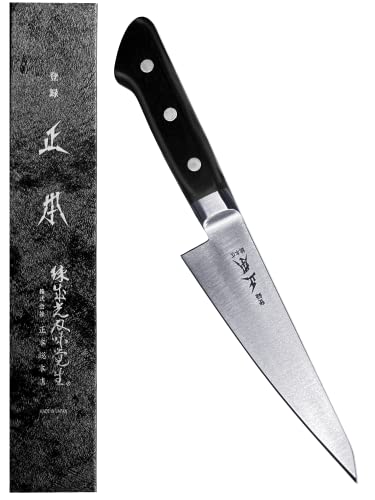
MASAMOTO 5.7" VG Honesuki Boning Knife
Best for: specialized poultry deboning tasks
- Blade Length
- 5.7 in (145 mm)
- Knife Type
- Honesuki boning knife
- Blade Material
- Hyper Molybdenum Vanadium steel
- Blade Hardness
- 58-59 HRC
- Handle Material
- POM Duracon
- Construction
- Full Tang
View on Amazon: MASAMOTO 5.7" VG Honesuki Boning Knife Affiliate link
The Masamoto VG Honesuki is a 5.7-inch boning knife built for poultry. It uses Hyper Molybdenum Vanadium steel at 58-59 HRC for a durable edge. The full tang design features a POM Duracon handle for grip. This knife weighs 6.2 ounces and balances precision with strength. It suits you if you need a specialized tool for breaking down chicken or fish.
Pros
- Hyper Molybdenum Vanadium steel holds a sharp edge
- Full tang construction with stainless steel bolster
- POM Duracon handle offers high durability
- Lightweight 6.2-ounce design for control
Cons
- Limited to 5.7-inch blade length
- Specific to poultry and precision tasks
- Western-style handle on a Japanese blade
Good fit if
- You need a specialized tool for deboning poultry
- You prefer a full tang knife for balance
- You want a durable high-carbon stainless steel blade
Skip if
- You require a larger blade for big roasts
- You prefer a wooden handle for traditional feel
- You need a versatile chef knife for all tasks
Verdict: Masamoto VG 5.7" Honesuki Boning Knife is a precise tool for poultry breakdown. It fits you if you value a durable, lightweight blade for specific deboning tasks.

MASAMOTO AT 5.7" Honesuki Boning Knife
Best for: Poultry deboning and precision cutting
- Blade Length
- 5.7 in (145 mm)
- Knife Type
- Honesuki boning knife
- Blade Material
- Molybdenum Vanadium stainless steel
- Blade Hardness
- 57 HRC
- Handle Material
- Pakkawood
- Construction
- Full Tang
View on Amazon: MASAMOTO AT 5.7" Honesuki Boning Knife Affiliate link
This Masamoto AT Honesuki is a 5.7-inch boning knife designed for poultry and precision tasks. It uses Molybdenum Vanadium stainless steel hardened to 57 HRC for a sharp, durable edge. The full tang construction includes a black Pakkawood handle with a stainless steel bolster. Weighing 6.1 ounces, it offers a balanced feel for deboning chicken or filleting fish.
Pros
- 5.7-inch blade length for precise control
- 57 HRC hardness for edge retention
- Full tang construction with bolster
- Non-slip Pakkawood handle
- Lightweight 6.1-ounce design
Cons
- Lower 57 HRC hardness compared to VG steel alternatives
- Heavier build than thinner Honesuki styles
- Western-style handle may feel less traditional
Good fit if
- You want a durable knife for poultry
- You prefer a full tang handle
- You need a versatile boning tool
Skip if
- You require ultra-sharp VG steel
- You want a lighter, thinner blade
- You prefer traditional Japanese handles
Verdict: Masamoto AT 5.7" Honesuki Boning Knife suits those who prioritize handle comfort and full tang durability over maximum sharpness. It is a practical tool for regular poultry breakdown.
Specifications side by side
| Spec | MASAMOTO 5.7" VG Honesuki Boning Knife | MASAMOTO AT 5.7" Honesuki Boning Knife |
|---|---|---|
| Blade Length | 5.7 in (145 mm) | 5.7 in (145 mm) |
| Knife Type | Honesuki boning knife | Honesuki boning knife |
| Blade Material | Hyper Molybdenum Vanadium steel | Molybdenum Vanadium stainless steel |
| Blade Hardness | 58-59 HRC | 57 HRC |
| Handle Material | POM Duracon | Pakkawood |
| Construction | Full Tang | Full Tang |
| Color | Black | Black |
| Style | Japanese | Japanese |
| Recommended Use | Boning, Meat | Boning, Meat |
| Weight | 6.2 ounces | 6.1 ounces |
| Size | 5.7" | 5.7" |
| Model | US-VG5614 | US-AT5614 |
Frequently asked questions
Is the Masamoto VG Honesuki heavier than the AT model?
The VG model weighs 6.2 ounces, making it slightly heavier than the AT version. The AT Honesuki tips the scales at 6.1 ounces. This minimal difference in weight is unlikely to affect your handling significantly. Both knives offer a balanced feel for precise poultry work.
What is the handle material on the Masamoto AT Honesuki?
The AT model features a Pakkawood handle. This material provides durability and resistance to moisture, which is useful in a wet kitchen environment. The VG model does not specify a handle material in its published data. Both knives maintain a traditional Japanese style throughout their design.
Do both Masamoto Honesuki knives have a full tang?
Yes, both the VG and AT models feature a full tang construction. This means the steel extends through the entire length of the handle. This design adds structural integrity and balance to the knife. It ensures the blade remains securely attached during rigorous deboning tasks.
What are the model numbers for these Masamoto knives?
The VG Honesuki Boning Knife has the model number US-VG5614. The AT Honesuki Boning Knife is identified as model US-AT5614. These codes help you verify the exact product when purchasing. They distinguish the specific steel type and handle configuration of each tool.
Can I use these knives for general meat boning?
Both knives are recommended for boning and meat tasks. They are specifically optimized for poultry breakdown due to their pointed triangular blade profiles. You can use them for other precision meat work as well. Their 5.7-inch size allows for control during detailed cutting operations.
Is there a color difference between the VG and AT models?
No, both knives are listed with a black color. The VG model is described as black, and the AT model is also black. This consistent aesthetic choice aligns with their Japanese style. The visual difference between them is not apparent from the color specifications alone.