Sunnecko 8-Inch Damascus Chef Knife vs Sunnecko 7-Inch Damascus Santoku Knife: Spec Comparison
As an Amazon Associate we earn from qualifying purchases. Links on this page are affiliate links.
The sunnecko 8 inch japanese damascus vs kitchen knife japanese damascus comparison highlights two Japanese-style knives from the same brand. Both feature a VG10 core and 67-layer Damascus construction for durability and rust resistance. They share a full tang design for balance and ergonomic handles. The main difference lies in the blade geometry and edge angle. One offers a sharper, narrower edge for precision, while the other provides a slightly wider angle for robust daily tasks. You get a chef knife or a Santoku, depending on your preferred cutting style.
Key differences
| Aspect | Sunnecko 8-Inch Damascus Chef Knife | Sunnecko 7-Inch Damascus Santoku Knife |
|---|---|---|
| Knife Type | Chef | Santoku |
| Blade Length | 8 in | 7 in |
| Edge Angle | 10-12° | 15° |
| Handle Material | ABS | not listed |
| Weight | 14.4 ounces | not listed |
| Total Length | 14.2 inches | 11.8 inches |
Which one should you choose?
Choose Sunnecko 8-Inch Damascus Chef Knife if
- You prefer a sharper 10-12° edge for precise slicing
- You need an 8-inch blade for larger cutting tasks
- You want to know the exact weight and handle material
Choose Sunnecko 7-Inch Damascus Santoku Knife if
- You prefer a traditional Santoku blade profile
- You want a slightly wider 15° edge for durability
- You need a shorter 7-inch blade for smaller spaces
Verdict: Choose the 8-inch Chef Knife if you want a sharper edge and more detailed specifications for heavier prep work. Pick the 7-inch Santoku if you prefer a versatile, slightly more durable edge angle for standard chopping. Both knives share the same core steel and layered construction quality.
8-Inch Chef vs 7-Inch Santoku Specs
Blade Length
The Sunnecko 8-Inch Damascus Chef Knife offers an 8-inch blade length, providing a longer cutting surface for slicing larger ingredients or handling bigger cuts of meat. In comparison, the Sunnecko 7-Inch Damascus Santoku Knife features a 7-inch blade. This slightly shorter length can offer more maneuverability for precise chopping tasks and may feel less cumbersome for users with smaller hands or tighter kitchen spaces. The difference in length directly impacts the reach and leverage you have during prep work, allowing you to choose based on the typical size of ingredients you handle most often.
Edge Angle
Blade geometry significantly influences cutting performance and maintenance. The Sunnecko 8-Inch Damascus Chef Knife is specified with a razor-sharp 10-12° edge angle per side. This narrower angle allows for extremely fine slicing with minimal resistance, ideal for delicate tasks like slicing fish or vegetables. The Sunnecko 7-Inch Damascus Santoku Knife is hand sharpened to a 15-degree cutting angle. While still sharp, this slightly wider angle may offer greater durability and edge retention during heavy-duty chopping or cutting through harder materials. You might prefer the sharper angle for precision or the wider angle for robustness.
Blade Material
Both knives share a core construction philosophy, utilizing Japanese VG-10 steel for the cutting core and 67 layers of Damascus steel for the outer layers. This combination is designed to provide high carbon content for edge retention and corrosion resistance, while the Damascus layers add aesthetic appeal and structural integrity. The data confirms both products use this 67-layer VG-10 Damascus construction. There is no distinct advantage in material composition between the two models regarding the steel type or layer count. Both rely on the same high-quality steel blend for performance and rust resistance.
Overall Length
The total length of the knife affects balance and storage. The Sunnecko 8-Inch Damascus Chef Knife has an overall length of 14.2 inches. This longer profile accommodates the larger blade and provides a substantial handle for grip. The Sunnecko 7-Inch Damascus Santoku Knife measures 11.8 inches in total length. This more compact size may fit better in smaller drawers or knife blocks and can feel more agile in the hand for detailed work. If you prioritize a longer reach for big jobs, the 8-inch model is longer; if you prefer a shorter, more manageable tool, the 7-inch version is more compact.
Weight
Weight influences how the knife feels during extended use. The Sunnecko 8-Inch Damascus Chef Knife weighs 14.4 ounces. This heft can provide momentum for cutting through tougher items and may feel more substantial and stable to some users. The weight specification for the Sunnecko 7-Inch Damascus Santoku Knife is not listed in the provided data. Without a specific weight value, it is unclear if the 7-inch model is significantly lighter. Generally, a shorter blade might be lighter, but the handle material and construction also play a role. You should consider if you prefer a heavier tool for chopping or a lighter one for precision.
Which Sunnecko Knife Fits Your Needs
You want the sharpest edge for precision work
The 8-inch chef knife has a 10-12 degree edge angle. This narrower angle creates a sharper cutting edge than the 15-degree angle on the Santoku. You will notice easier slicing through vegetables and meats. The finer edge holds its sharpness well due to the VG10 steel core. This makes prep work faster and more efficient for detailed tasks.
You prefer a lighter knife for less fatigue
The 7-inch Santoku knife is lighter than the 8-inch chef version. The chef knife weighs 14.4 ounces, while the Santoku is smaller and more compact. Its 11.8-inch total length offers better maneuverability for smaller hands or lighter chopping tasks. You will experience less wrist strain during extended periods of dicing and mincing ingredients in the kitchen.
You need a versatile workhorse for large cuts
The 8-inch blade length provides a longer cutting surface for slicing larger ingredients. You can handle bigger cuts of meat or wide vegetables with ease. The full tang design ensures stability during heavy-duty prep. This knife serves as a reliable partner for roasts or large batches of vegetables, offering consistent performance for various kitchen tasks.
The products compared

Sunnecko 8-Inch Damascus Chef Knife
Best for: Versatile daily prep and slicing tasks
- Blade Length
- 8 in
- Knife Type
- Chef
- Blade Material
- VG10 Damascus steel
- Construction
- Forged, 67 layers
- Edge Angle
- 10–12°
- Handle Material
- ABS
View on Amazon: Sunnecko 8-Inch Damascus Chef Knife Affiliate link
This Sunnecko chef knife features an 8-inch blade made from 67-layer VG10 Damascus steel. It has a 10-12° edge angle for sharpness and weighs 14.4 ounces. The full tang construction provides balance, while the ABS handle offers a secure grip. It suits cooks who need a versatile, heavy-duty prep tool for slicing and dicing.
Pros
- 67-layer VG10 Damascus steel blade resists corrosion
- 10-12° razor edge angle for effortless slicing
- Full tang design ensures balanced weight distribution
- ABS handle with decorative rivet for secure grip
Cons
- ABS handle material may feel less premium than wood
- Heavier at 14.4 ounces compared to lighter alternatives
- No specific rust-proof coating listed beyond steel composition
Good fit if
- You want a durable, multi-purpose chef knife for daily prep
- You prefer a balanced, full-tang knife for better control
- You need a sharp, corrosion-resistant blade for various ingredients
Skip if
- You prefer a lighter knife for extended use
- You want a wooden handle for traditional feel
- You need a specialized santoku shape for precise chopping
Verdict: Sunnecko 8-Inch Damascus Chef Knife is a solid choice for cooks who value a sharp, balanced blade for heavy-duty tasks. It fits those who prioritize durability and edge retention over lightweight handling.
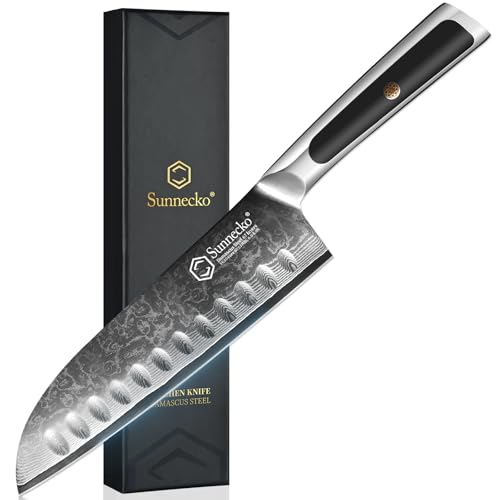
Sunnecko 7-Inch Damascus Santoku Knife
Best for: precise chopping with a 7-inch Santoku blade
- Blade Length
- 7 Inch
- Knife Type
- Santoku
- Blade Material
- Japanese VG-10, Damascus steel
- Construction
- Fully forged, 67-layer Damascus
- Edge Angle
- 15-degree
- Recommended Use
- Vegetables, Meat, Fruit
View on Amazon: Sunnecko 7-Inch Damascus Santoku Knife Affiliate link
This Sunnecko Santoku knife features a 7-inch blade made from Japanese VG-10 steel with 67 layers of high-carbon stainless steel. It is hand sharpened to a 15-degree angle for precise slicing. The fully forged, full tang design provides balanced weight and a secure grip. It suits cooks who prefer the versatility of a Santoku blade for chopping, dicing, and slicing vegetables and meats.
Pros
- 7-inch VG-10 core with 67 Damascus layers
- 15-degree hand-sharpened edge angle
- Fully forged full tang construction
- Ergonomic handle for balanced control
Cons
- 7-inch blade is shorter than the 8-inch chef knife option
- Limited blade length may not suit all chopping tasks
- No specific handle material details provided in data
Good fit if
- You prefer a Santoku blade shape
- You want a 7-inch blade length
- You value a 15-degree edge angle
Skip if
- You need an 8-inch chef knife blade
- You prefer a different blade material
- You want a non-Damascus steel construction
Verdict: Sunnecko 7-Inch Damascus Santoku Knife offers a 15-degree edge and 67-layer VG-10 steel for precise cuts. It fits users who prefer a 7-inch Santoku blade for detailed prep work.
Specifications side by side
| Spec | Sunnecko 8-Inch Damascus Chef Knife | Sunnecko 7-Inch Damascus Santoku Knife |
|---|---|---|
| Blade Length | 8 in | 7 Inch |
| Knife Type | Chef | Santoku |
| Blade Material | VG10 Damascus steel | Japanese VG-10, Damascus steel |
| Construction | Forged, 67 layers | Fully forged, 67-layer Damascus |
| Edge Angle | 10–12° | 15-degree |
| Handle Material | ABS | not stated |
| Color | Silver | Silver 7.2" |
| Style | Japanese | Japanese |
| Recommended Use | Vegetables, Meat, Fruit | Vegetables, Meat, Fruit |
| Dimensions | 14.2 × 3.4 × 1.2 inches | not stated |
| Weight | 14.4 ounces | not stated |
| Length | not stated | 11.8 inches |
| Size | 8" | 7" |
| Model | Sonne-ABS-S-8IN | Sun-E-S-003 |
Frequently asked questions
Which Sunnecko knife is better for slicing large roasts?
The 8-inch Chef Knife is the better choice for slicing large roasts. Its 8-inch blade provides a longer cutting surface than the 7-inch Santoku. This extra length allows you to make smooth, single-stroke cuts through bigger ingredients without sawing. The 14.4-ounce weight also helps power through dense meats.
Is the Sunnecko 7-inch Santoku lighter than the chef knife?
Yes, the Santoku is lighter and more compact. The 8-inch Chef Knife weighs 14.4 ounces and measures 14.2 inches in total length. The 7-inch Santoku has a total length of 11.8 inches. This reduced size and weight make the Santoku easier to handle for detailed prep work.
Do both knives use the same blade material?
Both knives feature Damascus steel construction. They share a VG-10 core surrounded by 67 layers of steel. This design offers durability and resistance to rust. The silver color on both blades comes from this layered steel pattern, which is standard for Japanese-style Damascus knives.
What is the edge angle difference between these two knives?
The Chef Knife has a sharper 10-12 degree edge angle. The Santoku features a 15-degree edge angle. A narrower angle creates a sharper cutting edge for easier slicing. The wider angle on the Santoku provides more durability for chopping tasks. This difference affects how each knife performs on food.
Which model is best for precise vegetable chopping?
The 7-inch Santoku is ideal for precise vegetable chopping. Its 7-inch blade length allows for better control during detailed prep work. The 15-degree edge angle offers durability for repetitive chopping. The shorter 11.8-inch total length also improves maneuverability when working with smaller ingredients on a cutting board.
How wide is the blade on the 8-inch Chef Knife?
The blade on the 8-inch Chef Knife is 3.4 inches wide. This width helps prevent food from sticking to the blade during slicing. The blade height is 1.2 inches. These dimensions provide a stable cutting surface for handling various kitchen tasks with confidence and control.
Are both knives full tang designs?
Yes, both knives utilize a full tang design. This construction method extends the blade steel through the entire length of the handle. It ensures balance and stability during use. The full tang adds durability to the handle connection, making both knives reliable for daily kitchen duties.