11 Best Japanese Cleavers, Compared
As an Amazon Associate we earn from qualifying purchases. Links on this page are affiliate links.
These are the best japanese cleavers for your kitchen, ranked by published specifications. We compared 11 models to find the right tool for your prep work. The imarku 7-Inch High-Carbon Steel Cleaver leads as the best overall pick. Its 0.74-pound weight and 2.4 mm spine offer precise cuts without excessive blade weight. Each selection is based strictly on the specs found on the product listings. This guide helps you decide which cleaver matches your cutting style and budget.
Quick picks
The best fit for you
- You need a balanced knife for everyday slicing imarku 7-Inch High-Carbon Steel Cleaver Its 0.74-pound weight and 15-degree double bevel provide precise cuts without excessive blade weight.
- You want to chop poultry and bone on a budget HOSHANHO 6.9-Inch Japanese Meat Cleaver The 3-millimeter spine and 60 HRC hardness handle heavy-duty bone chopping effectively.
- You prefer a pinch-grip hold for fine vegetable prep TUO 7-Inch AUS-10 Damascus Cleaver Its smooth bolster allows for precise pinch-grip control while slicing boneless meat.
- You require a dedicated set for full butchering tasks Huusk 3-Piece Japanese Butcher Knife Set This set includes three distinct full-tang blades designed for cutting, slicing, and trimming joints.
- You need downward authority for dense poultry joints Mitsumoto Sakari 7-Inch 9Cr18MoV Cleaver Its substantial 2.43-pound build and 60±2 HRC steel core provide strong cutting power.
Our 11 picks

imarku 7-Inch High-Carbon Steel Cleaver
Best for: everyday vegetable chopping and boneless meat slicing
- Style
- Japanese (what this guide is about)
- Blade Length
- 7 in
- Intended Use
- Chopping, mincing, slicing, boning
- Blade Steel
- Japanese high carbon stainless steel
- Handle Material
- Pakkawood
- Construction
- Forged
The imarku 7-Inch High-Carbon Stainless Steel Cleaver is a multi-purpose Japanese-style knife built for slicing, mincing, and chopping produce and meats. It features a 2.4 mm thick blade forged from high-carbon stainless steel with a 57±1 HRC rating. The double-bevel edge sits at 15 degrees per side, paired with an ambidextrous Pakkawood handle. At 0.74 pounds, it suits everyday prep work if you prefer a lighter, maneuverable rectangular blade.
Pros
- Forged Japanese high-carbon stainless steel rated at 57+1 HRC
- Double-sided 15-degree edge for precise cutting
- FSC-certified Pakkawood handle designed for left- and right-handed use
- Slender 2.4 mm blade profile at 0.74 pounds for low hand fatigue
Cons
- Hardness rating of 57+1 HRC requires more frequent sharpening than harder steels
- Thin 2.4 mm spine is unsuitable for cleaving thick animal bones
- No storage sheath or blade guard listed in specifications
Good fit if
- You need a lightweight 0.74-pound cleaver for chopping vegetables and slicing boneless meats.
- You want an ambidextrous Pakkawood handle that works equally well in either hand.
Skip if
- You need a heavy, thick blade designed to split dense bones.
- You prefer high-hardness steel above 60 HRC for longer edge retention.
Verdict: imarku 7-Inch High-Carbon Stainless Steel Cleaver is a balanced 0.74-pound knife suited for everyday slicing and mincing. Its 2.4 mm spine and 15-degree double bevel give you precise cuts without excessive blade weight.

HOSHANHO 6.9-Inch Japanese Meat Cleaver
Best for: heavy-duty bone and meat chopping
- Style
- Japanese (what this guide is about)
- Blade Length
- 6.9 in
- Intended Use
- Chopping bones, slicing vegetables
- Blade Steel
- 10Cr15CoMoV
- Handle Material
- Pakkawood
- Hardness
- 60 HRC
This Japanese meat cleaver pairs a 6.9-inch 10Cr15CoMoV high carbon stainless steel blade with a pakkawood handle. At three millimeters thick and ground to a 25-degree edge per side, the steel reaches 60 HRC hardness for cutting meat, bone, and vegetables. At 0.5 pounds, it gives you a balanced profile for cleaving ribs or poultry without heavy fatigue. It suits home cooks who need a dedicated, heavy-duty prep blade.
Pros
- 3 mm blade thickness provides structural strength for dense bone
- 60 HRC 10Cr15CoMoV high-carbon stainless steel retains edge hardness
- Symmetrical 25-degree bevel handles meat cutting and bone chopping
- Water- and crack-resistant pakkawood handle
Cons
- Steep 25-degree edge angle sacrifices ultra-thin vegetable slicing precision
- Weighs 0.5 pounds, offering less downward momentum than heavier cleavers
Good fit if
- You need to chop through ribs, poultry, or beef bones regularly.
- You prefer a 60 HRC Japanese high-carbon stainless steel blade.
- You want an ergonomic pakkawood handle that resists thermal cracking.
Skip if
- You want an acute edge angle strictly for razor-thin vegetable slicing.
- You prefer a heavy cleaver that relies on high mass for chopping.
Verdict: HOSHANHO 6.9-Inch Japanese Meat Cleaver delivers 60 HRC 10Cr15CoMoV steel and a 3-millimeter spine to handle poultry and bone chopping. It balances heavy-duty bone crushing with general kitchen slicing in a 0.5-pound frame.
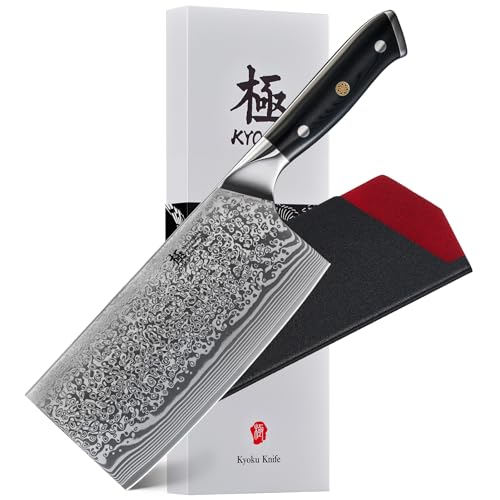
KYOKU Shogun Series 7" Forged Damascus Cleaver
Best for: precise vegetable prep and boneless meat slicing
- Style
- Japanese (what this guide is about)
- Blade Length
- 7 in
- Intended Use
- Vegetable slicing, meat slicing
- Blade Steel
- Japanese VG-10 Damascus
- Handle Material
- G10
- Construction
- Forged, full tang
View on Amazon: KYOKU Shogun Series 7" Forged Damascus Cleaver
This 7-inch Japanese-style vegetable cleaver features a forged VG-10 Damascus steel core hardened to 58-60 HRC. The straight-edge blade uses an 8-12 degree double bevel designed for push-cutting produce and slicing boneless proteins. Paired with a triple-riveted G10 composite handle and full-tang build, it includes a matching protective sheath and storage case. It suits you if you need a specialized, acute-angled blade for clean vegetable prep.
Pros
- Forged VG-10 Damascus steel core rated at 58-60 HRC
- Acute 8-12° double-sided edge angle
- Moisture-resistant G10 handle with full tang construction
- Includes protective sheath and storage case
Cons
- Acute edge angle unsuitable for hacking dense bone or frozen food
- Requires specialized sharpening equipment to match the 8-12° angle
Good fit if
- You prioritize edge retention from a high-hardness VG-10 core.
- You want an acute 8-12° bevel for precise slicing and vegetable chopping.
- You need an included sheath and storage case for blade protection.
Skip if
- You need a heavy cleaver to chop through thick animal bones.
- You prefer softer steel that hones quickly with standard rod sharpeners.
Verdict: KYOKU Shogun Series 7-Inch Damascus Vegetable Cleaver pairs a hard VG-10 steel core with an acute double-bevel edge built for fine slicing rather than bone chopping. It delivers durable edge retention and includes dedicated storage hardware for routine prep work.

HexClad 7-Inch Japanese Damascus Cleaver
Best for: precise slicing and home butcher prep
- Style
- Japanese (what this guide is about)
- Blade Length
- 7.5 in
- Intended Use
- Turnips, squash, proteins, bones
- Blade Steel
- Japanese Damascus stainless steel
- Handle Material
- Pakkawood
- Construction
- Full tang, 67 layers
This Japanese cleaver features a 7.5-inch stainless steel blade built from 67 Damascus layers and ground to a 12-degree double-beveled edge. Measuring 12.5 inches overall with a 4.5-inch Pakkawood handle, it uses full-tang construction for stability. If you prepare dense squash, root vegetables, meats, and bone sections, this knife provides an acute cutting angle and steady control.
Pros
- 67-layer Damascus stainless steel blade with full-tang construction
- Acute 12-degree double-beveled cutting edge
- Ergonomic 4.5-inch Pakkawood handle
- Rated for slicing produce, proteins, tendons, and bones
Cons
- Hand wash only; dishwasher use voids the lifetime warranty
- Requires frequent honing to maintain edge geometry
- Foodservice or commercial use is excluded from warranty coverage
Good fit if
- You want a full-tang cleaver crafted with 67 layers of Damascus steel.
- You need a sharp 12-degree double-beveled edge for slicing produce and proteins.
- You prefer an ergonomic Pakkawood handle for grip control.
Skip if
- You prefer kitchen knives that are dishwasher-safe.
- You want a low-maintenance blade that does not need frequent honing.
- You plan to use the cleaver in a commercial foodservice setting.
Verdict: HexClad 7-Inch Japanese Damascus Cleaver combines a 67-layer steel blade with an acute 12-degree edge for diverse kitchen prep. Its full-tang Pakkawood design delivers solid balance if you maintain it with hand washing and regular honing.

TUO 7-Inch AUS-10 Damascus Cleaver
Best for: pinch-grip slicing with high-hardness Damascus steel
- Style
- Japanese (what this guide is about)
- Blade Length
- 7 in
- Intended Use
- meat and vegetables
- Blade Steel
- Japanese AUS-10 45-layer steel
- Handle Material
- pakkawood
- Hardness
- 62+/-2 HRC
The TUO 7-Inch AUS-10 Damascus Cleaver Knife is a Japanese-style vegetable and slicing cleaver built with a 45-layer AUS-10 stainless steel blade. It features a high hardness rating of 62 HRC, a hand-honed 18-degree edge per side, and a polished bolster for pinch grips. At 0.65 pounds, it suits you if you want an agile, high-retention prep blade for daily kitchen slicing instead of a heavy-duty meat chopper.
Pros
- 45-layer Japanese AUS-10 Damascus stainless steel construction
- High hardness rating of 62±2 HRC from vacuum heat treatment
- Polished handle bolster designed for pinch grips
- Ergonomic natural Pakkawood handle
Cons
- 18-degree edge angle per side is wider than traditional Japanese profiles
- Total weight of 0.65 pounds lacks the mass needed for heavy bone chopping
Good fit if
- You want a 62 HRC high-hardness blade for edge retention.
- You hold knives with a pinch grip against a polished bolster.
- You prefer a lighter 0.65-pound cleaver for routine slicing.
Skip if
- You need an acute 15-degree edge bevel for ultra-thin slicing.
- You require a heavy bone cleaver for splitting dense joints.
Verdict: TUO 7-Inch AUS-10 Damascus Cleaver Knife delivers 62 HRC edge retention and a smooth bolster for pinch-grip control. Its 0.65-pound weight makes it an efficient vegetable and meat slicer rather than a bone splitter.

Huusk 3-Piece Japanese Butcher Knife Set
Best for: dedicated multi-blade meat cutting and butchering
- Style
- Japanese (what this guide is about)
- Intended Use
- Bone smashing, precision slicing
- Blade Steel
- Japanese steel
- Handle Material
- Wood
- Construction
- Hand forged, full tang
- Recommended Use
- Meat
This three-piece set equips you with a 6.2-inch butcher knife, a 6.2-inch chef's knife, and a 5.9-inch viking knife. Each blade is forged from Japanese steel with a 16-degree V-shaped edge, full-tang construction, and an integrated finger hole for blade control. If you need dedicated tools for cutting meat, breaking down joints, and general outdoor or kitchen prep instead of a single cleaver, this set gives you multiple specialized profiles.
Pros
- Includes three distinct blades: butcher, chef, and viking profiles
- Full-tang solid steel construction with contoured wooden handles
- Blades feature 16-degree V-shaped edges and built-in finger holes
- Hammered blade finish designed to minimize food sticking
Cons
- Specific Japanese steel grade is not detailed in specifications
- No blade sheaths or edge guards listed in package contents
- Total set weight exceeds 2.5 pounds
Good fit if
- You want three different blade shapes for jointing, dicing, and butchering meat
- You prefer a full-tang build with an integrated finger hole for grip control
- You need a dedicated meat-cutting set packaged in a gift box
Skip if
- You only want a single standalone cleaver rather than a three-piece set
- You require blades with named steel alloys such as AUS-10 or VG-10
Verdict: Huusk 3-Piece Japanese Butcher Knife Set provides three distinct full-tang blades designed for cutting meat, slicing, and trimming joints. Its 16-degree edges and blade finger holes give you versatile cutting options across kitchen prep and outdoor cooking.

Mitsumoto Sakari 7-Inch 9Cr18MoV Cleaver
Best for: Heavy meat prep and poultry joint butchering
- Style
- Japanese (what this guide is about)
- Blade Length
- 7 in
- Intended Use
- heavy chopping, meat portioning
- Blade Steel
- 9Cr18MoV high carbon stainless steel
- Handle Material
- rosewood
- Construction
- San-Mai hand-forged, 3-layer
This 7-inch Japanese meat cleaver from Mitsumoto Sakari is built for heavy chopping tasks like cartilage, poultry joints, and dense squash. It features a three-layer San-Mai 9Cr18MoV stainless steel blade treated to 60±2 HRC and an octagonal rosewood handle. At 2.43 pounds and 2.44 inches high, it provides substantial downward cutting mass. You will appreciate this knife if you need a heavy, rigid blade for portioning meat and firm produce.
Pros
- Three-layer 9Cr18MoV San-Mai stainless steel blade construction
- Deep cryogenic heat treatment delivering 60±2 HRC hardness
- Octagonal rosewood handle designed for grip orientation
- Comes packaged with a dedicated sandalwood storage box
Cons
- Substantial 2.43-pound weight can cause hand fatigue during long prep sessions
- Blade height of 2.44 inches provides less knuckle clearance than taller cleaver profiles
Good fit if
- You need heavy cutting mass to chop poultry joints, cartilage, and ribs.
- You prefer the feel and control of an octagonal rosewood handle.
- You want high-carbon stainless steel with a rated hardness of 60±2 HRC.
Skip if
- You want a lightweight cleaver for agile, rapid slicing.
- You prefer an extra-tall blade face for scooping chopped ingredients off the board.
Verdict: Mitsumoto Sakari 7-Inch San-Mai Meat Cleaver provides substantial downward cutting authority for poultry and dense produce with its 2.43-pound build. Its 60±2 HRC steel core and octagonal rosewood handle make it a dependable tool for rigorous butcher work.
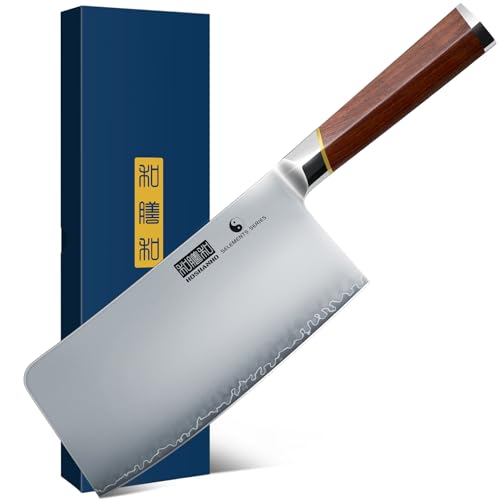
HOSHANHO 7-Inch Japanese Steel Cleaver
Best for: versatile cutting with high-retention Japanese steel
- Style
- Japanese (what this guide is about)
- Blade Length
- 7 in
- Intended Use
- Dicing, chopping herbs, slicing meats
- Blade Steel
- 10Cr15CoMoV
- Handle Material
- Red sandalwood
- Hardness
- 62 HRC
This 7-inch Japanese-style cleaver is built for slicing meats, breaking down poultry, and dicing vegetables. It features Japanese 10Cr15CoMoV high-carbon steel tempered to 62 HRC, giving you strong edge retention across daily prep work. Its double-bevel edge is ground to 15 degrees, while the red sandalwood handle supports a comfortable grip. It suits you if you need a hard, multi-purpose blade for both produce and meats.
Pros
- Japanese 10Cr15CoMoV high-carbon steel hardened to 62 HRC
- 15° double-bevel edge for slicing and chopping
- Dense red sandalwood handle contoured for comfort
- Mirror-polished blade finish designed to resist food sticking
Cons
- Does not include a protective sheath or blade guard
- Blade weight and spine thickness are not specified
Good fit if
- You want a hard 62 HRC Japanese high-carbon steel blade for lasting edge retention.
- You need a 7-inch profile suited for both vegetable slicing and poultry breakdown.
- You prefer a dense, natural red sandalwood handle.
Skip if
- You need a cleaver that includes a dedicated sheath for storage.
- You prefer verifying exact tool weight before buying.
Verdict: HOSHANHO 7-Inch High-Carbon Steel Cleaver pairs hard 62 HRC Japanese steel with a 15-degree cutting angle for versatile meat and vegetable prep. It provides strong edge retention and a dense sandalwood handle for everyday cutting tasks.
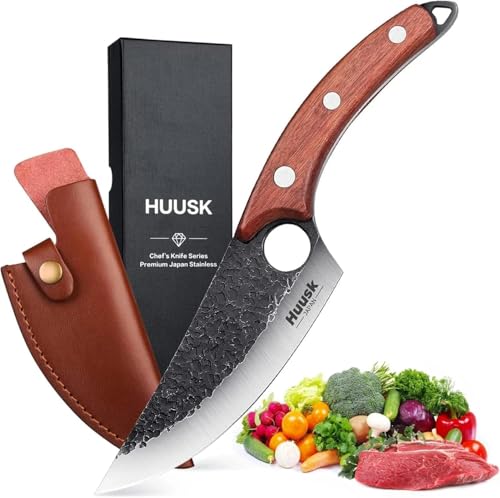
Dream Reach Huusk Forged Japanese Cleaver
Best for: outdoor cooking and heavy meat butchering
- Style
- Japanese (what this guide is about)
- Intended Use
- mincing, slicing, chopping, deboning
- Blade Steel
- high carbon and high manganese steel
- Construction
- handmade forged, SAN MAI
- Included Storage
- leather sheath
- Color
- Brown
This Japanese-style cleaver features a forged San Mai construction combining a high-carbon steel core with high-manganese steel cladding. Weighing 0.97 pounds with an overall length of 10.8 inches, it provides substantial heft for chopping and trimming. It arrives with a dedicated leather sheath and sports a brown finish. Because the steel is not stainless, you must keep it dry to prevent rust. It suits you if you need a heavy outdoor-ready kitchen blade.
Pros
- San Mai construction pairing high-carbon and high-manganese steel
- Includes leather sheath with belt loop for transport
- Substantial 0.97-pound forged build provides chopping heft
- 12-month warranty covering quality-related issues
Cons
- Non-stainless steel requires drying after use to prevent rust
- Arched blade profile differs from traditional flat cleavers
Good fit if
- You want a forged high-carbon knife equipped with a travel sheath.
- You prefer a hefty 0.97-pound weight for trimming and butchering.
Skip if
- You want rust-resistant, low-maintenance stainless steel.
- You prefer a flat, traditional rectangular Japanese cleaver edge.
Verdict: Dream Reach Huusk Forged Japanese Cleaver delivers a heavy high-carbon build paired with an included belt sheath. It provides solid cutting power if you maintain the non-stainless carbon blade properly.

KEEMAKE 7-Inch German Steel Nakiri Knife
Best for: straight-down vegetable prep and boneless slicing
- Style
- Japanese (what this guide is about)
- Blade Length
- 7 in
- Intended Use
- Vegetable slicing, dicing, mincing
- Blade Steel
- German high carbon stainless steel
- Handle Material
- Pakkawood
- Construction
- Forged full tang
The KEEMAKE 7-Inch German Steel Nakiri Knife is a Japanese-style vegetable cleaver built for push-cut prep work. It features a flat 7-inch rectangular blade ground to a 15-degree edge from 58 HRC German high-carbon stainless steel. At 0.56 pounds, the knife pairs a full-tang build with an ergonomic pakkawood handle. You get knuckle clearance and straight-line board contact suited for slicing produce and boneless proteins.
Pros
- 58 HRC German high-carbon stainless steel blade
- 15-degree cutting angle with a flat rectangular edge
- Full-tang pakkawood handle weighing 0.56 pounds
- Comes with a protective sheath for storage and transport
Cons
- Not designed for cutting through bones or frozen food
- Flat blade profile prevents rocking cutting motions
Good fit if
- You want a dedicated flat-edge blade for straight-down vegetable chopping.
- You prefer a lightweight 0.56-pound knife with a full-tang pakkawood grip.
- You need a blade that includes a protective sheath for safe storage.
Skip if
- You need a heavy cleaver to chop through dense bones.
- You rely on a curved blade profile for rocking cuts.
Verdict: KEEMAKE 7-Inch German Steel Nakiri Knife provides a sharp 15-degree flat profile and full-tang balance tailored for straight-down vegetable prep.

Mac Knife 6.5-Inch Nakiri Knife
Best for: lightweight Japanese vegetable slicing
- Style
- Japanese (what this guide is about)
- Blade Length
- 6.5 in
- Blade Steel
- molybdenum steel
- Color
- Silver
- Recommended Use
- Vegetables
- Weight
- 9.44 ounces
This Japanese-style vegetable cleaver features a 6.5-inch molybdenum steel blade paired with a Pakkawood handle. At 0.59 pounds, it provides a lightweight profile designed for controlled vegetable prep rather than heavy butchering. It is made in Japan and requires hand washing to preserve the materials. If you want a compact, maneuverable Japanese cleaver dedicated to slicing produce, this knife fits your kitchen.
Pros
- Molybdenum steel blade construction
- Lightweight build at 0.59 pounds
- Pakkawood handle
- Manufactured in Japan
Cons
- Not dishwasher safe; hand wash only
- Shorter 6.5-inch blade length
Good fit if
- You want a lightweight 0.59-pound Japanese vegetable knife.
- You prefer molybdenum steel paired with a Pakkawood handle.
- You need a compact 6.5-inch blade for vegetable prep.
Skip if
- You need a dishwasher-safe kitchen knife.
- You prefer a longer or heavier cleaver for dense cutting tasks.
Verdict: Mac Knife 6.5-Inch Nakiri Knife provides a dedicated, lightweight cutting tool with molybdenum steel and a Pakkawood handle for routine vegetable prep. Its Japanese build balances maneuverability with precise handling for those who do not mind hand washing.
Specifications side by side
| Spec | imarku 7-Inch High-Carbon Steel Cleaver | HOSHANHO 6.9-Inch Japanese Meat Cleaver | KYOKU Shogun Series 7" Forged Damascus Cleaver | HexClad 7-Inch Japanese Damascus Cleaver | TUO 7-Inch AUS-10 Damascus Cleaver | Huusk 3-Piece Japanese Butcher Knife Set | Mitsumoto Sakari 7-Inch 9Cr18MoV Cleaver | HOSHANHO 7-Inch Japanese Steel Cleaver | Dream Reach Huusk Forged Japanese Cleaver | KEEMAKE 7-Inch German Steel Nakiri Knife | Mac Knife 6.5-Inch Nakiri Knife |
|---|---|---|---|---|---|---|---|---|---|---|---|
| Blade Length | 7 in | 6.9 in | 7 in | 7.5 in | 7 in | not specified | 7 in | 7 in | not specified | 7 in | 6.5 in |
| Intended Use | Chopping, mincing, slicing, boning | Chopping bones, slicing vegetables | Vegetable slicing, meat slicing | Turnips, squash, proteins, bones | meat and vegetables | Bone smashing, precision slicing | heavy chopping, meat portioning | Dicing, chopping herbs, slicing meats | mincing, slicing, chopping, deboning | Vegetable slicing, dicing, mincing | not specified |
| Blade Steel | Japanese high carbon stainless steel | 10Cr15CoMoV | Japanese VG-10 Damascus | Japanese Damascus stainless steel | Japanese AUS-10 45-layer steel | Japanese steel | 9Cr18MoV high carbon stainless steel | 10Cr15CoMoV | high carbon and high manganese steel | German high carbon stainless steel | molybdenum steel |
| Handle Material | Pakkawood | Pakkawood | G10 | Pakkawood | pakkawood | Wood | rosewood | Red sandalwood | not specified | Pakkawood | not specified |
| Construction | Forged | not specified | Forged, full tang | Full tang, 67 layers | not specified | Hand forged, full tang | San-Mai hand-forged, 3-layer | not specified | handmade forged, SAN MAI | Forged full tang | not specified |
| Hardness | 57+1 HRC | 60 HRC | 58-60 HRC | not specified | 62+/-2 HRC | not specified | HRC 60±2 | 62 HRC | not specified | 58 HRC | not specified |
| Blade Thickness | 2.4 mm | 3 mm | not specified | not specified | not specified | not specified | not specified | not specified | not specified | not specified | not specified |
| Included Storage | not specified | not specified | Sheath and case | not specified | not specified | not specified | sandalwood box | not specified | leather sheath | Protective sheath | not specified |
| Blade Material | High-Carbon Stainless Steel | not specified | Damascus Steel | Stainless Steel | Damascus Steel | not specified | not specified | not specified | not specified | not specified | not specified |
| Storage Type | not specified | not specified | Sheath | not specified | not specified | not specified | not specified | not specified | Sheath | not specified | not specified |
| Color | Light Black | Silver | Life-time Warranty, Japanese VG10 Steel Core, Full Tang, G10 Handle with Engraved Rivet & Mosaic Pin, Included Guard, Ice Tempered & Heat Treated, Superior Sharpness, Ergonomic handle & well-balanced design | Espresso | Rose Pattern | Butcher Knife Set of 3 | wooden,Black | Silver | Brown | Black 7" Nkiri Knife | Silver |
| Style | Japanese | Japanese | Japanese | Japanese | Japanese | Japanese | Japanese | Japanese | Japanese | Japanese | Japanese |
| Size | 7" | 6.9" | 7" | 7-Inch Cleaver Knife | 7" | 6.3" + 5.7" + 5.7" | 7 Inch | 7" | 125" | 7" | 6.5" |
| Recommended Use | not specified | Meat | Vegetables, Meat | not specified | Vegetables, Meat | Meat | Boning, Meat | Vegetables, Meat | Boning, Meat | Vegetables | Vegetables |
| Dimensions | 12 × 3.3 × 0.8 inches | 6.9 × 5 × 2 inches | 14.6 × 2 × 1 inches | not specified | not specified | not specified | 12.7 × 0.98 × 2.44 inches | not specified | not specified | not specified | not specified |
| Weight | 11.8 ounces | 8 ounces | 0.35 ounces | not specified | 10.4 ounces | 2.51 pounds | 2.43 pounds | not specified | 15.5 ounces | 8.96 ounces | 9.44 ounces |
| Length | not specified | not specified | not specified | not specified | not specified | not specified | not specified | not specified | 10.8 inches | not specified | not specified |
| Model | I-KC0009 | 6.9 inch Butcher Knife | not specified | CTCLK07-EPW | not specified | MDX-GJ | MS-784 | 7 Inch Meat Cleaver | Dream Reach1 | Z2340102K-2K | MJU-65 |
How to Choose a Japanese Cleaver
-
Check Steel Hardness Ratings
You should inspect the Rockwell Hardness rating to determine edge durability. Japanese blades typically range from 60 to 62 HRC. Steel hardened to 62 HRC, such as the AUS-10 core on the TUO 7-Inch Cleaver, stays sharp longer through repetitive push cuts. However, harder steels have lower ductility and can chip if twisted against hard cutting boards. If you want maximum edge retention for boneless prep, choose a higher rating. Select moderate hardness near 60 HRC if you prefer simpler honing and less brittleness.
-
Evaluate the Cutting Angle
You must check the blade bevel angle to match your cutting style. Most Japanese cleavers feature double-bevel angles between 12 and 16 degrees per side. An acute 12-degree angle, found on the HexClad 7-Inch Cleaver, reduces cutting resistance and glides smoothly through delicate meats and soft produce. In contrast, 15-degree or 16-degree profiles provide extra steel behind the cutting apex. Choose a 12-degree edge if fine slicing is your main priority. Pick a wider 15-degree edge if you need greater resistance to rolling during rapid daily chopping.
-
Select Handle Material Carefully
You should review handle materials to ensure grip stability and water resistance. Japanese-style cleavers use synthetic composites, pakkawood, or natural hardwoods like rosewood and sandalwood. Synthetic G10 composite, featured on the KYOKU Shogun 7-Inch Cleaver, resists moisture, humidity, and heat without cracking or swelling over time. Dense hardwoods and resin-infused pakkawood offer traditional warmth in hand but require immediate hand drying after washing to prevent moisture damage. Choose G10 if you want low-maintenance durability. Select natural wood handles if you prioritize organic grip texture and balanced hand feel.
-
Assess Spine Thickness
You should check the blade spine measurement to avoid food wedging. Cleavers with thinner spines pass through dense ingredients like squash, cabbage, and potatoes with minimal friction. The imarku 7-Inch Cleaver features a 2.4-millimeter spine, which prevents splitting firm vegetables while maintaining structural rigidity for repetitive downward slicing. Broader spines add substantial weight but tend to crack firm produce rather than cutting cleanly. If your daily prep centers on produce chopping and boneless proteins, prioritize a spine measurement below 2.5 millimeters. Choose thicker spines only when splitting dense cartilage.
-
Choose the Blade Length
You must evaluate blade length based on your prep workspace and cutting board dimensions. Most Japanese cleavers measure 7 inches long, giving you ample edge contact for scooping diced ingredients and clearing large heads of greens. However, compact blades like the 6.3-inch Imarku Japanese Steel Meat Cleaver offer greater agility in confined kitchen stations. Shorter blades provide better tip control and reduce hand fatigue when trimming small cuts of meat. Choose a standard 7-inch profile for all-around prep work. Select a compact 6.3-inch or 6.5-inch model if your cutting space is tight.
-
Look for Protective Sheaths
You should check whether the cleaver includes dedicated protective storage hardware. Wide cleaver blades do not fit into standard wooden kitchen blocks and can sustain edge damage if placed loosely in kitchen drawers. Carbon steel blades also need shielding from ambient moisture. The Dream Reach Huusk Cleaver includes a fitted belt sheath, keeping the blade edge shielded during storage and outdoor transport. If you plan to store your knife in a shared drawer or carry it outside, choose a model that includes a dedicated sheath. Otherwise, plan to purchase a separate blade guard.
Frequently asked questions
What is the best Japanese cleaver for everyday vegetable chopping?
The imarku 7-Inch High-Carbon Steel Cleaver is the top choice for everyday slicing and mincing. It weighs 0.74 pounds and features a 2.4 mm spine. This balance allows for precise cuts without excessive weight. The 15-degree double bevel edge ensures clean results for vegetables and boneless meat.
Which cleaver is best for heavy-duty bone chopping?
The HOSHANHO 6.9-Inch Japanese Meat Cleaver handles poultry and bone chopping effectively. It uses 60 HRC 10Cr15CoMoV steel with a 3-millimeter spine. This robust construction balances heavy-duty crushing with general kitchen slicing. The lightweight 0.5-pound frame makes it manageable for rigorous tasks.
How does blade hardness affect a Japanese cleaver's performance?
Blade hardness determines edge retention and durability. Higher Rockwell Hardness ratings, such as the 62 HRC on the TUO 7-Inch Cleaver, provide longer-lasting sharpness. The Mitsumoto Sakari uses 60±2 HRC steel for substantial cutting authority. Harder steel holds an edge longer but may require more careful handling.
What makes a Damascus steel cleaver different from standard steel?
Damascus cleavers combine a hard steel core with softer outer layers. The KYOKU Shogun Series uses a VG-10 core for durable edge retention. The HexClad model features a 67-layer steel blade. This construction often allows for acute edges, like the 12-degree angle on the HexClad, for precise slicing.
Are Japanese cleavers suitable for boneless meat slicing?
Yes, many Japanese cleavers excel at boneless meat slicing. The imarku and KYOKU models are designed for fine slicing rather than bone chopping. Their acute double-bevel edges and balanced weights provide control. The TUO 7-Inch Cleaver offers a smooth bolster for pinch-grip control during detailed meat prep.
What handle materials are common in Japanese cleavers?
Common handle materials include Pakkawood and rosewood. The HexClad and Mac Knife models use Pakkawood for durability and balance. The Mitsumoto Sakari features an octagonal rosewood handle for a secure grip. The TUO model also utilizes a Pakkawood handle for efficient slicing. These materials offer ergonomic comfort during extended use.
Is a full-tang construction important for a Japanese cleaver?
Full-tang construction provides solid balance and durability. The HexClad and Huusk 3-Piece Set feature full-tang designs for even weight distribution. This construction ensures the knife can handle rigorous tasks without weakening. It also contributes to the overall stability and control you feel during cutting.
How do you maintain a high-carbon steel cleaver?
High-carbon steel requires proper maintenance to prevent rust. The Dream Reach Huusk cleaver uses non-stainless carbon blade that needs careful care. Regular hand washing and drying are essential. The HexClad model also requires hand washing and regular honing to maintain its 67-layer steel blade integrity.