QKOQKO 7-Inch Damascus Wood Handle vs QKOQKO 7-Inch Damascus Santoku (2026): Key Differences
As an Amazon Associate we earn from qualifying purchases. Links on this page are affiliate links.
When comparing the qkoqko 7 inch damascus wood handle vs 7 inch damascus santoku, you see two sharp tools from the same brand. Both feature a 7-inch blade, a 9Cr18MoV steel core, and a forged 67-layer Damascus construction. They share the same ergonomic natural wood handle. The main difference lies in the blade profile. One is a Nakiri with a straight edge for vegetables. The other is a Santoku for all-purpose tasks including meat.
Key differences
| Aspect | QKOQKO 7-Inch Damascus Wood Handle Nakiri Knife | QKOQKO 7-Inch Damascus Santoku |
|---|---|---|
| Knife Type | Nakiri | Santoku |
| Edge Type | Straight edge | not listed |
| Recommended Use | Vegetables | Meat |
| Model | DXCK-001 | DSK-001 |
Which one should you choose?
Choose QKOQKO 7-Inch Damascus Wood Handle Nakiri Knife if
- You primarily cut firm vegetables like sweet potatoes or zucchini
- You prefer a square blade with a straight edge for precise slicing
- You want a knife specifically designed for vegetable preparation
Choose QKOQKO 7-Inch Damascus Santoku if
- You need a versatile knife for everyday cooking tasks
- You frequently cut fruits, vegetables, and all kinds of meat
- You prefer a traditional Santoku profile for multi-purpose use
Verdict: Choose the Nakiri if your main goal is efficient vegetable prep with a straight edge. Pick the Santoku if you need a single knife for meat and general kitchen duties. Both share the same steel quality and handle comfort.
Nakiri vs Santoku Key Differences
Blade Profile
The QKOQKO 7-Inch Damascus Wood Handle Nakiri Knife features a square blade with a straight edge, designed specifically for cutting firm vegetables like sweet potatoes and zucchini. This rectangular profile allows for a precise chopping motion. In contrast, the QKOQKO 7-Inch Damascus Santoku uses a traditional Santoku shape, which is better suited for everyday cooking tasks involving fruits, vegetables, and meat. The Santoku’s curved edge facilitates a rocking cut, offering versatility that the flat Nakiri blade does not provide.
Recommended Use
You should choose the QKOQKO 7-Inch Damascus Wood Handle Nakiri Knife if your primary goal is preparing vegetables. Its design excels at slicing firm produce while preserving texture and flavor. The QKOQKO 7-Inch Damascus Santoku is marketed for broader everyday cooking, including cutting all kinds of meat. If you need a single tool for mixed ingredients, the Santoku’s recommended use covers a wider range of kitchen duties than the vegetable-focused Nakiri.
Edge Type
Both knives share a straight edge configuration, which contributes to clean, smooth slices. The QKOQKO 7-Inch Damascus Wood Handle Nakiri Knife explicitly lists a straight edge, complementing its square blade for accurate chopping. The QKOQKO 7-Inch Damascus Santoku also utilizes a straight edge design, though its Santoku profile allows for some rocking motion. Since both rely on straight edges, neither has a distinct advantage in this specific specification, making this a tie for buyers prioritizing edge geometry.
Blade Material
Both the QKOQKO 7-Inch Damascus Wood Handle Nakiri Knife and the QKOQKO 7-Inch Damascus Santoku are crafted from identical materials. Each features a 9Cr18MoV steel core forged within 67 layers of premium Damascus steel. This construction ensures durability, rust resistance, and a razor-sharp finish. The precision heat treatment applied to both blades is the same, meaning you get equivalent cutting performance and edge retention regardless of which model you select.
Handle Material
Both knives feature an ergonomic natural wood handle designed for a secure and balanced grip. The QKOQKO 7-Inch Damascus Wood Handle Nakiri Knife offers outstanding control with every cut due to its wooden construction. Similarly, the QKOQKO 7-Inch Damascus Santoku uses the same ergonomic natural wood handle to provide flexibility and comfort. Since the handle material and design philosophy are identical across both products, there is no difference in grip feel or material composition.
Which QKOQKO Knife Fits Your Cooking
Vegetable-focused cooks wanting precision
Choose the Nakiri if your daily prep involves firm vegetables like sweet potatoes or zucchini. The square blade and straight edge allow for precise, vertical chopping motions. This profile keeps ingredients intact and ensures clean, smooth slices that preserve texture and flavor for your meals.
All-purpose cooks handling meat and veg
Select the Santoku for versatility with fruits, vegetables, and all kinds of meat. The 7-inch blade handles everyday cooking tasks efficiently. Its design supports a rocking motion, making it a practical companion for diverse ingredients while maintaining the sharpness and durability of the 9Cr18MoV steel core.
Those seeking a balanced, comfortable grip
Both knives share an ergonomic natural wood handle, but the Nakiri offers a secure, balanced grip specifically tuned for control during chopping. The handle provides outstanding stability with every cut. This design ensures you master ingredients with ease, combining flexibility and comfort for extended kitchen use without fatigue.
The products compared
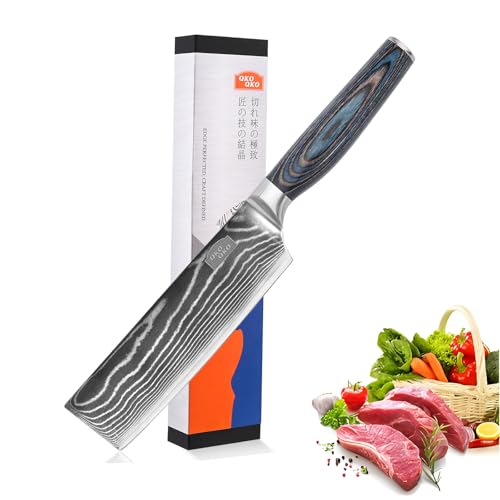
QKOQKO 7-Inch Damascus Wood Handle Nakiri Knife
Best for: Dedicated vegetable chopping and slicing
- Blade Length
- 7 in
- Knife Type
- Nakiri
- Blade Material
- 9Cr18MoV steel core
- Construction
- Forged 67-layer Damascus
- Edge Type
- Straight edge
- Handle Material
- Natural wood
View on Amazon: QKOQKO 7-Inch Damascus Wood Handle Nakiri Knife Affiliate link
This QKOQKO Nakiri knife features a 7-inch blade with a straight edge, designed for precise vegetable prep. The construction includes 67 layers of Damascus steel surrounding a 9Cr18MoV core. It uses a natural wood handle for balance. The blade is 2mm thick and weighs 8 ounces. This tool suits cooks who need a dedicated vegetable knife with a traditional Japanese profile.
Pros
- Forged from 67 layers of Damascus steel with a 9Cr18MoV core
- Straight edge blade excels at cutting firm vegetables
- Ergonomic natural wood handle for secure grip
- 2mm thick blade provides sturdy cutting performance
Cons
- Natural wood handle requires careful maintenance to prevent damage
- Straight edge lacks the rocking motion of a Western chef knife
- Dedicated vegetable shape limits use on other ingredients
Good fit if
- You want a dedicated knife for chopping vegetables
- You prefer the balance of a natural wood handle
- You value the durability of a 9Cr18MoV steel core
Skip if
- You need a multi-purpose chef knife for rocking cuts
- You prefer a lightweight stainless steel blade
- You want a knife with a synthetic, low-maintenance handle
Verdict: QKOQKO 7-Inch Damascus Nakiri is a specialized tool for vegetable prep, offering a sturdy 2mm blade and balanced wood handle. It fits users who want a dedicated Japanese-style vegetable knife rather than a general-purpose cutter.

QKOQKO 7-Inch Damascus Santoku
Best for: Everyday prep with a wooden handle
- Blade Length
- 7 in
- Knife Type
- Santoku
- Blade Material
- 9Cr18MoV steel core
- Construction
- Forged 67-layer Damascus
- Handle Material
- Natural wood
- Style
- Japanese
View on Amazon: QKOQKO 7-Inch Damascus Santoku Affiliate link
This QKOQKO Santoku knife features a 7-inch blade forged from 67 layers of Damascus steel with a 9Cr18MoV core. The natural wood handle provides an ergonomic grip for balanced control. It is designed for cutting meat, fruits, and vegetables. The blade thickness is 2mm. This knife suits cooks who prefer traditional Japanese styling and durable, layered steel construction for everyday kitchen tasks.
Pros
- Forged 67-layer Damascus construction with 9Cr18MoV steel core
- 7-inch blade length with 2mm thickness
- Ergonomic natural wood handle for secure grip
- Suitable for cutting meat, fruits, and vegetables
Cons
- Natural wood handle requires careful maintenance to prevent damage
- 7-inch blade may be too small for large roasts
- Specific model number not disclosed in available data
Good fit if
- You prefer the look and balance of a wooden handle
- You want a versatile knife for daily prep tasks
- You value layered Damascus steel aesthetics
Skip if
- You need a larger blade for heavy-duty butchery
- You prefer low-maintenance synthetic handles
- You require a specific model number for warranty purposes
Verdict: QKOQKO 7-Inch Damascus Santoku Knife offers a classic Japanese design with a durable 9Cr18MoV core. It is a strong choice for home cooks who prioritize aesthetic appeal and precise, everyday cutting performance.
Specifications side by side
| Spec | QKOQKO 7-Inch Damascus Wood Handle Nakiri Knife | QKOQKO 7-Inch Damascus Santoku |
|---|---|---|
| Blade Length | 7 in | 7 in |
| Knife Type | Nakiri | Santoku |
| Blade Material | 9Cr18MoV steel core | 9Cr18MoV steel core |
| Construction | Forged 67-layer Damascus | Forged 67-layer Damascus |
| Edge Type | Straight edge | not stated |
| Handle Material | Natural wood | Natural wood |
| Style | Japanese | Japanese |
| Recommended Use | Vegetables | Meat |
| Weight | 8 ounces | not stated |
| Size | 7 Inch Nakiri Knife | 7.5 |
| Color | Damascus 7 inch Nakiri Knife | 7” Damascus Santoku Knife |
| Model | DXCK-001 | DSK-001 |
Frequently asked questions
Does the QKOQKO 7-Inch Damascus Wood Handle Nakiri Knife have a wood handle?
Yes, this knife features a natural wood handle. The product data lists the handle material as wood. This provides an ergonomic grip suitable for dedicated vegetable prep. It pairs with a sturdy 2mm blade for precise chopping motions on firm produce.
Is the QKOQKO 7-Inch Damascus Santoku suitable for cutting meat?
Yes, the recommended use for this knife includes meat. It is designed for everyday prep tasks involving protein. The classic Japanese design supports precise cutting performance. You get a durable 9Cr18MoV core blade for reliable daily use in the kitchen.
What is the weight of the QKOQKO 7-Inch Damascus Wood Handle Nakiri Knife?
The QKOQKO 7-Inch Damascus Wood Handle Nakiri Knife weighs 8 ounces. This weight contributes to its balanced feel during use. The model DXCK-001 combines this mass with a 7-inch blade size for controlled vegetable slicing and chopping tasks.
Does the QKOQKO 7-Inch Damascus Santoku have a Damascus steel blade?
Yes, the blade is made of Damascus steel. This construction includes a 9Cr18MoV core surrounded by forged layers. The aesthetic appeal is matched by durable cutting performance. The 7-inch blade length offers versatility for various home cooking needs.
Which QKOQKO knife is better for vegetable chopping?
The QKOQKO 7-Inch Damascus Wood Handle Nakiri Knife is better for vegetables. It is a specialized tool for vegetable prep with a square blade profile. This design allows for precise vertical chopping. The Santoku is more general-purpose, while the Nakiri focuses on produce.
Are both knives Japanese style?
Yes, both knives are Japanese style. The Nakiri and the Santoku share this design heritage. This style emphasizes precision and specific cutting techniques. You get traditional aesthetics combined with modern Damascus steel construction in both models for distinct culinary applications.