The Best MIYABI Kitchen Knives in 2026: 15 Picks
As an Amazon Associate we earn from qualifying purchases. Links on this page are affiliate links.
Finding the right MIYABI kitchen knife depends on matching blade profiles to your food preparation needs. The MIYABI lineup includes 5.5-inch to 8-inch chef's knives, santokus, and rocking santokus crafted with FC61, VG10, or SG2 steel cores. The Miyabi Birchwood SG2 8-Inch Chef's Knife takes the top spot for daily prep requiring an acute edge because of its 9.5 to 12-degree cutting angle and SG2 core.
For 2026, this guide evaluates 15 knives using only the specifications published on their product listings.
Quick picks
Our 15 picks

Miyabi Birchwood SG2 8-Inch Chef's Knife
Best for: daily prep requiring an acute edge
- Blade Length
- 8-inch
- Knife Type
- Chef's Knife
- Blade Material
- SG2
- Construction
- 100-layer flower Damascus pattern
- Edge Angle
- 9.5 to 12 degree
- Handle Material
- Karelian Birch
This 8-inch Japanese chef's knife pairs an SG2 micro-carbide powder steel core with a Damascus steel exterior. It features a thin blade profile hand-honed using the three-step Honbazuke process to an edge between 9.5 and 12 degrees. With a 5.39-inch Karelian birch handle and an overall weight of 1.18 pounds, it suits you if you need a precise, full-sized cutting tool for daily kitchen prep.
Pros
- Hand-honed 9.5 to 12 degree Honbazuke edge
- SG2 micro-carbide powder steel core
- 5.39-inch Karelian birch handle
- Thin Japanese blade profile with Damascus steel
Cons
- Listed specification weight is 1.18 pounds
- Size options in this line limited to 8-inch and 9-inch models
Good fit if
- You want an 8-inch Japanese chef knife with an edge honed between 9.5 and 12 degrees.
- You prefer a Karelian birch wood handle measuring 5.39 inches.
- You want an SG2 micro-carbide powder steel core wrapped in Damascus steel.
Skip if
- You prefer a shorter 6-inch or 7-inch chef knife profile.
- You want a synthetic handle material instead of natural birch wood.
Verdict: MIYABI Birchwood SG2 8-Inch Chef's Knife provides an acute 9.5 to 12 degree edge and an SG2 micro-carbide core for kitchen prep. It is an authentic thin Japanese chef's knife balanced with a 5.39-inch Karelian birch handle.
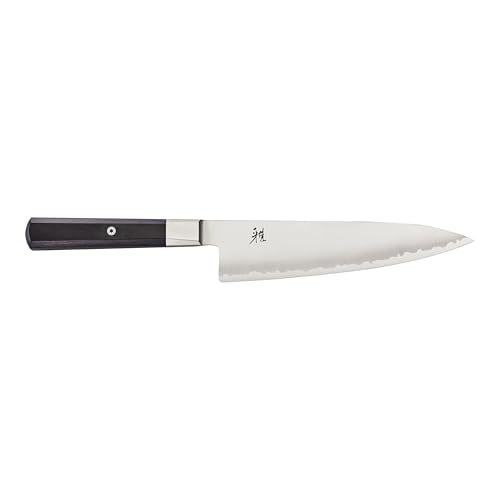
MIYABI Koh 8-Inch FC61 Chef's Knife
Best for: streamlined Japanese chef knife performance
- Blade Length
- 8-inch
- Knife Type
- Chef's Knife
- Blade Material
- FC61 fine carbide stainless steel
- Edge Angle
- 9.5-12°
- Blade Hardness
- 61 Rockwell
- Handle Material
- Pakkawood
The MIYABI Koh 8-inch Chef's Knife is a Japanese kitchen knife built with FC61 fine carbide stainless steel hardened to 61 Rockwell. Its blade features an acute 9.5 to 12-degree Honbazuke edge and FRIODURx2 ice hardening for edge retention. At 0.6 pounds with an ergonomic black Pakkawood handle, it gives you a balanced profile. It suits you if you want a lightweight Japanese chef knife for everyday prep.
Pros
- FC61 fine carbide stainless steel blade rated at 61 Rockwell hardness
- Hand-honed Honbazuke edge ground to a 9.5–12 degree angle
- Ice-hardened FRIODURx2 treatment for durability and corrosion resistance
- Rounded spine and heel designed for comfortable cutting
Cons
- Single-layer blade lacks decorative Damascus cladding
- No blade guard or storage sheath listed in specifications
Good fit if
- You want an acute 9.5 to 12-degree cutting edge made from 61 Rockwell steel.
- You prefer a clean mirror-polished blade over decorative patterned steel.
- You need a standard 8-inch chef knife profile with an ergonomic Pakkawood handle.
Skip if
- You prefer a multi-layer Damascus or hammered blade finish.
- You want a shorter 6-inch or 7-inch Santoku profile instead of an 8-inch chef knife.
Verdict: MIYABI Koh 8-Inch FC61 Chef's Knife pairs 61 Rockwell FC61 steel with a hand-honed 9.5 to 12-degree Honbazuke edge. It provides standard Japanese cutting geometry in a streamlined, unadorned format.

MIYABI Koya 8-Inch Chef's Knife
Best for: precise cutting with a lightweight Japanese blade
- Blade Length
- 8-inch
- Knife Type
- Chef's Knife
- Blade Material
- FC61 fine carbide stainless steel
- Edge Type
- Katana edge, double bevel
- Edge Angle
- 12°
- Blade Hardness
- 61 Rockwell
The MIYABI Koya 8-Inch Chef's Knife is a Japanese kitchen knife forged from FC61 fine carbide stainless steel with 61 Rockwell hardness. You get a full-tang, ice-hardened blade sharpened to a 12-degree double bevel. It features a faceted birchwood pakkawood handle and weighs 0.38 pounds. This knife suits you if you want a lightweight 8-inch chef's knife built for precise daily cutting tasks.
Pros
- FC61 fine carbide stainless steel with 61 Rockwell hardness
- Hand-honed 12° double bevel edge
- Full-tang ice-hardened Friodur2 construction
- Lightweight build at 0.38 pounds
Cons
- Hand-wash only; not dishwasher safe
- No blade sheath or edge guard included
Good fit if
- You want an 8-inch chef knife with an acute 12° edge angle.
- You prefer a light knife weighing under 0.4 pounds.
- You want a faceted pakkawood handle with a full-tang blade.
Skip if
- You require dishwasher-safe kitchen cutlery.
- You prefer a heavier knife than this 0.38-pound model.
Verdict: MIYABI Koya 8-Inch Chef's Knife pairs FC61 steel and a 12° edge with a 0.38-pound profile. It delivers a balanced, full-tang design for users who prioritize precision and lightweight handling.

Miyabi Birchwood SG2 7-Inch Santoku Knife
Best for: precision vegetable prep and fine slicing
- Blade Length
- 7"
- Knife Type
- Santoku Knife
- Blade Material
- G2 micro-carbide powder steel
- Construction
- 101-layer flower Damascus
- Edge Type
- Katana edge
- Edge Angle
- 9.5 to 12 degree
This 7-inch santoku knife features an SG2 micro-carbide powder steel core with a 101-layer flower Damascus design. It has an authentic thin Japanese profile and a CRYODUR ice-hardened blade rated at Rockwell 63 hardness. The edge is hand-honed to an angle between 9.5 and 12 degrees. Paired with a Karelian birch handle and weighing 0.8 pounds, it suits you if you want a dedicated precision prep knife.
Pros
- CRYODUR blade ice-hardened to Rockwell 63
- Hand-honed 9.5- to 12-degree Honbazuke edge
- SG2 micro-carbide powder steel core with 101-layer Damascus design
- Karelian birch handle
Cons
- 7-inch blade length is shorter than standard 8-inch chef knives
- High hardness rating of Rockwell 63 requires careful handling
Good fit if
- You want an SG2 powder steel santoku with an acute 9.5 to 12 degree edge angle.
- You prefer a natural Karelian birch wood handle.
- You need a lightweight 0.8-pound knife for Japanese-style prep work.
Skip if
- You prefer an 8-inch or larger blade for processing bulk items.
- You want a softer steel blade for heavy-duty chopping tasks.
Verdict: MIYABI Birchwood SG2 7-Inch Santoku Knife provides high hardness and a precise edge geometry through its SG2 steel core and 101-layer Damascus construction. It serves as a specialized Japanese prep knife for fine cutting tasks.
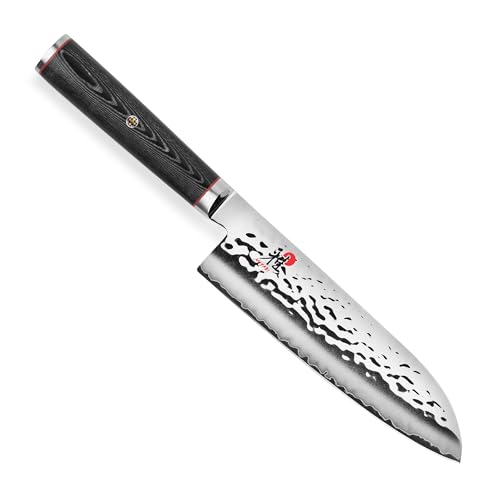
MIYABI Mizu 7-Inch SG2 Santoku Knife
Best for: precise prep work requiring high edge retention
- Blade Length
- 7"
- Knife Type
- Santoku Knife
- Blade Material
- SG2 Micro-Carbide Powder Stainless Steel
- Edge Type
- Double bevel
- Edge Angle
- 12 degree
- Blade Hardness
- 63 Rockwell Hardness
This 7-inch Japanese santoku knife features an SG2 micro-carbide powder stainless steel blade with a hammered Damascus finish. The blade is ice-hardened to a 63 Rockwell hardness rating and sharpened to a 12-degree double-bevel edge. At 0.47 pounds, it includes a D-shaped Micarta handle with an integrated bolster. It suits you if you want a hard Japanese steel core with a balanced grip for routine kitchen chopping.
Pros
- SG2 micro-carbide powder stainless steel core
- Cryodur ice-hardened blade with 63 Rockwell hardness
- 12-degree double-bevel Honbazuke edge
- Micarta D-shape handle with bolster and metal end cap
- Hammered Tsuchime Damascus finish
Cons
- Asymmetrical D-shape handle favors right-handed grip
- No storage sheath or blade guard included in specs
Good fit if
- You want a 63 Rockwell hardness SG2 steel blade with a 12-degree edge.
- You prefer a D-shaped Micarta handle with a metal end cap.
- You need a lightweight 0.47-pound santoku for detailed food prep.
Skip if
- You prefer a symmetrical handle for ambidextrous cutting.
- You need a longer 8-inch blade for dividing large cuts of meat.
Verdict: MIYABI Mizu 7-Inch SG2 Santoku Knife pairs a 63 Rockwell hardness core with a 12-degree Honbazuke edge and a D-shaped Micarta handle. It provides high edge retention and balance for daily kitchen prep.
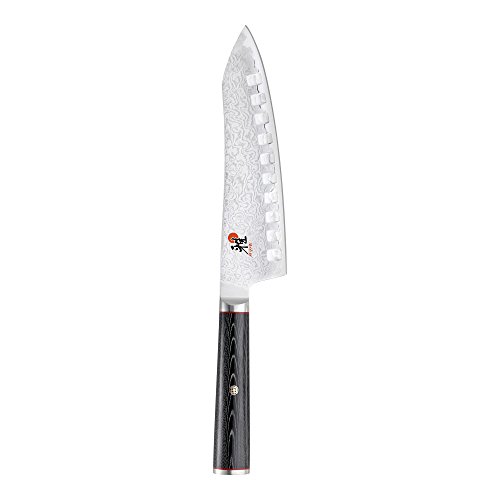
MIYABI Kaizen 7-inch Hollow Edge Rocking Santoku
Best for: rocking cuts with minimal food stick
- Blade Length
- 7 in
- Knife Type
- Rocking Santoku
- Blade Material
- VG10 super steel
- Construction
- 65-layer flower Damascus
- Edge Type
- Hollow edge
- Edge Angle
- 9.5 to 12 degree
View on Amazon: MIYABI Kaizen 7-inch Hollow Edge Rocking Santoku
The MIYABI Kaizen 7-inch Hollow Edge Rocking Santoku Knife pairs a curved cutting line with hollow indents along the blade. It features a VG10 core wrapped in 65-layer flower Damascus, ice-hardened to Rockwell 60. Honed to a 9.5 to 12-degree edge per side, it includes a D-shaped black linen Micarta handle. This tool suits you if you want fluid rocking motions and less food adherence.
Pros
- VG10 core ice-hardened to Rockwell 60
- Hand-honed 9.5 to 12-degree Honbazuke edge
- Hollow edge design to assist food release
- Durable black linen Micarta handle
Cons
- D-shaped handle is asymmetrical rather than ambidextrous
- Rockwell 60 rating is softer than SG2 powder steel alternatives
Good fit if
- You prefer rocking chopping motions over flat push cuts.
- You want hollow indents to reduce food sticking to the blade.
Skip if
- You need a symmetrical handle shape for left-handed use.
- You prefer a flatter, traditional Japanese santoku profile.
Verdict: MIYABI Kaizen 7-inch Hollow Edge Rocking Santoku combines a curved belly, hollow-ground edge, and VG10 steel for fluid cutting. It serves cooks who want rocking mechanics paired with Japanese edge geometry.

MIYABI 7-Inch SG2 Rocking Santoku Knife
Best for: rocking cuts requiring high edge retention
- Blade Length
- 7-inch
- Knife Type
- Rocking Santoku
- Blade Material
- SG2 micro-carbide powder steel
- Edge Angle
- 9.5 to 12 degree
- Color
- Black
- Dimensions
- 3 × 1.31 × 14.8 inches
This 7-inch rocking santoku knife features an authentic thin Japanese blade profile forged from SG2 micro-carbide powder steel. Hand-honed via the traditional three-step Honbazuke process, the cutting bevel reaches an acute 9.5 to 12 degree angle per side. Weighing 0.6 pounds, it provides a curved edge designed for rocking motions during everyday prep work. It suits you if you want high-hardness steel combined with a curved Japanese santoku format.
Pros
- SG2 micro-carbide powder steel blade
- Acute 9.5 to 12 degree edge angle from three-step Honbazuke honing
- Lightweight 0.6-pound build with a thin Japanese profile
Cons
- Curved rocking edge lacks the flat profile of standard santokus
- Thin, acute edge requires careful maintenance to avoid chipping
Good fit if
- You prefer a rocking cutting motion rather than straight push-cutting.
- You want SG2 powder steel sharpened to a narrow 9.5 to 12 degree angle.
Skip if
- You prefer a flat-edged traditional Japanese santoku profile.
- You need a heavier blade for chopping through dense, hard materials.
Verdict: MIYABI 7-Inch SG2 Rocking Santoku Knife pairs high-hardness powder steel edge retention with a curved belly tailored for rocking cuts.

MIYABI Artisan 7-Inch Santoku Knife
Best for: precision slicing with a pakkawood handle
- Blade Length
- 7"
- Knife Type
- Santoku
- Blade Material
- Sg2 micro-carbide powder steel
- Edge Type
- Fine Edge
- Edge Angle
- 9.5 to 12 degree
- Blade Hardness
- 63 Rockwell hardness
This 7-inch Japanese santoku knife features an SG2 micro-carbide powder steel core tempered to 63 Rockwell hardness. Hand-honed to a 9.5 to 12 degree edge through a three-step Honbazuke process, it delivers a precise cutting bevel. The knife weighs 0.6 pounds and pairs its thin profile with a D-shaped pakkawood handle. It suits you if you need a specialized slicing knife with high edge retention for precise kitchen prep.
Pros
- SG2 micro-carbide powder steel blade construction
- Tempered to 63 Rockwell hardness for edge retention
- Hand-honed Honbazuke edge angled at 9.5 to 12 degrees
- D-shaped pakkawood handle
Cons
- Steep 9.5 to 12 degree angle requires precise sharpening maintenance
- Fine edge lacks hollow indents to help release food
Good fit if
- You want an SG2 powder steel blade hardened to 63 Rockwell.
- You prefer a D-shaped pakkawood handle.
- You need a 7-inch Japanese profile sharpened to a 9.5 to 12 degree edge.
Skip if
- You prefer a longer 8-inch blade for your primary kitchen prep.
- You want hollow-ground blade depressions to reduce food sticking.
Verdict: MIYABI Artisan 7-Inch Santoku Knife delivers SG2 micro-carbide steel with 63 Rockwell hardness and a hand-honed Honbazuke edge. Its authentic thin profile and D-shaped pakkawood handle provide balanced control for fine slicing.

Miyabi Birchwood SG2 6-Inch Chef's Knife
Best for: smaller hands seeking lightweight precision cutting
- Blade Length
- 6-inch
- Knife Type
- Chef's Knife
- Blade Material
- G2 micro-carbide powder steel
- Construction
- 100-layer flower Damascus
- Edge Angle
- 9.5 to 12 degree
- Handle Material
- Karelian Birch
This 6-inch chef's knife features an SG2 micro-carbide powder steel core layered with Damascus steel. Its authentic thin Japanese blade is hand-honed via the three-step Honbazuke process to an acute 9.5-to-12-degree edge. At 0.6 pounds, the lighter build gives you agile control for prep work. It suits you if you prefer a compact blade sized for smaller hands rather than a standard 8-inch chef knife.
Pros
- SG2 micro-carbide powder steel core with Damascus steel
- Hand-honed three-step Honbazuke 9.5- to 12-degree edge
- Weighs 0.6 pounds for a lightweight feel
- Thin Japanese blade profile for precise slicing
Cons
- Shorter 6-inch blade offers less cutting reach than 8-inch models
- Narrow 1.38-inch width provides less knuckle clearance on the board
Good fit if
- You have smaller hands and want a lightweight 0.6-pound knife.
- You want an acute 9.5-to-12-degree Honbazuke edge for precise cuts.
- You prefer a maneuverable 6-inch blade over longer chef knives.
Skip if
- You need an 8-inch or longer blade to slice large vegetables and proteins.
- You prefer a heavier Western-style blade profile for hefty chopping tasks.
Verdict: MIYABI Birchwood SG2 6-Inch Chef's Knife delivers high-precision slicing with its acute Honbazuke edge and compact 6-inch profile. It is a practical alternative if you find standard 8-inch knives cumbersome.

MIYABI Evolution 7-Inch Rocking Santoku
Best for: lightweight personalized prep work
- Blade Length
- 7 in
- Knife Type
- Rocking Santoku
- Color
- Silver
- Weight
- 4.8 ounces
The MIYABI Evolution 7-Inch Rocking Santoku gives you a specialized Japanese kitchen knife designed for both slicing and rocking cuts. It features a 7-inch length, a silver finish, and custom engraved personalization. Weighing just 0.3 pounds, this knife provides an ultra-light option for everyday food preparation. This tool suits you if you want a lightweight 7-inch rocking blade that includes personalized styling.
Pros
- Weighs 0.3 pounds for lightweight handling
- 7-inch rocking santoku blade profile
- Includes custom engraved personalization
- Classic silver finish
Cons
- Specific blade steel alloy not listed in specifications
- Handle material and construction details omitted from data
Good fit if
- You want an ultra-lightweight knife weighing only 0.3 pounds.
- You prefer a 7-inch rocking santoku blade profile.
- You want custom engraved personalization on your cutlery.
Skip if
- You prefer a heavier kitchen knife than 0.3 pounds.
- You require explicit blade steel specifications before choosing a knife.
Verdict: MIYABI Evolution 7-Inch Rocking Santoku delivers a 0.3-pound cutting option with a silver finish and custom personalization. It is a practical fit if you need a lightweight 7-inch rocking blade.

MIYABI 5.5-inch FC61 Santoku Knife
Best for: compact prep work needing precise blade control
- Blade Length
- 5.5"
- Knife Type
- Santoku
- Blade Material
- FC61 fine carbide steel
- Blade Hardness
- Rockwell 61
- Color
- Silver
- Dimensions
- 3 × 1 × 14.8 inches
This is a compact Japanese santoku knife featuring a 5.5-inch blade made of FC61 fine carbide steel. The blade undergoes FRIODUR ice-hardening to reach a hardness of Rockwell 61 and is sharpened with a three-step Honbazuke process. Weighing 0.3 pounds, it provides a lightweight cutting tool with a thin profile and mirror finish. You will find it suits detailed cutting tasks when a full-sized 7-inch knife feels too large.
Pros
- FC61 fine carbide steel ice-hardened to Rockwell 61
- Lightweight build at 0.3 pounds
- Hand-honed three-step Honbazuke cutting edge
- Authentic thin Japanese blade profile
Cons
- Shorter 5.5-inch blade length limits reach on large produce
- No hollow-edge indentations listed to reduce food sticking
Good fit if
- You want a lightweight 0.3-pound knife for smaller prep jobs.
- You prefer a compact 5.5-inch blade over a standard 7-inch santoku.
Skip if
- You need a standard 7-inch or 8-inch blade for larger cutting tasks.
- You require hollow ground indentations along the blade face.
Verdict: MIYABI 5.5-inch FC61 Santoku Knife delivers a compact, 0.3-pound cutting option with Rockwell 61 steel hardness. It serves well if you need precise control without the length of standard 7-inch santokus.

MIYABI Kaizen II Santoku Knife
Best for: precise slicing with a thin Japanese profile
- Blade Length
- 7 in
- Knife Type
- Santoku
- Blade Material
- FC61 steel
- Construction
- 48 layers of damast steel
- Edge Angle
- 9.5 to 12 degrees
- Blade Hardness
- 61 Rockwell
This Japanese santoku knife features an FC61 steel core surrounded by 48 layers of Damascus steel. Its double ice-hardened FRIODUR blade delivers a 61 Rockwell hardness rating and comes hand-honed to a 9.5 to 12-degree angle using the Honbazuke method. Weighing 0.43 pounds, it suits you if you want a lightweight slicing blade with a thin Japanese profile for detailed everyday cutting tasks on your prep station.
Pros
- Core of FC61 steel protected by 48 Damascus layers
- Double ice-hardened FRIODUR blade at 61 Rockwell hardness
- Hand-honed Honbazuke edge sharpened between 9.5 and 12 degrees
- Lightweight 0.43-pound total weight
Cons
- Acute 9.5 to 12-degree edge requires specialized maintenance
- No storage sheath or blade guard listed in specifications
Good fit if
- You want an FC61 steel core protected by 48 Damascus layers.
- You prefer an acute cutting edge sharpened to 9.5 to 12 degrees.
- You need a lightweight knife weighing under half a pound.
Skip if
- You prefer a heavier Western-style kitchen knife.
- You want an edge angle wider than 12 degrees for heavy butchery.
Verdict: MIYABI Kaizen II Santoku Knife provides high hardness and cutting precision with its 61 Rockwell FC61 steel core. Its 48 Damascus layers and Honbazuke edge give you a dedicated slicing tool for daily prep work.

Miyabi Iki 7-Inch Santoku Knife
Best for: ultra-hard edge retention and precise prep slicing
- Blade Length
- 7"
- Knife Type
- Santoku knife
- Blade Material
- MC66 steel
- Construction
- 49-layer Damascus
- Edge Angle
- 9.5° to 12°
- Blade Hardness
- 66 HRC
The MIYABI Iki 7-Inch MC66 Santoku Knife provides a compact cutting profile with a 7-inch blade and an overall length of 12.5 inches. Built with a 49-layer Damascus construction around an MC66 steel core, it reaches 66 HRC through ice-hardening. The blade features a Honbazuke edge sharpened between 9.5 and 12 degrees. Finished with a dark maple wood handle and weighing 0.44 pounds, this knife suits you if you prioritize extreme edge hardness.
Pros
- MC66 steel core ice-hardened to 66 HRC
- 49-layer stainless steel Damascus blade
- Honbazuke-honed cutting edge angled at 9.5° to 12°
- Lightweight build at 0.44 pounds
Cons
- Ultra-hard 66 HRC steel requires specialized sharpening care
- Natural maple wood handle requires manual washing and care
Good fit if
- You want an ultra-hard 66 HRC steel core that maintains a sharp cutting edge.
- You prefer a lightweight 0.44-pound santoku for detailed vegetable and meat prep.
- You want a factory edge honed to an acute 9.5° to 12° angle.
Skip if
- You need a heavy knife designed to cut through dense bones or frozen items.
- You prefer synthetic dishwasher-safe handles over natural maple wood.
- You want softer blade steel that quickly realigns with a standard honing rod.
Verdict: MIYABI Iki 7-Inch MC66 Santoku Knife pairs an exceptionally hard 66 HRC core with a 49-layer Damascus finish for fine slicing. It delivers acute edge geometry for cooks who value extended sharpness over rugged impact resistance.

Miyabi Black 5000MCD67 7-Inch Rocking Santoku
Best for: rocking cuts requiring maximum steel hardness
- Blade Length
- 7-inch
- Knife Type
- Rocking Santoku
- Blade Material
- MC66 MicroCarbide steel
- Construction
- 133 layers, floral Damascus
- Blade Hardness
- 66 HRC
- Handle Material
- Black ash
View on Amazon: Miyabi Black 5000MCD67 7-Inch Rocking Santoku
This 7-inch rocking santoku knife features an MC66 MicroCarbide steel core hardened to 66 HRC and wrapped in 133 layers of steel. It weighs 0.8 pounds and includes a D-shaped black ash wood handle. Handcrafted in Seki, Japan, the blade uses a traditional three-step Honbazuke sharpening method. You get exceptional edge retention with a curved profile built for rocking cuts.
Pros
- MC66 MicroCarbide core steel hardened to 66 HRC
- 133-layer damascus blade construction
- Traditional three-step Honbazuke sharpened edge
- D-shaped black ash wood handle
Cons
- Hard 66 HRC steel requires careful use to prevent chipping
- Total length of 16.75 inches requires extra drawer or block clearance
Good fit if
- You want maximum edge retention from 66 HRC hardened steel.
- You use a curved rocking motion for prep work.
Skip if
- You need an ambidextrous handle rather than a D-shaped design.
- You want softer steel that tolerates rough chopping.
Verdict: MIYABI Black 7-Inch Rocking Santoku Knife pairs 133-layer steel construction with a 66 HRC core for long-lasting sharpness. It is a solid choice if you prefer a curved santoku profile and ultra-hard Japanese steel.

MIYABI Koya 7-Inch Santoku Knife
Best for: all-around 7-inch Japanese knife prep
- Blade Length
- 7-inch
- Knife Type
- Santoku Knife
- Blade Material
- FC61 fine carbide stainless steel
- Edge Type
- Katana edge, double bevel
- Edge Angle
- 12°
- Blade Hardness
- 61 Rockwell
The MIYABI Koya 7-Inch Santoku Knife provides a general-purpose Japanese profile built with FC61 fine carbide stainless steel at 61 Rockwell hardness. You get an ice-hardened, full-tang Friodur2 blade featuring a hand-honed 12-degree double-bevel edge. At 0.38 pounds, it combines a lightweight feel with a faceted birchwood pakkawood handle. This design suits you if you prepare produce and boneless proteins using controlled, precise downward cuts.
Pros
- FC61 stainless steel blade hardened to 61 Rockwell hardness
- Hand-honed 12-degree double-bevel cutting edge
- Full-tang construction with ice-hardened Friodur2 treatment
- Faceted birchwood pakkawood handle with mosaic pin
Cons
- Hand-wash only; not dishwasher safe
- No sheath or blade guard included in specs
Good fit if
- You want a 7-inch santoku with an acute 12-degree cutting edge.
- You prefer a faceted wood-composite handle over standard rounded grips.
- You want a lightweight 0.38-pound knife for slicing produce and boneless meats.
Skip if
- You need dishwasher-safe kitchen tools for fast cleanup.
- You cut dense bones or frozen items requiring a softer, heavy-duty edge profile.
Verdict: MIYABI Koya 7-Inch Santoku Knife delivers precise cutting performance with its 61 HRC FC61 steel core and 12-degree edge geometry. It gives you balanced handling through a full-tang build and faceted pakkawood grip.
Specifications side by side
| Spec | Miyabi Birchwood SG2 8-Inch Chef's Knife | MIYABI Koh 8-Inch FC61 Chef's Knife | MIYABI Koya 8-Inch Chef's Knife | Miyabi Birchwood SG2 7-Inch Santoku Knife | MIYABI Mizu 7-Inch SG2 Santoku Knife | MIYABI Kaizen 7-inch Hollow Edge Rocking Santoku | MIYABI 7-Inch SG2 Rocking Santoku Knife | MIYABI Artisan 7-Inch Santoku Knife | Miyabi Birchwood SG2 6-Inch Chef's Knife | MIYABI Evolution 7-Inch Rocking Santoku | MIYABI 5.5-inch FC61 Santoku Knife | MIYABI Kaizen II Santoku Knife | Miyabi Iki 7-Inch Santoku Knife | Miyabi Black 5000MCD67 7-Inch Rocking Santoku | MIYABI Koya 7-Inch Santoku Knife |
|---|---|---|---|---|---|---|---|---|---|---|---|---|---|---|---|
| Blade Length | 8-inch | 8-inch | 8-inch | 7" | 7" | 7 in | 7-inch | 7" | 6-inch | 7 in | 5.5" | 7 in | 7" | 7-inch | 7-inch |
| Knife Type | Chef's Knife | Chef's Knife | Chef's Knife | Santoku Knife | Santoku Knife | Rocking Santoku | Rocking Santoku | Santoku | Chef's Knife | Rocking Santoku | Santoku | Santoku | Santoku knife | Rocking Santoku | Santoku Knife |
| Blade Material | SG2 | FC61 fine carbide stainless steel | FC61 fine carbide stainless steel | G2 micro-carbide powder steel | SG2 Micro-Carbide Powder Stainless Steel | VG10 super steel | SG2 micro-carbide powder steel | Sg2 micro-carbide powder steel | G2 micro-carbide powder steel | not specified | FC61 fine carbide steel | FC61 steel | MC66 steel | MC66 MicroCarbide steel | FC61 fine carbide stainless steel |
| Construction | 100-layer flower Damascus pattern | not specified | not specified | 101-layer flower Damascus | not specified | 65-layer flower Damascus | not specified | not specified | 100-layer flower Damascus | not specified | not specified | 48 layers of damast steel | 49-layer Damascus | 133 layers, floral Damascus | not specified |
| Edge Type | not specified | not specified | Katana edge, double bevel | Katana edge | Double bevel | Hollow edge | not specified | Fine Edge | not specified | not specified | not specified | not specified | not specified | not specified | Katana edge, double bevel |
| Edge Angle | 9.5 to 12 degree | 9.5-12° | 12° | 9.5 to 12 degree | 12 degree | 9.5 to 12 degree | 9.5 to 12 degree | 9.5 to 12 degree | 9.5 to 12 degree | not specified | not specified | 9.5 to 12 degrees | 9.5° to 12° | not specified | 12° |
| Blade Hardness | not specified | 61 Rockwell | 61 Rockwell | Rockwell 63 | 63 Rockwell Hardness | Rockwell 60 | not specified | 63 Rockwell hardness | not specified | not specified | Rockwell 61 | 61 Rockwell | 66 HRC | 66 HRC | 61 Rockwell |
| Handle Material | Karelian Birch | Pakkawood | Birchwood pakkawood | Karelian Birch | Micarta | black linen Micarta | not specified | Rosewood Pakkawood | Karelian Birch | not specified | not specified | not specified | Dark maple wood | Black ash | Birchwood pakkawood |
| Color | Birch/Stainless Steel | Black | Brown | Brown | Black & Stainless Steel | Multicolor | Black | Silver | Silver | Silver | Silver | Silver | Silver | White | Brown |
| Style | Japanese | not specified | not specified | Japanese | not specified | not specified | not specified | Japanese | Japanese | not specified | not specified | not specified | not specified | not specified | not specified |
| Size | 8" | 8" | 8" | 7" | 7" | 7" | 7" | 7" | 6" | 7" | 5.5" | 8" | 7" | 7" | 7 Inch |
| Dimensions | 3.31 × 1.38 × 15.1 inches | 14.8 × 3 × 1 inches | 13.8 × 1 × 2 inches | 16.8 × 3 × 1 inches | 12.5 × 1 × 2 inches | 14.8 × 3 × 1 inches | 3 × 1.31 × 14.8 inches | 3 × 1.13 × 14.8 inches | 3.25 × 1.38 × 15.1 inches | not specified | 3 × 1 × 14.8 inches | 12.7 × 0.98 × 1.85 inches | 12.5 × 1 × 2 inches | 16.8 × 3 × 1 inches | 13 × 1 × 2 inches |
| Weight | 1.18 pounds | 9.6 ounces | 6.08 ounces | 12.8 ounces | 7.52 ounces | 9.6 ounces | 9.6 ounces | 9.6 ounces | 9.6 ounces | 4.8 ounces | 4.8 ounces | 6.88 ounces | 7.04 ounces | 12.8 ounces | 6.08 ounces |
| Model | 34373-203 | 33951-203 | 1026929 | 34388-183 | 1012484 | 34198-183 | 34088-183 | 34074-183 | 34373-163 | not specified | 34028-143 | 1019592 | 1033755 | 34408-183 | 1026927 |
MIYABI Knife Lineup Comparison
Steel core hardness divides the lineup. High-hardness options like the Miyabi Iki 7-Inch Santoku Knife feature MC66 steel reaching 66 HRC, whereas the MIYABI Koh 8-Inch FC61 Chef's Knife uses FC61 steel at 61 Rockwell. Choose MC66 or SG2 blades if you prioritize maximum edge retention for fine slicing. Select FC61 models if you want dependable cutting geometry with 9.5 to 12-degree edges.
Blade profile also separates these tools. Standard chef and santoku profiles favor direct push-cutting. Curved designs like the MIYABI Kaizen 7-inch Hollow Edge Rocking Santoku and MIYABI Evolution 7-Inch Rocking Santoku incorporate rounded bellies. Select rocking santokus if you prefer continuous rocking cuts and want hollow-ground blade indentations to reduce food stick.
MIYABI Range Coverage and Kitchen Gaps
This MIYABI selection covers core prep tasks with blades ranging from the 5.5-inch FC61 santoku up to 8-inch chef's knives and santokus. Profiles focus on broad cutting platforms: standard chef's blades, flat santokus, and curved rocking santokus weighing from 0.3 to 1.18 pounds.
Notable gaps exist if you need specialized kitchen tools. The lineup includes no blades shorter than 5.5 inches, omitting paring knives. It also offers nothing beyond 8 inches, and excludes serrated bread knives, boning knives, or boxed knife sets. The range suits you strictly for medium-sized board chopping and slicing.
Selecting the Right MIYABI Kitchen Knife
-
Rocking Versus Flat Blade Profiles
You should examine the blade belly curve to match your cutting style. A traditional santoku features a straighter edge made for clean push-cutting and up-and-down vegetable chopping. If you prefer a continuous circular motion where the tip stays grounded on the cutting board, look for a rocking santoku model. Knives such as the MIYABI Kaizen 7-inch Hollow Edge Rocking Santoku provide a pronounced curve along the cutting edge. This profile accommodates circular rocking strokes while retaining the broad face of a classic Japanese kitchen blade.
-
Overall Weight and Hand Fatigue
Check the listed weight specification to match your hand endurance and cutting routine. MIYABI blades range from ultra-light options around 0.3 pounds up to substantial builds over one pound. Lighter knives reduce hand strain during prolonged prep sessions and offer rapid directional control. Heavier blades supply more downward momentum when parting through dense root vegetables. If you prioritize minimal heft without sacrificing an eight-inch reach, the MIYABI Koya 8-Inch Chef's Knife lists at just 0.38 pounds, pairing a full-tang build with an exceptionally light handling balance.
-
Handle Material and Grip Shape
Inspect handle materials and geometric shaping to ensure a secure grip during kitchen prep. MIYABI uses materials including Karelian birch, synthetic Micarta, and pakkawood. Karelian birch provides a tactile, natural wood finish, while Micarta and pakkawood provide moisture resistance and dense composite durability. Many models feature an asymmetrical D-shaped handle designed to nestle into the fingers of your cutting hand. For instance, the MIYABI Artisan 7-Inch Santoku Knife uses a D-shaped pakkawood handle, providing a contoured grip that prevents blade twisting during repetitive slicing tasks.
-
Blade Length for Workspace Size
Choose a blade length based on your cutting board dimensions and workspace constraints. An eight-inch blade handles large cabbages, melons, and broad roasts in single, efficient slicing passes. However, longer blades require adequate kitchen countertop clearance. If you work on compact cutting boards or manage small, delicate items like garlic and shallots, a shorter knife offers improved tip control. The Miyabi Birchwood SG2 6-Inch Chef's Knife provides an acute edge profile in a maneuverable six-inch length, giving you precise control when tabletop prep space is restricted.
-
Edge Angle and Geometry
Review the bevel angle specification to match your cutting precision demands. Traditional Western kitchen knives typically sharpen to broader angles, but Japanese designs feature steep bevels between 9.5 and 12 degrees. A narrower 9.5 to 12-degree angle slices through soft proteins and crisp vegetables with negligible wedging resistance. Fixed 12-degree bevels offer a consistent reference angle for maintenance. For example, the MIYABI Koh 8-Inch FC61 Chef's Knife features a hand-honed Honbazuke edge sharpened between 9.5 and 12 degrees per side, maximizing initial sharpness for precise culinary slicing.
-
Damascus Cladding and Layer Count
Examine whether the blade uses mono-steel construction or multi-layer Damascus cladding. Cladded knives envelop a hard cutting core between softer stainless steel layers. Layer counts across this lineup range from 48 and 49 layers up to 101 or 133 layers. Multi-layer Damascus supports the brittle, high-hardness core steel against lateral stress while providing a decorative exterior pattern. If you want maximum steel layering, the Miyabi Black 5000MCD67 7-Inch Rocking Santoku incorporates a 133-layer steel construction, encasing its high-hardness core within extensive cladding to balance structural protection and edge retention.
Frequently asked questions
What edge angle do MIYABI knives have?
MIYABI knives feature acute cutting angles, typically hand-honed to a 9.5 to 12-degree Honbazuke edge per side. For instance, the Birchwood SG2 8-Inch Chef's Knife and Koh 8-Inch FC61 both use this 9.5 to 12-degree range. Other models like the Koya 8-Inch and Mizu 7-Inch Santoku are sharpened to a precise 12-degree angle.
What handle materials are used across the MIYABI knife lines?
MIYABI fits its knives with distinct handle materials designed for balanced handling. The Birchwood SG2 collection uses Karelian birch wood, while the Artisan and Koya series feature durable pakkawood shaped in traditional D-shaped or faceted grips. Other options include the Mizu line, which utilizes a D-shaped Micarta handle for moisture-resistant control during long prep tasks.
How many Damascus layers do MIYABI blades feature?
The Damascus layering varies across MIYABI collections depending on the blade construction. For example, the Kaizen II Santoku Knife features 48 Damascus layers protecting its core, while the Iki 7-Inch Santoku uses 49 layers. Higher-tier models feature more complex steel work, such as 101 layers on the Birchwood 7-Inch Santoku and 133 layers on the Black 5000MCD67.
What is the purpose of the hollow edge on the MIYABI Kaizen santoku?
The hollow ground indentations along the blade of the MIYABI Kaizen 7-Inch Rocking Santoku reduce surface friction during cutting. These small oval depressions create air pockets between the steel and your ingredients. This design prevents starchy vegetables like potatoes or moist proteins from adhering to the blade surface, resulting in cleaner and faster food release.
What is the lightest MIYABI knife available in this guide?
The MIYABI Evolution 7-Inch Rocking Santoku and the MIYABI 5.5-inch FC61 Santoku Knife are the lightest options on the list, each weighing exactly 0.3 pounds. If you want a full-sized 8-inch chef blade with minimal heft, the MIYABI Koya 8-Inch Chef's Knife weighs only 0.38 pounds, providing balanced maneuverability without wrist fatigue.
Which MIYABI knife sizes work best for smaller hands or compact workspaces?
Compact blades like the MIYABI 5.5-inch FC61 Santoku and the MIYABI Birchwood SG2 6-Inch Chef's Knife work best in tighter prep spaces. The 5.5-inch blade weighs only 0.3 pounds for agile control, while the 6-inch Birchwood provides an acute Honbazuke edge in a shorter, maneuverable package if you find standard 8-inch chef knives too cumbersome.
What does the Honbazuke edge honing process mean for MIYABI knives?
A Honbazuke edge refers to a traditional three-step Japanese sharpening method that gives the blade exceptional sharpness out of the box. Craftsmen hone the blade twice on rotating whetstones before mirror-polishing it on a leather stropping wheel. On models like the Artisan and Koh, this process creates an ultra-fine 9.5 to 12-degree cutting edge designed for clean precision slicing.